

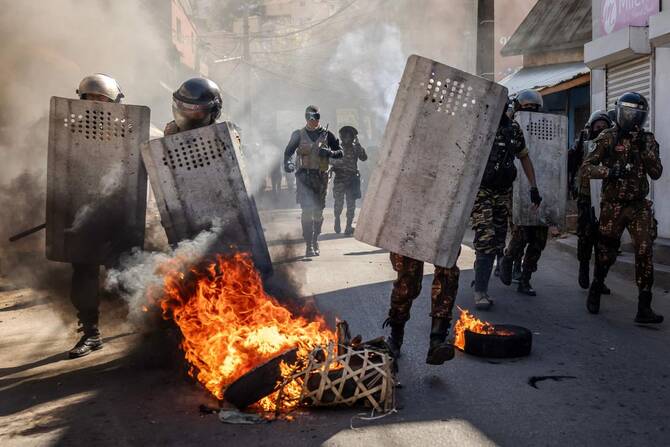

ANTANANARIVO: Several thousand anti-government demonstrators marched on Thursday through Madagascar’s capital, several of them injured when police cracked down on the latest youth-led protest of the past two weeks.
The fresh rally came after the Gen Z movement called for a general strike and rejected President Andry Rajoelina’s attempts to defuse the tensions rocking the Indian Ocean Island.
The president has appointed a new prime minister and called for dialogue in a bid to quell the near-daily protests that erupted on September 25.
The unrest was sparked by anger over regular and lengthy power and water shortages and evolved into a broader anti-government movement.
Security forces charged at protesters with armored vehicles, firing tear gas and rubber bullets to disperse the initial crowds of about 1,000 that gathered on Thursday near Lake Anosy and started marching toward the Ambohijatovo Gardens, AFP reporters saw.
Street battles later broke out between the police and demonstrators, who responded by throwing stones.
Tear gas fired near a maternity ward forced nursing staff to move premature babies to the back of the building, an AFP journalist saw.
At least four people were injured by rubber bullets and two by projectiles from stun grenades, according to AFP reporters on the ground and two local medical organizations.
A man was left unconscious on the ground after being chased and severely beaten by security forces in the neighboring district of Anosibe before being evacuated by the Red Cross.
Conflict monitoring group ACLED said the month of September saw the second highest level of protests in Madagascar since it began collecting data in 1997, surpassed only by a surge before the 2023 vote.
- ‘Problem is the system’ -
Hundreds of protesters again marched through the large southern coastal city of Toliara on Thursday, reports said.
“We’re still struggling,” said Heritiana Rafanomezantsoa, one of the marchers in Antananarivo.
“The problem is the system. Our lives haven’t improved since we gained independence from France,” the 35-year-old told AFP
Student Niaina Ramangason said Rajoelina — who himself came to power following an uprising in 2009 — was “selfish.”
“He makes promises but doesn’t keep them. I don’t believe in him anymore,” the 20-year-old said.
After initially adopting a conciliatory tone and dismissing his entire government, Rajoelina appointed a military officer as prime minister on October 6.
He said the country “no longer needs disturbances” and chose to make the first appointments in his new cabinet to the ministries of the armed forces, public security and armed police.
More than 200 civil society organizations said on Thursday they were “concerned about a military drift in the country’s governance, rather than a search for appeasement and an end to repression.”
- Death toll -
The United Nations said on September 29 that at least 22 people had been killed in the first days of protests, a toll Rajoelina disputed on Wednesday.
“There have been 12 confirmed deaths and all of these individuals were looters and vandals,” he told French-speaking television channel Reunion La Premiere.
The UN’s human rights office said some of the 22 victims were protesters or bystanders killed by security forces, while others had died in violence sparked by criminal gangs and looters in the wake of the demonstrations.
Twenty-eight protesters have been referred to the prosecutor’s office for formal charges, their lawyers said on Wednesday.
Five are in pre-trial detention in Tsiafahy prison, a jail described by Amnesty International as overcrowded and “hellish.”
The protest movement has issued Rajoelina with a list of demands that includes a public apology for the violence against them but no longer mentions its previous calls for him to step down.
Despite rich natural resources, nearly three quarters of Madagascar’s population of 32 million lived below the poverty line in 2022, according to World Bank figures.
The Indian Ocean island’s per capita GDP fell from $812 in 1960 to $461 in 2025, according to the World Bank.


