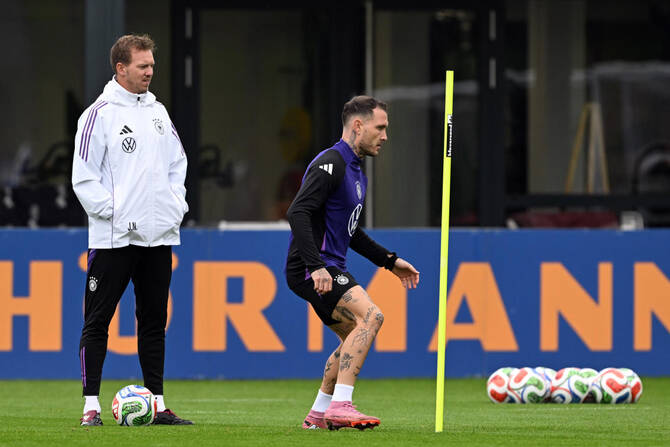
BERLIN: A World Cup without Germany used to be unthinkable. Now the four-time champion needs to turn things around to ensure a spot at next year’s tournament.
A shock 2-0 loss to Slovakia in World Cup qualifying means Julian Nagelsmann’s team may need a perfect record in the rest of their qualifiers, starting with wins over Luxembourg on Friday and Northern Ireland on Monday.
“Everyone expects of us that we’ll beat every opponent 5-0, 6-0 but that’s no longer possible,” midfielder Nadiem Amiri said in comments reported by German agency dpa.
“The times have simply changed. Everyone’s good, everyone can hold their own. For us it’s just important to win. We need win after win.”
The qualifying format — a four-team group where only the winner qualifies automatically — means Germany must win each of their remaining games unless Slovakia slips up, and get ahead of Slovakia on goal difference too.
Second place would put Germany into a bracket of four teams competing for one spot early next year.
Making history the wrong way
If Germany did fail to make it to the expanded, 48-team World Cup, it would be a historic shock.
Until their loss in Slovakia last month, Germany had never lost a World Cup qualifying game away from home. The only times they missed the men’s World Cup were the inaugural 13-team 1930 event, which they skipped along with most of Europe, and 1950, when they were excluded following World War II.
Of course, even when they have qualified, Germany haven’t always produced the goods.
Group-stage exits in 2018 and 2022 were huge disappointments for a team which had top-class individual players but didn’t seem to gel as a team. A goose-themed motivational talk by then-coach Hansi Flick at the 2022 World Cup fell flat and seemed to typify the lack of enthusiasm.
That all means Germany haven’t played a World Cup knockout game since winning the 2014 final.
Overcoming injuries
Germany’s qualification fight has been made harder by injuries.
Barcelona’s Marc-André ter Stegen would be first-choice goalkeeper if fit but hasn’t played all year, while Real Madrid defender Antonio Rüdiger is out with a muscle injury and Bayern Munich’s attacking midfield star Jamal Musiala likely won’t return until the new year.
Nagelsmann seems intent on forging a partnership between Florian Wirtz and Newcastle’s Nick Woltemade, but Wirtz has yet to find his best form since his Liverpool move and Woltemade has had a flu-like illness this week. That meant the tall striker was training separately Wednesday.
There’s extra attention on new player Nathaniel Brown, a left back from Eintracht Frankurt who would also be eligible for the United States. Brown faces the challenge of doing better than his Frankfurt teammate Nnamdi Collins, who was dropped after costly errors on debut in the Slovakia loss.

‘We need win after win’: Crunch time looms for Germany in World Cup qualifying
https://arab.news/jc7rr
‘We need win after win’: Crunch time looms for Germany in World Cup qualifying
- “Everyone expects of us that we’ll beat every opponent 5-0, 6-0 but that’s no longer possible,” midfielder Nadiem Amiri said
- Until their loss in Slovakia last month, Germany had never lost a World Cup qualifying game away from home
FIA, Formula 1 and all 11 race teams sign 9th Concorde Agreement
- FIA President Mohammed Ben Sulayem says new contract secures the FIA Formula One World Championship’s long-term future
DUBAI: The Federation Internationale de l’Automobile, the global governing body for motorsport and the federation for mobility organisations worldwide, and Formula One Group, the commercial rights holder, have announced the signing of the Concorde Governance Agreement, a contract defining the regulatory framework and governance terms of the FIA Formula One World Championship until 2030.
This follows the announcement in March that the 2026 Commercial Concorde Agreement had been signed by all the teams and Formula One Group.
Together, these agreements constitute the ninth Concorde Agreement, a major step forward in the professionalisation and global development of the sport.
First introduced in 1981, the Concorde Agreements are designed to promote sporting fairness, technological innovation and operational excellence, and align all key stakeholders around a shared vision for structured governance and continued growth of the sport.
Each iteration of the Concorde Agreements has shaped the FIA Formula One World Championship into the global spectacle it is today.
The ninth Concorde Agreement announced today marks the beginning of a new era of collaboration between the FIA and Formula One Group, who have worked together to write the next chapter in Formula One history, demonstrating mutual respect, transparency and shared purpose between the two organisations.
It confirms the participation of all FIA Formula One World Championship teams, including the incoming Cadillac Formula One team, through the end of the decade, and provides a stable foundation for the sporting and technical evolution of the sport.
The Concorde Agreement underscores the commitment of the FIA, Formula One Group and all teams to continue growing and developing the sport, and to keep driving the momentous expansion it has enjoyed in recent years.
The new contract enables the FIA to invest further in improved race regulation, race direction, stewarding and technical expertise for the benefit of the championship, and means the sport can continue to evolve, providing exciting technological innovation and sporting action for fans, broadcasters and partners, all within a stable and structured regulatory framework.
Combined with record viewership growth, a dynamic race calendar, and increasing engagement from younger audiences, the FIA Formula One World Championship enters this next chapter with unprecedented momentum.
Mohammed Ben Sulayem, president of the FIA, said: “The ninth Concorde Agreement secures the FIA Formula One World Championship’s long-term future and I am proud of the dedication that has been invested in this process.
“I would like to thank Stefano Domenicali and his team in what has been a strong collaboration, building a framework grounded in fairness, stability, and shared ambition. This agreement allows us to continue modernising our regulatory, technological, and operational capabilities, including supporting our race directors, officials, and the thousands of volunteers whose expertise underpin every race.
“We are ensuring that Formula One remains at the forefront of technological innovation, setting new standards in global sport.”
Domenicali, president and CEO of Formula One Group, said: “Today is an important day for Formula One. As we celebrate 75 years of this incredible sport, we are proud to write the next chapter in our long and amazing history.
“This agreement ensures that Formula One is in the best possible position to continue to grow around the world. I want to thank the president of the FIA, Mohammed Ben Sulayem and all the teams for the collaboration and determination to achieve the best results for the entire sport in our discussions.
“We have a huge amount to be proud of, but we also are focused on the opportunities and exciting potential for Formula One in the years ahead.”


