Starmer meets Modi to promote tech, jobs after UK-India trade pact

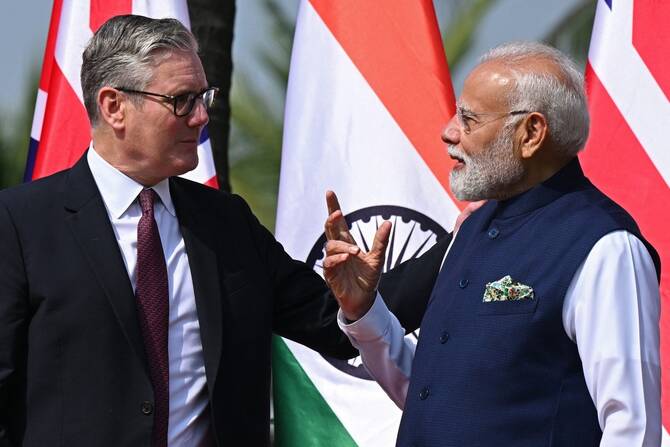
Indian Prime Minister Narendra Modi receives UK Prime Minister Keir Starmer at the Raj Bhavan in Mumbai on Oct. 9, 2025. (AFP)
Short Url
Updated 09 October 2025
Follow

Starmer meets Modi to promote tech, jobs after UK-India trade pact

  • Keir Starmer arrived in India’s financial capital with the largest-ever British trade mission
  • India and UK announce joint center for AI, opening of British campuses in Bengaluru, GIFT

NEW DELHI: UK Prime Minister Keir Starmer met his Indian counterpart, Narendra Modi, in Mumbai on Thursday, as he brought the largest-ever British business delegation to expand ties under a recently signed free trade agreement.

Starmer arrived in India’s financial capital on Wednesday. It is his first visit since taking office, and he is accompanied by Business and Trade Secretary Peter Kyle, Scotland Secretary Douglas Alexander, Investment Minister Jason Stockwood, and 125 CEOs, entrepreneurs, university vice chancellors and cultural leaders.

The trip follows the signing of the multibillion-dollar UK-India Comprehensive Economic and Trade Agreement during Modi’s visit to London two months ago.

“India and the UK are natural partners,” the Indian PM said in a joint press briefing at the Raj Bhavan in Mumbai, the official residence of the governor of the state of Maharashtra, where he received Starmer.

“There are immense possibilities in the technology partnership between India and the UK. We are working to connect the UK’s industrial expertise and R&D with India’s talent and scale.”

In a joint statement, India and the UK announced a dozen of tech, innovation, education and trade initiatives and planned investments, including the establishment of an India-UK connectivity and innovation center and a joint center for AI, and a critical minerals guild to strengthen supply chains.

Lancaster University is set to open its campus in Bengaluru, and the University of Surrey in Gujarat’s GIFT City.

“The UK and India stand side by side as global leaders in tech and innovation. And so we’ve also taken the opportunity to deepen our cooperation through our Technology Security initiative with new commitments on AI, advanced communication, defense technologies, and much, much more,” Starmer said.

“More British universities will be setting up campuses right here in India, making Britain, India’s leading international provider of higher education.”

While the UK-India free trade deal is expected to take effect next year, as it is yet to be ratified by both governments in a process that usually takes about 12 months, the British prime minister sought to build on its potential with the Mumbai visit.

“When we leave India later on tonight, I expect that we will have secured major new investments, creating thousands of high-skilled jobs in the sectors of the future for both of our nations,” he said.

Under the new pact, about 99 percent of Indian goods will get duty-free access to the UK market.

It will also halve import duties on UK-produced whiskey and gin from 150 percent, followed by a further decrease to 40 percent in a decade. Tariffs on automobiles will be reduced from 100 percent to 10 percent.

The FTA has been widely estimated to increase bilateral trade by 60 percent. Currently, it stands at about $54 billion, according to UK Department for Business and Trade data, with UK exports to India estimated at $21.7 billion and imports at $32.4 billion.


India rolls out strictest anti-pollution curbs as toxic smog engulfs Delhi

Demonstrator wearing an oxygen mask and holding oxygen tanks takes part in protest.
Updated 14 December 2025
Follow

India rolls out strictest anti-pollution curbs as toxic smog engulfs Delhi

  • Private monitors in several parts of northern Delhi recorded AQI spikes between 550 and 700s
  • Authorities invoked stage four of the capital region’s emergency pollution-control framework

NEW DELHI: India’s capital choked under a thick blanket of smog on Sunday, with the government imposing anti-pollution curbs after monitoring stations in some areas recorded extremely hazardous air quality.

Home to 30 million people, Delhi has not recorded a single “clean air” day in 2025, with Air Quality Index readings hitting high above the 50 score throughout the year.

On the AQI scale from 0 to 500, good air quality is represented by levels below 50, while levels above 300 are dangerous.

Worsening since late October, official records over the weekend were in the severe to severe-plus range of 400–500, but as 24-hour averages, they did not capture the peaks. Private monitors in several parts of North and North West Delhi recorded AQI spikes above 550 and even into the 700s in real-time.

On Saturday evening, the Ministry of Environment’s Commission for Air Quality Management invoked stage four — the highest level — of the Graded Response Action Plan for Delhi and surrounding areas.

To “prevent further deterioration of air quality in the region,” the commission suspended all non-essential construction, shut stone crushers and mining operations, stopped entry of trucks into the capital region, and ordered schools to shift to hybrid classes or online, where possible.

While authorities blamed the pollution on “adverse meteorological conditions,” residents have been demanding more government action.

“The situation is so bad in Delhi that we don’t have any option but to force kids to do online classes. The government has failed us; it has not done anything to address the issue,” said Nabanita Nayak, who decided for her teenage children to attend school online only, despite concerns over their screen addiction.

“If the kids are too much in front of laptops, that’s also an issue. As a mother, I am worried.” 

Delhi’s pollution has been worsening since Diwali in late October, when the average AQI has been above 370, or “very poor.” Since mid-November, it has been over 400, which means “severe” air quality, with certain areas recording 500 and above, which is classified as a “hazardous” level.

“I don’t feel proud living in Delhi. It’s the capital city of the country … We talk about being a developed nation by 2047 — we have deadlines,” said Jagriti Arora, who is keeping her 7-year-old daughter at home to prevent allergy flare-ups caused by air pollution.

“The government has to do something … China had a big problem with pollution, but now they’ve managed to bring it down.”

Delhi’s air quality deteriorates in winter due to local emissions and seasonal weather conditions. Cold temperatures and low wind speeds result in a temperature inversion, which traps pollutants close to the ground instead of letting them disperse. This allows emissions from millions of vehicles, ongoing construction, and nearby industrial activity to accumulate in the air. Urban waste burning and dust from construction sites further add to it.

“This is not a new thing. This has been happening now for over 10 years,” Arora said. “You can see it. You don’t need to actually look at an AQI meter to see how bad the pollution is these days.”