

World Sight Day: Blindness falls to 0.5 percent in Pakistan but experts warn of new threats

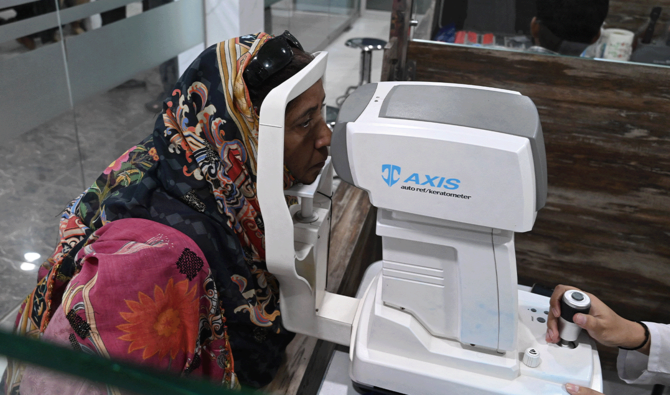
A patient suffering from an eye infection gets examined by a doctor at a hospital in Lahore on September 27, 2023. (AFP/File)
Short Url
Updated 09 October 2025
Follow

World Sight Day: Blindness falls to 0.5 percent in Pakistan but experts warn of new threats

  • Al-Shifa Trust credits public-private cooperation for sharp decline in avoidable blindness
  • Dow University says 40 million Pakistanis suffer from eye diseases, urges regular check-ups

KARACHI: Pakistan has recorded a dramatic reduction in blindness rates, from 1.78 percent in 1990 to just 0.5 percent today, according to a study by one of the country’s leading non-profit eye hospitals, which credited decades of joint effort by public and private stakeholders for the improvement.

Founded in 1985, the Al-Shifa Trust Eye Hospital provides free and subsidized eye care through a national network of hospitals and outreach programs. The organization’s extensive fieldwork, data collection, and partnerships with government health departments have made it a key reference point for national blindness statistics and trends.

Pakistan’s health experts have long cited preventable eye diseases, including cataracts, trachoma and diabetic retinopathy, as a major cause of disability. But as the population grows and life expectancy rises, genetic disorders and lifestyle-related conditions are expected to form a growing share of the country’s vision loss burden, experts warned on Thursday.

Speaking at an event on World Sight Day, which falls on Oct. 9 each year, prominent ophthalmologist Dr. Tayyab Afghani said while the country’s success against avoidable blindness was encouraging, the focus must now shift toward new and complex causes of vision loss.

“Genetic diseases are increasingly becoming a significant cause of blindness in Pakistan,” he said. “To address this, Al-Shifa Trust has established the country’s first ophthalmic genetics center, focused on early detection through community health education, qualified genetic counselling, and gene analysis.”

Afghani also warned that lifestyle factors such as diabetes and excessive screen time were fueling a rise in eye disorders among Pakistanis, particularly children.

“Apart from diabetes, myopia has reached epidemic levels in Pakistan and worldwide,” he said, urging families to limit children’s exposure to screens and promote regular eye exams through school screening programs.

Afghani called on the government to expand preventive eye care and rural infrastructure, warning that rising disease burdens could overwhelm public hospitals.

“The lack of trained specialists and unequal distribution of services continue to push low-income households toward expensive private treatment,” he said. “This leads to long-term economic and social impacts such as increased poverty and reduced productivity.”

To date, the Al-Shifa Trust has screened over three million children for vision-related issues nationwide. The charity runs six hospitals in Rawalpindi, Muzaffarabad, Chakwal, Kohat, Sukkur and Gilgit, and plans to open a Lahore branch by 2027. It holds more than 150 free eye camps annually, treating over 900,000 patients and performing 73,000 surgeries each year, nearly 80 percent of them free of cost.

In Karachi, the Dow University of Health Sciences (DUHS) marked World Sight Day with an awareness walk and seminar, where experts warned that millions of Pakistanis continue to live with untreated eye conditions.

Professor Jehan Ara Hasan, Pro-Vice Chancellor at DUHS, said that nearly 40 million people in Pakistan suffer from various eye diseases, citing national survey data. 

“According to available data, 49 percent of blindness cases are caused by cataract, while the remaining 51 percent are due to other causes such as glaucoma, diabetic retinopathy, and macular degeneration,” she said.

Hasan said that despite the high prevalence of diabetes in Pakistan, many patients still do not undergo regular retinal examinations, which are essential for those above forty. 

“According to global statistics, there are approximately 39 million blind people worldwide, while 285 million people suffer from visual impairment or other vision-related disorders,” she added.

According to the Pakistan Survey Report 2022, around 485,000 people in the country are completely blind, while nine million have weak eyesight and require corrective glasses.


Pakistan, Qatar discuss Afghanistan situation, urge dialogue for regional stability

Updated 7 sec ago
Follow

Pakistan, Qatar discuss Afghanistan situation, urge dialogue for regional stability

  • The development comes amid renewed Islamabad-Kabul tensions after last week’s Pakistani airstrikes inside Afghanistan
  • Qatar, along with other states, helped mediate a ceasefire between the neighbors following weeklong skirmishes in Oct.

ISLAMABAD: Pakistan Prime Minister Shehbaz Sharif and Qatar’s Deputy PM Sheikh Saoud Al-Thani on Tuesday discussed the situation in Afghanistan and called for dialogue to promote regional stability during high-level talks held in Doha, Sharif’s office said.

The development comes amid renewed tensions between Pakistan and Afghanistan after Islamabad conducted airstrikes on what it said were Tehreek-e-Taliban Pakistan (TTP) targets in Afghanistan last week. Kabul said the strikes killed civilians and vowed to respond to the violation of its sovereignty.

This is the second time in less than six months that Pakistan has conducted airstrikes in Afghanistan. The last strikes triggered heavy, weeklong clashes between the neighbors along their border before Qatar and Turkiye mediated a ceasefire between them in Oct. last year.

During their meeting in Doha, PM Sharif and Qatari Deputy PM Sheikh Saoud Al-Thani, who is also the state minister for defense affairs, discussed defense and security relations between the two countries, according to Sharif’s office.

“Regional developments were also discussed, in particular the situation in Iran and Afghanistan,” Sharif’s office said in a statement. “Both sides emphasized the importance of dialogue, de-escalation and collective efforts to promote peace and stability in the region.”

Sheikh Saoud appreciated the professionalism and expertise of the Pakistani armed forces and conveyed Qatar’s interest in deepening defense partnership between the two countries, according to the statement.

The Pakistan premier expressed satisfaction over the ongoing collaboration and underscored Islamabad’s commitment to further expanding defense collaboration.

Separately, Sharif held meetings with Qatar’s State Minister for Trade Dr. Ahmed bin Mohammed Al-Sayed and a delegation of the Qatar Businessmen Association (QBA).

During his meeting with the Qatari trade minister, the two sides reviewed bilateral trade and economic cooperation and expressed satisfaction over the growing momentum in Pakistan–Qatar relations.

“The Prime Minister emphasized the importance of enhancing bilateral trade volumes and diversifying Pakistan’s exports to Qatar, particularly in agricultural products, food items and value-added goods,” the Pakistani information ministry said.

Pakistan has been seeking closer economic engagement with Gulf partners amid its broader push to stabilize the economy and attract investment, while maintaining security and defense cooperation with key regional states.

Sharif highlighted Pakistan’s investment-friendly reforms and the role of the Special Investment Facilitation Council (SIFC) in facilitating foreign investment, according to the Pakistani information ministry.

Dr. Al-Sayed, who is also the chairman of Pak-Qatar joint business taskforce, reiterated Qatar’s interest in expanding economic cooperation and strengthening private-sector and business linkages between the two countries.

“The two sides also agreed to convene a meeting of the task force comprising relevant officials of both countries, within the month of Ramadan, to discuss concrete investment proposals for Qatari investment in Pakistan,” it added.

In his meeting with QBA delegates, Sharif highlighted Pakistan’s improving macroeconomic indicators and invited QBA members to explore opportunities in infrastructure, logistics, energy, agriculture, technology and export-oriented manufacturing.

Sharif is also scheduled to meet Qatar’s Emir Sheikh Tamim bin Hamad Al Thani and Qatar’s Prime Minister Sheikh Mohammed bin Abdulrahman bin Jassim Al Thani in Doha today, Tuesday, to discuss ways to further strengthen bilateral relations, Sharif’s office said.

“Discussions will take place on further strengthening bilateral relations,” it added.