Sudan paramilitary strike on mosque kills 13 in El-Fasher: Eyewitnesses

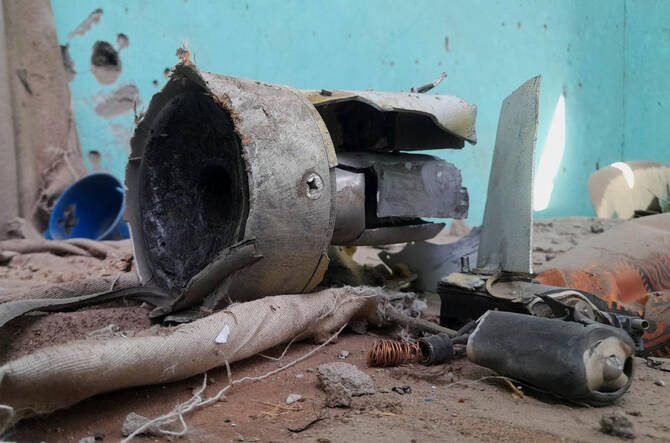
Remnants of a shell that targeted the refugee center, in El Fasher, Sudan, October 7, 2025. (REUTERS)
Short Url
Updated 09 October 2025
Follow

Sudan paramilitary strike on mosque kills 13 in El-Fasher: Eyewitnesses

  • Across Sudan, the war has displaced millions and pushed nearly 25 million into acute hunger

PORT SUDAN: An artillery attack by Sudan’s paramilitary Rapid Support Forces killed 13 people in a mosque where displaced families were sheltering in the besieged city of El-Fasher, two eyewitnesses told AFP on Thursday.
The strike on the mosque came from the north, both sources said on condition of anonymity, where the RSF has overrun the Abu Shouk displacement camp and set up positions in an attempt to wrest control of the city from the Sudanese army.
“After the shelling in the afternoon, we pulled 13 bodies from under the rubble and buried them,” one man who lives in the area said of the attack which occurred Wednesday.
A survivor of the strike said: “We were 70 families inside the mosque’s walls after the Rapid Support Forces entered our homes. Yesterday, artillery shells fell, killing 13 of us, wounding 20, and destroying part of the mosque.”
The RSF’s current assault on El-Fasher is its fiercest since war began with the army in April 2023.
The North Darfur state capital, besieged by the RSF since May of last year, is the last major city still under army control, though the territory controlled by the military and its allies has progressively shrunk.
The RSF has launched near-daily artillery and drone strikes and overrun the displacement camps surrounding the city, reportedly killing hundreds and extorting survivors for safe passage.
Millions displaced
Between Tuesday and Wednesday, 20 people were killed in RSF strikes on El-Fasher Hospital, one of the last functioning health facilities in the city.
Last month, at least 75 people were killed in a single drone strike on a mosque.
Across Sudan, the war has displaced millions and pushed nearly 25 million into acute hunger, creating what the United Nations says are the world’s largest hunger and displacement crises.
It has also killed tens of thousands of people, but there is no official toll, with most of the wounded unable to access hospitals and survivors forced to bury their dead wherever they can.
The RSF’s siege on El-Fasher has caused mass starvation in the city, where families have for months survived on animal feed, but even that has grown scarce and now costs hundreds of dollars per sack.
If the city falls to the paramilitaries, the RSF will be in control of the entire Darfur region, where they have sought to establish a rival administration.
The army holds the country’s north, center and east.


Trump claims Iran working on missiles that could hit US

Updated 42 min 42 sec ago
Follow

Trump claims Iran working on missiles that could hit US

  • Trump says his preference is diplomacy, but would never allow Tehran to have a nuclear weapon

WASHINGTON: US President Donald Trump on Tuesday claimed Iran is seeking to develop missiles that can strike the United States and accused Tehran of working to rebuild a nuclear program that was targeted by American strikes last year.

The United States and Iran are engaged in high-stakes negotiations over Iran’s atomic program and other issues including missiles, with Trump saying he prefers diplomacy but is willing to use force if talks fail.

“They’ve already developed missiles that can threaten Europe and our bases overseas, and they’re working to build missiles that will soon reach the United States of America,” Trump said during his State of the Union address.

In 2025, the US Defense Intelligence Agency said Iran could potentially develop a militarily viable intercontinental ballistic missile by 2035 “should Tehran decide to pursue the capability,” but did not say if it had made such a decision.

Tehran currently possesses short- and medium-range ballistic missiles with ranges that top out at about 1,850 miles (3,000 kilometers), according to the US Congressional Research Service.

The continental United States is more than 6,000 miles from Iran’s western tip.

Washington and Tehran have concluded two rounds of talks aimed at reaching a deal on Iran’s nuclear program to replace the agreement that Trump tore up during his first term in office.

 ‘Preference’ is diplomacy

The United States has repeatedly called for zero uranium enrichment by Iran but has also sought to address its ballistic missile program and support for armed groups in the region — demands Iran has rejected.

Iran has also repeatedly rejected that it is pursuing nuclear weapons.

Trump ordered strikes on three Iranian nuclear sites last year, claiming afterward that Tehran’s atomic program was obliterated.

On Tuesday, he said Iran wants “to start all over again,” and that it is “at this moment again pursuing their sinister nuclear ambitions.”

Trump has sent a massive US military force to the Middle East, deploying two aircraft carriers as well as more than a dozen other ships, a large number of warplanes and other assets to the region.

He has repeatedly threatened to strike Iran if negotiations fail to reach a new agreement. Talks with Tehran are currently set to continue on Thursday.

“My preference is to solve this problem through diplomacy but one thing is certain: I will never allow the world’s number one sponsor of terror, which they are by far, to have a nuclear weapon,” Trump said.

The US president’s speech primarily focused on domestic issues, making no mention at all of China — Washington’s primary military and economic rival — and only briefly referring to Russia.

Trump said he was working to end the bloody conflict between Russia and Ukraine, and repeated his inaccurate claim that he had brought eight other wars to an end since returning to office in January 2025.

He also hailed NATO’s decision to spend five percent of gross domestic product on defense — a move made under heavy pressure from Trump and his administration.