


ISLAMABAD: Pakistan’s army leadership on Wednesday linked national security with diplomatic outreach as it welcomed a new Strategic Mutual Defense Agreement with Saudi Arabia, describing it as a step toward regional peace and joint defense cooperation.
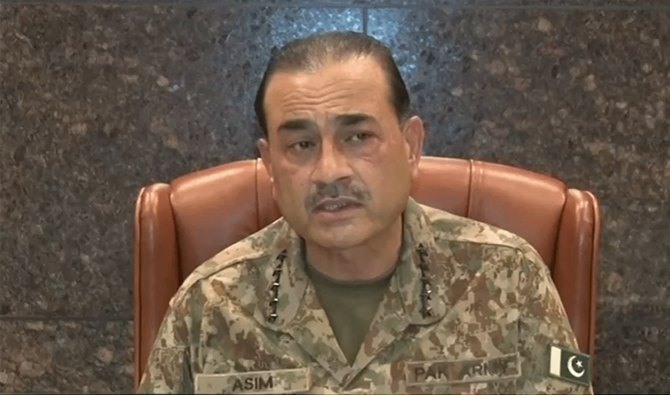
Chaired by Field Marshal Asim Munir, the country’s army chief, the 272nd Corps Commanders’ Conference in Rawalpindi reviewed counterterrorism operations, the security environment and relations with neighboring countries and allies. In an unusual addition for a military statement, the communiqué issued after the meeting also referred to Pakistan’s “recent high-level diplomatic engagements,” underscoring the military’s growing and more transparent role in international affairs.
In recent months, Field Marshal Munir has played an unusually visible role in Pakistan’s diplomatic outreach, appearing alongside Prime Minister Shehbaz Sharif in meetings with foreign leaders and envoys. He has also met US President Donald Trump twice in a matter of months — once jointly with Sharif and once separately — underscoring the military’s direct involvement in shaping Pakistan’s external engagements.
“The participants acknowledged the significance of Pakistan’s recent high-level diplomatic engagements and reaffirmed the commitment to global and regional peace,” the Inter-Services Public Relations (ISPR), the army’s media wing, said in a statement after the meeting.
“The Forum welcomed the landmark Strategic Mutual Defense Agreement between Pakistan and the Kingdom of Saudi Arabia, aimed at strengthening strategic relations and enhancing multi-domain cooperation for a joint response to any external aggression.”
The ISPR said the pact with Riyadh reflected “shared values, mutual respect, and a joint vision for peace and security in the Middle Eastern and South Asian regions.” The agreement follows months of high-level exchanges between the two countries and comes amid growing defense and economic cooperation under Saudi Arabia’s Vision 2030 framework.
The statement said the forum carried out an extensive assessment of current counterterrorism operations and affirmed that the armed forces remain fully prepared to counter threats from Pakistan’s adversaries in every domain.
Without naming Indian Army Chief Gen. Upendra Dwivedi, the statement took aim at recent remarks by Indian leaders, calling them provocative and aimed at stoking “war hysteria for political benefits.”
Dwivedi told soldiers near the Pakistan border on Friday that Islamabad must stop “backing terror” if it wanted to “remain on the world map.” Dwivedi said India would not show the restraint it exercised during a brief war with Pakistan in May this year, in which, according to the Indian army, nine facilities inside Pakistan were hit and more than 100 Pakistani soldiers and militants killed.
The May 2025 hostilities — the most serious confrontation between the nuclear-armed neighbors in years — saw Pakistan and India exchange missile, drone and artillery strikes for four days before an uneasy ceasefire was restored through US mediation.
The Pakistan army and government have responded to Dwivedi’s remarks, saying any Indian aggression would be met with a swift and decisive military response.
Wednesday’s forum also reaffirmed support for “comprehensive counterterrorism operations across all domains” to dismantle networks of “Indian-sponsored terror proxies.” Islamabad has long accused neighbors like India and Afghanistan of backing militant groups that attack Pakistan, Both Kabul and New Delhi deny the allegations.
The army also expressed solidarity with Palestinians and called for a ceasefire in Gaza, backing a two-state solution with “an independent Palestinian state based on pre-1967 borders and Al-Quds Al-Sharif as its capital.” It also reiterated Pakistan’s “uncompromising support” for the people of Kashmir in line with UN Security Council resolutions.
In closing remarks, Munir directed commanders to ensure “the highest standards of operational readiness, discipline, physical fitness, innovation and responsiveness,” expressing full confidence in the army’s capability to counter threats “across the entire spectrum, from conventional and sub-conventional to hybrid and asymmetric.”


