MANILA: More than 9,000 aftershocks have rattled Cebu since a deadly earthquake last week, the Philippine Institute of Volcanology and Seismology said on Wednesday.
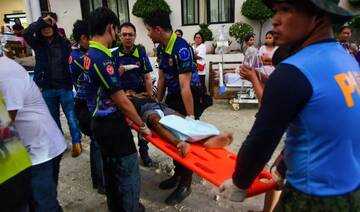
At least 72 people were killed and 500 injured on Sept. 30, when the central Philippine province was jolted by the magnitude 6.9 quake — the most powerful to strike the region in more than a decade.
The quake’s epicenter was in Bogo City and most of the casualties were in its neighborhood, but strong tremors and damage were also recorded in the provincial capital, Cebu City, some 100 km away.
“As of 6 a.m., we have recorded 9,037. The strongest so far is the October 3 aftershock, which was magnitude 5.1,” PHIVOLCS director Dr. Teresito Bacolcol told the local Dobol B TV.
In an afternoon update, PHIVOLCS said that the number of aftershocks had increased to 9,308.
“The strong aftershocks can further damage the structures previously affected by the main shock, can trigger landslides, especially in mountainous areas where tension cracks are already visible,” Charmaine V. Villamil, geologist and senior researcher at PHIVOLCS, told Arab News.
“They can cause more sinkholes, can further cause coastal subsidence and lateral spreading — liquefaction.”
Liquefaction is a process after earthquakes that makes solid soil behave like a liquid — often leading to severe damage — buildings or roads may sink or collapse even if they were not directly damaged by shaking.
The National Disaster Risk Reduction and Management Council estimated that, as of Wednesday, more than 62,500 houses had been damaged by the quake and subsequent tremors.
The earthquake was the most powerful to strike the central region of the Philippines in more than a decade.
The whole Cebu province, home to 3.5 million people, was placed under a state of calamity following the earthquake, which came just weeks after the region was hit by two typhoons in a row.
Even though Cebu is outside the usual typhoon path in the country, it still faces strong storms and is prone to earthquakes because it is part of the Pacific Ring of Fire.
In 2013, at least 215 people were killed when a magnitude 7.2 earthquake hit Cebu and the neighboring island province of Bohol.