Landslide in northern India hits a bus, killing at least 15 people

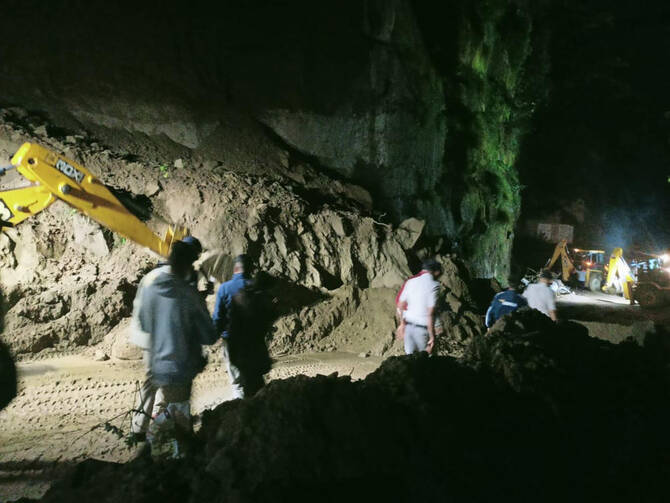
In this photo released by District Public Relation Office Bilaspur, rescued passengers of a bus are taken to a hospital after debris from a massive landslide hit their bus near Bilaspur in India's northern state of Himachal Pradesh, Tuesday, Oct. 7, 2025. (District Public Relation Office Bilaspur via AP)
Short Url
Updated 08 October 2025
Follow

Landslide in northern India hits a bus, killing at least 15 people

  • At least 15 people have died after debris from a massive landslide hit a bus in India’s northern state of Himachal Pradesh
  • The bus was traveling on a hilly stretch late Tuesday when a landslide struck following days of torrential rains

NEW DELHI: At least 15 people were killed late Tuesday after debris from a massive landslide hit a bus in India’s northern state of Himachal Pradesh, local authorities said.
The bus was traveling on a hilly stretch near Bilaspur district when a landslide struck following days of torrential rains. There were at least 20 to 25 passengers on the bus at the time. Nine men, four women and two children were among those killed, police said.
Three injured children were rescued and admitted to a local hospital for treatment, according to a statement from the office of Sukhvinder Singh Sukhu, the state’s highest-elected official.
Rescue operations continued Wednesday trying to find other missing passengers who are believed to be dead, police said.
Intermittent rains have lashed the region since Monday, making the fragile mountain slopes unstable.
President Draupadi Murmu and Prime Minister Narendra Modi offered their condolences following the deadly landslide.
Extreme rains this year have caused flooding and landslides across the South Asian region, which includes India, Pakistan, Bangladesh, Bhutan, Sri Lanka, Afghanistan, Maldives and Nepal.
Flash floods swept away an entire village in India’s northern state of Uttarakhand in August, while at least 44 people were killed in neighboring Nepal over the weekend due to mudslides and flooding triggered by severe rainfall.
The weekend’s heavy rainfall arrived at the end of Nepal’s monsoon season, which usually begins in June and ends by mid-September. It also left parts of the capital, Katmandu, flooded and caused the cancelation of all domestic flights on Saturday.
Experts say human-caused climate change is intensifying South Asia’s monsoons, which traditionally run from June to September and again from October to December. The rains, once predictable, now arrive in erratic bursts that dump extreme amounts of water in short periods, followed by dry spells.


Fossil fuel lobbyists out in force at Amazon climate talks: NGOs

Updated 7 sec ago
Follow

Fossil fuel lobbyists out in force at Amazon climate talks: NGOs

BELEM: Lobbyists tied to the fossil fuel industry have turned up in strength at the UN climate talks in the Brazilian Amazon, an NGO coalition said Friday, warning that their presence undermines the process.
A total of 1,602 delegates with links to the oil, gas and coal sectors have headed to Belem, equivalent to around one in 25 participants, according to Kick Big Polluters Out (KBPO), which analyzed the list of attendees.
By comparison, hosts Brazil have sent 3,805 delegates.
The list compiled by KBPO includes representatives of energy giants ExxonMobil, Chevron, Shell and TotalEnergies, as well as state-owned oil firms from Africa, Brazil, China and the Gulf.
But it also includes personnel from a broad range of companies such as German automaker Volkswagen or Danish shipping giant Maersk, or representatives of trade associations and other groups.
The Venice Sustainability Foundation is on the list because its members include Italian oil firm Eni.
KBPO also counted Danish wind energy giant Orsted, as it still has a gas trading business, and French energy firm EDF — most of its power comes from nuclear plants but it still uses some fossil fuels.
The list includes state-owned Emirati renewable firm Masdar.
One of the analysts, Patrick Galey, head of fossil fuel investigations at Global Witness, told AFP that some of the names might appear “surprising” at first sight, but KBPO analyzes data and open source material to identify those linked to fossil fuels.
Any renewable company that is a subsidiary of a fossil fuel firm made the list, for instance, because they are “at the beck and call” of their parent group, Galey said.
KBPO said it considers a fossil fuel lobbyist any delegate who “represents an organization or is a member of a delegation that can be reasonably assumed to have the objective of influencing” policy or legislation in the interests of the oil, gas and coal industry.
KBPO started analyzing official lists of COP participants in 2021.
COP28 in oil-rich Dubai in 2023 had a record number of participants — over 80,000 — but also the most fossil fuel lobbyists ever counted by KBPO at 2,456, or three percent of the total.
In Belem, 3.8 percent of attendees are tied to fossil fuel interests, the largest share ever documented by KBPO.
The UN began publishing a more comprehensive list of participants at COP28, making historical comparisons tricky.
“It’s common sense that you cannot solve a problem by giving power to those who caused it,” said Kick Big Polluters Out member Jax Bonbon from IBON International in the Philippines, which was recently struck by a devastating typhoon.
“Yet three decades and 30 COPs later, more than 1,500 fossil fuel lobbyists are roaming the climate talks as if they belong here,” Bonbon said in a statement.
The numbers could be higher.
According to Transparency International, 54 percent of participants in national delegations either withheld their affiliation or selected a vague category such as “guest” or “other.”