

Grief piles up for Gaza woman who lost family in Israeli strikes

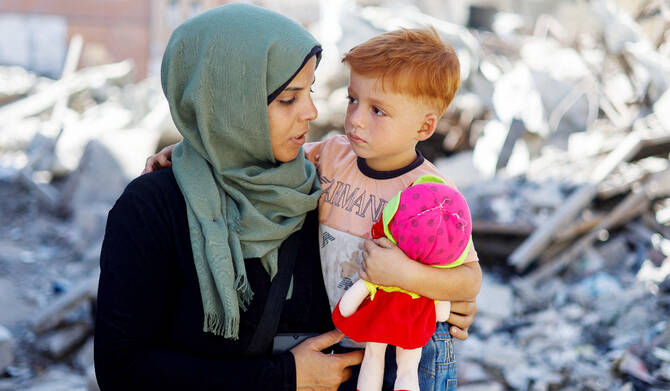
Palestinian woman Inas Abu Maamar, who was photographed at Nasser hospital morgue on October 17 cradling the body of her five-year-old niece Saly, killed in an Israeli strike, sits with her nephew Ahmed, Saly's brother, at the site where Saly was killed, in Khan Younis in the southern Gaza Strip September 11, 2024. (REUTERS)
Short Url
Updated 07 October 2025
Follow

Grief piles up for Gaza woman who lost family in Israeli strikes

  • Inas now lives with orphaned nephew
  • The war destroyed us all. It destroyed our family, destroyed our homes. It left pain and loss in our hearts

GAZA: Two years of Israeli bombardment of Gaza has piled grief upon grief for displaced Palestinian Inas Abu Maamar.

In the first days of the war, a photograph showed Abu Maamar stricken in a hospital morgue, cradling the shrouded body of her five-year-old niece Saly.
Since then, Israeli airstrikes and tank shells have killed many of her close relatives and left her bereaved, hungry and homeless, caring for her orphaned young nephew.


Palestinian woman Inas Abu Maamar, 36, embraces the body of her 5-year-old niece Saly, who was killed in an Israeli strike, at Nasser hospital in Khan Younis in the southern Gaza Strip, October 17, 2023. (REUTERS)

Saly was killed when an Israeli missile struck the family home in Khan Younis in southern Gaza. Photographer Mohammed Salem found Abu Maamar embracing her body at the Nasser Hospital morgue in Khan Younis on Oct. 17, 2023.
The blast also killed Abu Maamar’s aunt and uncle, her sister-in-law and her cousins, as well as Saly’s baby sister Seba. This summer, her father and her brother Ramez, Saly’s father, were killed while bringing food back to the family. They are among more than 67,000 Palestinians who have been killed in Israel’s onslaught in Gaza. 
Thousands more are believed to be lying dead under the rubble but not counted in the official death toll.
“The war destroyed us all. It destroyed our family, destroyed our homes. It left pain and loss in our hearts,” said Abu Maamar, who is now 38.
Abu Maamar and her remaining relatives have fled waves of Israeli bombing and ground incursions several times over the past two years and are now living in a crowded tent encampment on bare sand near the beach.
Conditions are harsh. Sickness is rife. Food and clean water are scarce. Israeli bombardments terrify the traumatized population.
Abu Maamar’s greatest concern is for her nephew Ahmed, the son of Ramez and younger brother of Saly.
Having lost his mother, both sisters and maternal grandparents 10 days into the conflict, he lost his father and paternal grandfather when they were killed while fetching food in June after it had run out the previous day, Abu Maamar said.
“His father would take him around, play with him, take him to the beach, take him around to see his aunts,” Abu Maamar said of her nephew.


Blood oozing from corpses haunts escapees from Sudan’s El-Fasher

Updated 57 min 27 sec ago
Follow

Blood oozing from corpses haunts escapees from Sudan’s El-Fasher

  • The United Nations estimates nearly 90,000 have fled El-Fasher in the past two weeks, many going days without food

TINE: It took 16-year-old Mounir Abderahmane 11 days to reach the Tine refugee transit camp in Chad, crossing arid plains after fleeing the bloodshed in the Sudanese city of El-Fasher.
When the Rapid Support Forces (RSF) entered the city in late October, Abderahmane was at the Saudi hospital, watching over his father, a soldier in the regular army who had been wounded fighting the militia several days earlier.
“They summoned seven nurses and ushered them into a room. We heard gunshots and I saw blood seeping out for under the door,” he told AFP, his voice cracking with emotion.
Abderahmane fled the city the same day with his father, who died several days on the route westwards to Chad.
The RSF, locked in civil war with the army since April 2023, captured El-Fasher, the army’s last stronghold in the vast western Darfur region, on October 26 after an 18-month siege.
Both sides have been accused of atrocities.
The RSF traces its origins back to the Janjaweed, a largely Arab militia armed by the Sudanese government to kill mainly black African tribes in Darfur two decades ago.
Between 2003 and 2008, an estimated 300,000 people were slaughtered in those campaigns of ethnic cleansing and nearly 2.7 million were displaced.

- ‘Never look back’ -

At the Tine camp in eastern Chad — more than 300 kilometers (185 miles) from El-Fasher — escapees said drone attacks had intensified in the city on October 24, just before it fell to the RSF.
Locals crammed into makeshift shelters to escape the bombs, with only “peanut shells” for food, 53-year-old Hamid Souleymane Chogar said.
“Every time I went up to get some air, I saw new corpses in the street, often those of local people I knew,” he shuddered.
Chogar took advantage of a lull to flee in the night.
Crippled, he said, by the Janjaweed in 2011, he had to be hoisted onto a cart that zigzagged through the city between the debris and corpses.
They moved without speaking or lights to avoid detection.
When the headlights of an RSF vehicle swept the night, Mahamat Ahmat Abdelkerim, 53, dived into a nearby house with his wife and six children.
The seventh child had been killed by a drone days earlier.
“There were about 10 bodies in there, all civilians,” he said. “The blood was still oozing from their corpses.”
Mouna Mahamat Oumour, 42, was fleeing with her family when a shell struck the group.
“When I turned round, I saw my aunt’s body torn to pieces. We covered her with a cloth and kept going,” she said through tears.
“We walked on without ever looking back.”

- Extortion -

At the southern edge of the city, they saw corpses piled up in the huge trench the RSF had dug to surround it.
Samira Abdallah Bachir, 29, said she and her three young children had to climb down into the ditch to escape, negotiating the morass of bodies “so we wouldn’t step on them.”
Once past the trench, refugees had to negotiate checkpoints on the two main roads leading out of El-Fasher, where witnesses reported rape and theft.
At each roadblock, the fighters demanded cash — $800 to $1,600 — for safe passage.
The United Nations estimates nearly 90,000 have fled El-Fasher in the past two weeks, many going days without food.
“People are being relocated from Tine to reduce crowding and make room for new refugees,” said Ameni Rahmani, 42, of medical charity Doctors Without Borders (MSF).
The power struggle between the RSF and the army — in part to control Sudan’s gold and oil — has killed tens of thousands of people since April 2023, displaced nearly 12 million and triggered what the UN calls the world’s most extensive hunger crisis.