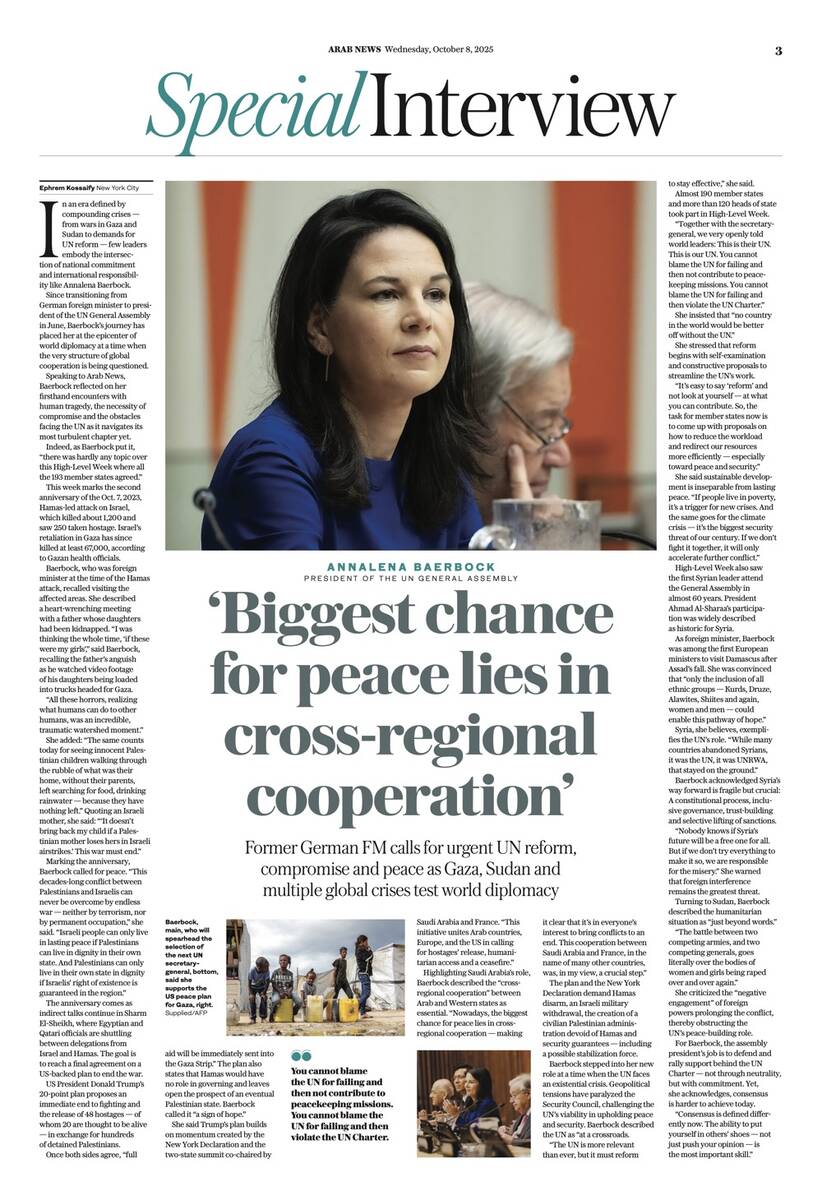

NEW YORK CITY: In an era defined by compounding crises — from devastating wars in Gaza and Sudan to global demands for UN reform — few leaders embody the intersection of national commitment and international responsibility as Annalena Baerbock.
Since transitioning from German foreign minister to president of the UN General Assembly in June, Baerbock’s journey has placed her at the epicenter of world diplomacy at a time when the very structure of global cooperation is being questioned.
Speaking to Arab News shortly after the intensive High-Level Week of the 80th session of the UN General Assembly, Baerbock reflected on her firsthand encounters with human tragedy, the urgent necessity of compromise and the obstacles facing the UN as it navigates perhaps its most turbulent chapter since its founding.
Indeed, as Baerbock put it, “there was hardly any topic over this High-Level Week where all the 193 member states agreed.”

Annalena Baerbock with UN Secretary-General Antonio Guterres. (UN Photo)
This week marks the second anniversary of the Oct. 7, 2023, Hamas-led attack on Israel, which killed about 1,200 people and saw 250 taken hostage. Israel’s military retaliation in Gaza has since killed 67,000 Palestinians, according to Palestinian health officials, although the true figure is likely far higher.
Baerbock, who was serving as Germany’s foreign minister at the time of the Hamas attack, recalled visiting the affected areas. She described a heart-wrenching meeting with a father whose daughters had been kidnapped.
“I was thinking the whole time, ‘if these were my girls’,” Baerbock told Arab News, recalling the father’s anguish as he watched video footage of his daughters being loaded into trucks by militants headed for Gaza.
“All these horrors, realizing what humans can do to other humans, was an incredible, traumatic watershed moment.”
She added: “The same counts today for seeing innocent Palestinian children walking through the rubble of what was their home, without their parents, left searching for food, drinking rainwater — because they have nothing left.”
Quoting an Israeli mother, she said: “‘It doesn’t bring back my child if a Palestinian mother loses hers in Israeli airstrikes.’ This war must end.”
Marking the solemn anniversary, Baerbock called for immediate peace. “This decades-long conflict between Palestinians and Israelis can never be overcome by endless war — neither by terrorism, nor by permanent occupation,” she said.
“Israeli people can only live in lasting peace if Palestinians can live in dignity in their own state. And Palestinians can only live in their own state in dignity if Israelis’ right of existence is guaranteed in the region.”
The second anniversary of the attack comes as indirect talks continue in Sharm El-Sheikh, where Egyptian and Qatari officials are shuttling between delegations from Israel and Hamas. The goal is to reach a final agreement on a US-backed plan to end the Gaza war.

An injured man holds an injured child after surviving an Israeli bombing in Khan Yunis. (AFP/File)
US President Donald Trump’s 20-point peace plan proposes an immediate end to fighting and the release of 48 hostages — of whom only 20 are thought to be alive — in exchange for hundreds of detained Palestinians.
It stipulates that once both sides agree, “full aid will be immediately sent into the Gaza Strip.” The plan also states that Hamas would have no role in governing Gaza and leaves open the prospect of an eventual Palestinian state.
Baerbock called it “a sign of hope” that, after more than 700 days of suffering, the world’s major powers are signaling that the war must end.
She said Trump’s plan builds on momentum created by the New York Declaration and the two-state summit co-chaired by Saudi Arabia and France during High-Level Week. “This initiative unites Arab countries, Europe, and the US in calling for hostages’ release, humanitarian access and a ceasefire,” she said.
Highlighting Saudi Arabia’s role, Baerbock described the “cross-regional cooperation” between key Arab and Western states as essential for reviving peace efforts. Drawing on her diplomatic experience, she noted how preparatory meetings in Riyadh and Munich laid essential groundwork.
“Nowadays, the biggest chance for peace lies in cross-regional cooperation — making it clear that it’s in everyone’s interest to bring conflicts to an end. This cooperation between Saudi Arabia and France, in the name of many other countries, was, in my view, a crucial step.
“But it didn’t come out of the blue. In my previous role, I remember all the night meetings I had with key Arab countries and a few European foreign ministers. We met in Riyadh, we met in Munich, in closed rooms, to prepare for these peace plan steps.”
The plan and the New York Declaration exceed calls for a ceasefire. They demand Hamas disarm, an Israeli military withdrawal from Gaza, the creation of a civilian Palestinian administration devoid of Hamas and security guarantees — including a possible stabilization force to prevent future violence, a force Baerbock herself proposed as foreign minister.

Naima Abu Ful with her 2-year-old malnourished child, Yazan, at their home in the Shati refugee camp in Gaza City. (AP/File)
Baerbock stepped into her new role at a time when the UN faces an existential crisis. Geopolitical tensions have paralyzed the Security Council, budget cuts have triggered a financial crisis and global threats — from climate change and artificial intelligence to multiple wars — challenge the UN’s viability in upholding peace and security.
Reflecting on the 80th General Assembly session, Baerbock described the UN as “at a crossroads.
“The UN is more relevant than ever, but it must reform to stay effective,” she said.
Almost 190 member states and more than 120 heads of state took part in High-Level Week, reinforcing the UN’s continued centrality in addressing global crises.
“Together with the secretary-general, we very openly told world leaders: This is their UN. This is our UN. You cannot blame the UN for failing and then not contribute to peacekeeping missions. You cannot blame the UN for failing and then violate the UN Charter.”
Despite initial skepticism, Baerbock noted a shift among leaders who embraced the assembly’s “Better Together” motto and committed to engaging with the reform process. She insisted that “no country in the world would be better off without the UN.”
She stressed that reform begins with self-examination and constructive proposals to streamline the UN’s work and focus its resources, especially toward peace and security.
“It’s easy to say ‘reform’ and not look at yourself — at what you can contribute. So, the task for member states now is to come up with proposals on how to reduce the workload and redirect our resources more efficiently — especially toward peace and security.”
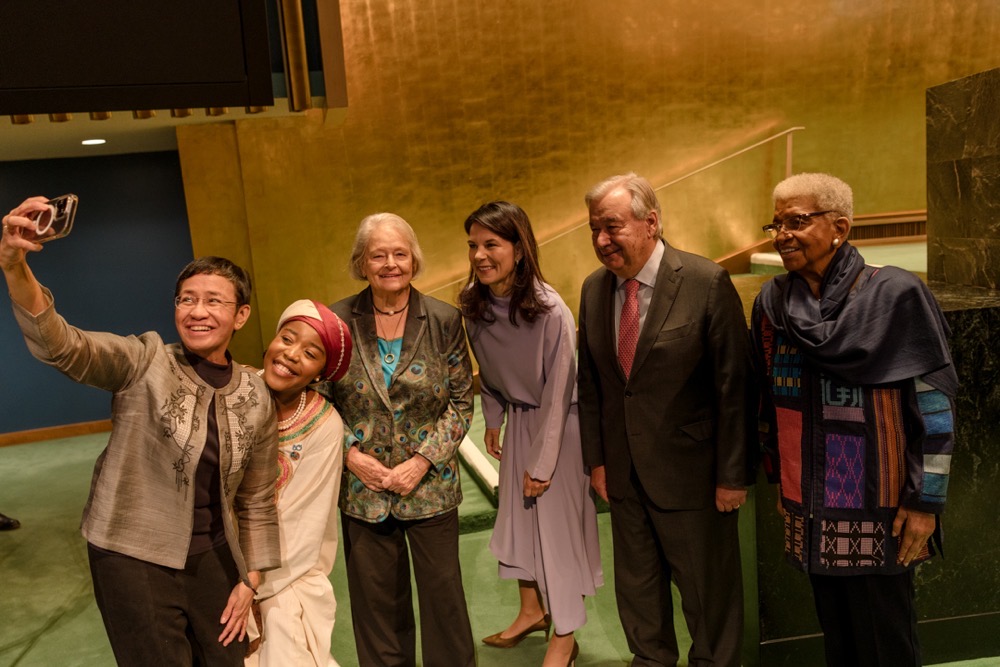
Reflecting on the 80th General Assembly session, Baerbock described the UN as “at a crossroads. (UN Photo)
She said sustainable development is inseparable from lasting peace. “If people live in poverty, it’s a trigger for new crises. And the same goes for the climate crisis — it’s the biggest security threat of our century. If we don’t fight it together, it will only accelerate further conflict.”
High-Level Week also saw the first Syrian leader attend the General Assembly in almost 60 years. President Ahmad Al-Sharaa’s participation was widely described as historic for Syria, which had been internationally isolated for years. In his address, he pledged a “new Syria,” free of its “wretched past,” and committed to national rebuilding and reform.
As foreign minister, Baerbock was among the first European ministers to visit Damascus after Bashar Assad’s fall. Meeting twice with the Syrian president and with representatives from Syria’s diverse ethnic groups, she was convinced that “only the inclusion of all ethnic groups — Kurds, Druze, Alawites, Shiites and again, women and men — could enable this pathway of hope.”
Despite security warnings, she preferred direct engagement, inspired by the resilience of Syrian refugees and the harsh realities of places like Sednaya prison.
“It is the currency of diplomacy to meet face to face. That’s why I was there — also as a female foreign minister, the first from a European country — to speak directly with the new government about whether the international community can trust the promises that this will be a Syria for all ethnic groups.”
She added: “I felt we as an international community owe it to the millions of Syrians. I’ve met so many Syrian refugees, especially in Germany, knowing what they’ve been through — and then standing in the prison of Sednaya, again seeing what people can do to other human beings.”
Syria, she believes, exemplifies the UN’s essential role. “While many countries abandoned Syrians, it was the UN, it was UNRWA, that stayed on the ground, providing education for thousands of children, even though 40 percent of schools were destroyed.”

Syrian President Ahmed Al-Sharaa delivered a speech at the United Nations General Assembly in September. (AFP)
Baerbock acknowledged that Syria’s way forward is fragile but crucial: A constitutional process, inclusive governance, trust-building and selective lifting of sanctions.
“Nobody knows if Syria’s future will be a free one for all. But if we don’t try everything to make it so, we are responsible for the misery.”
She warned that foreign interference remains the greatest threat. “External actors are still trying to hinder this process. Interference isn’t just a violation of sovereignty — it’s the biggest threat to a peaceful, inclusive future for Syria.”
Turning to Sudan, Baerbock described the humanitarian situation as “just beyond words.” She highlighted that the extent of suffering — widespread hunger and sexual violence against women and girls — exceeds many other conflicts.
“The battle between two competing armies, and two competing generals, goes literally over the bodies of women and girls being raped over and over again,” she said.
She criticized the “negative engagement” of foreign powers prolonging the conflict through arms deliveries and political interference, thereby obstructing the UN’s peace-building role.
Her transition from German foreign minister to General Assembly president, Baerbock said, was not simply swift but uniquely valuable given her background in Middle East diplomacy.
“Without having been part of such intensive discussions and negotiations, I wouldn’t have been able to lead on such a complex and non-consensual topic,” she reflected on the two-state summit.

A displaced child, whose family fled violence by two rival Sudanese generals, stands in the courtyard of the University of Al-Jazira in Al-Hasahisa, Khartoum. (AFP/File)
“It helped that I knew the French president and (Saudi Foreign Minister) Prince Faisal (bin Farhan) personally. Again, it’s about trust.”
For Baerbock, the assembly president’s job is to defend and rally support behind the UN Charter — not through neutrality, but with commitment. Yet, she acknowledges, consensus is harder to achieve today.
“Consensus is defined differently now. The ability to put yourself in others’ shoes — not just push your opinion — is the most important skill.”
Her record as a negotiator is now seen as key to her ability to marshal support for reforms. Analysts say her experience prepares her to rally former peers toward renewed multilateral cooperation.
“We didn’t come up with the idea ourselves,” she said of former ministers taking up the presidency. “It’s based on the good example of our predecessors. Years of face-to-face negotiation builds the trust you need to tackle difficult issues.
“You can handle tough topics better if you’ve been through nights of negotiation and know each other on a personal level. Not just knowing heads of government, but having their phone number. Texting them before they speak: ‘Remember to bring an example of why the UN matters to your region.’ Or texting them after they leave New York: ‘Remember to bring your reform proposal when you come back.’ You can send it with a smiley. But they know I mean it.”

Baerbock transitioned from German foreign minister to president of the UN General Assembly in June. (UN Photo)
Looking ahead, Baerbock will spearhead the process of selecting the next UN secretary-general, a responsibility she approaches with urgency and optimism.
Many member states, she says, support the nomination of a woman — not just for symbolism, but to reinforce the UN’s credibility on gender equity. She also notes a growing call for the General Assembly to play a greater role in selection, particularly as the Security Council remains deadlocked.
She highlighted the need for transparency, outlining that coordination with the Security Council — including current president Russia — has already begun.
“There’s a strong call for a very transparent process,” she said, reinforcing the importance of accountability and the engagement of member states.