

Dubai airshow bars Israeli companies from exhibiting: organizer

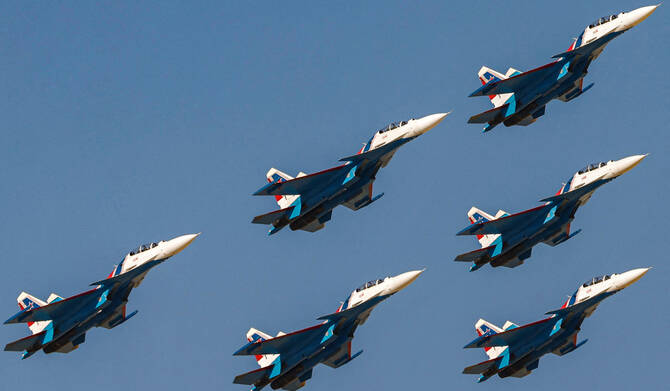
Russian Air Force aerobatic team the 'Russian Knights' in Su-27 aircraft perform aerial manuevers during the 2021 Dubai Airshow in the Gulf emirate on November 14, 2021. (AFP)
Short Url
Updated 07 October 2025
Follow

Dubai airshow bars Israeli companies from exhibiting: organizer

  • Since then, the Gaza war has dramatically worsened Israel’s standing with its Arab neighbors

DUBAI: Israeli defense companies have been barred from the upcoming Dubai Airshow after a “technical review,” its organizer said on Tuesday, without providing further details, two years into the devastating Gaza war.
Registrations were withdrawn for all six Israeli defense companies that were due to take part, said Tim Hawes, managing director of Informa Markets, which organizes the show.
“The (Israeli) exhibitors that were previously coming won’t be participating,” said Hawes, on the sidelines of a press conference to announce details of the exhibition.
“There was a technical review which we do of all companies that take part in the show,” he said, adding the decision had been taken by the airshow’s technical committee. Hawes did not elaborate on the reasons for the decision. The next edition of the biennial airshow, one of the world’s biggest, takes place in November.
Israel’s inaugural participation in 2023 was overshadowed by the start of the Gaza war. Israeli defense exhibitions were empty and unstaffed at the start of the show.
The United Arab Emirates is among a handful of Arab nations with ties to Israel.
It established normal diplomatic relations with Israel under the Abraham Accords in 2020.
Since then, the Gaza war has dramatically worsened Israel’s standing with its Arab neighbors.
Tuesday marks the two-year anniversary of the Oct. 7, 2023 attacks by Hamas that triggered the war, which has left tens of thousands dead and much of Gaza in ruins.


Syrian refugee returns set to slow as donor support fades

Updated 08 December 2025
Follow

Syrian refugee returns set to slow as donor support fades

  • Some aid officials say Syria is one of the first crises to be hit by aid funding cuts because the end of the war means it no longer counts as an emergency, eligible for priority funding

GENEVA: More than 3 million Syrians have returned home since the collapse of Bashar Assad’s rule a year ago but a decline in global funding could deter others, the UN refugee agency said on Monday.
Some 1.2 million refugees in addition to 1.9 million internally displaced people have gone back home following the civil war that ended with Assad’s overthrow, but millions more are yet to return, according to UNHCR.
The agency said much more support was needed to ensure the trend continues.
“Syrians are ready to rebuild – the question is whether the world is ready to help them do it,” said UNHCR head Filippo Grandi. Over 5 million refugees remain outside Syria’s borders, mostly in neighboring countries like Jordan and Lebanon.

RISK OF REVERSALS
Grandi told donors in Geneva last week that there was a risk that those Syrians who are returning might even reverse their course and come back to host states.
“Returns continue in fairly large numbers but unless we step up broader efforts, the risk of (reversals) is very real,” he said.
Overall, Syria’s $3.19 billion humanitarian response is 29 percent funded this year, according to UN data, at a time when donors like the United States and others are making major cuts to foreign aid across the board.
The World Health Organization sees a gap emerging as aid money drops off before national systems can take over.
As of last month, only 58 percent of hospitals were fully functional and some are suffering power outages, affecting cold-chain storage for vaccines.
“Returnees are coming back to areas where medicines, staff and infrastructure are limited – adding pressure to already thin services,” Christina Bethke, Acting WHO Representative in Syria, told reporters.
The slow pace of removing unexploded ordnance is also a major obstacle to recovery, said the aid group Humanity & Inclusion, which reported over 1,500 deaths and injuries in the last year. Such efforts are just 13 percent funded, it said.
Some aid officials say Syria is one of the first crises to be hit by aid funding cuts because the end of the war means it no longer counts as an emergency, eligible for priority funding.
Others may have held back as they wait to see if authorities under President Ahmed Al-Sharaa make good on promises of reform and accountability, including for massacres of the Alawite minority in March, they say.