

Bangladesh to send skilled workers to Saudi Arabia under new recruitment deal

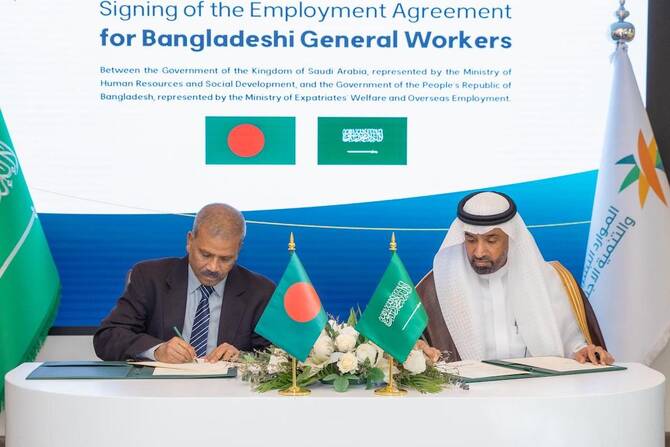
Saudi Human Resources and Social Development Minister Ahmad bin Sulaiman Al-Rajhi and Bangladesh’s Expatriates’ Welfare and Overseas Employment Adviser Asif Nazrul sign a labor recruitment agreement in Riyadh, Oct. 6, 2025. (Ministry of Expatriates’ Welfare and Overseas Employment)
Short Url
Updated 07 October 2025
Follow

Bangladesh to send skilled workers to Saudi Arabia under new recruitment deal

  • Agreement signed with Kingdom’s Human Resources and Social Development Ministry
  • Authorities try to meet the target of deploying 30,000 skilled workers every month

DHAKA: Bangladesh is preparing to send more skilled workers to Saudi Arabia, authorities said on Tuesday, following the signing of a new recruitment agreement in Riyadh.

Around 3 million Bangladeshi nationals live and work in Saudi Arabia. They are the largest expat group in the Kingdom and the biggest community outside their country.

Bangladeshi citizens have been working in Saudi Arabia since the 1970s but until now their employment was regulated by memoranda on specific labor deployment.

The new pact, signed on Monday by the Kingdom’s Human Resources and Social Development Minister Ahmad bin Sulaiman Al-Rajhi and Bangladesh’s Expatriates’ Welfare and Overseas Employment Adviser Asif Nazrul, is the first such agreement for general worker recruitment.

“With this agreement, it is expected that the recruitment of skilled workers from Bangladesh to Saudi Arabia across various professions will increase, and the rights and interests of both workers and employers will be better protected,” the Ministry of Expatriates’ Welfare and Overseas Employment said in a statement.

In the wake of numerous infrastructure projects underway in the Kingdom, the current demand is 30,000 certified workers per month, joint secretary of the ministry’s training wing, Mokhlesur Rahman Akand, told Arab News.

“We are taking all measures to meet the demand of the Saudi certification authorities, since sending more skilled workforces ensures better opportunities.”

Candidates are tested by the Saudi agency Takamol, which certifies workers according to standards and requirements of the Skill Verification Program. It is an initiative launched in 2021 under Vision 2030 to advance the professional competence of employees in the Kingdom’s labor market.

“They oversee everything online,” Akand said. “We provide the training in our Technical Training Centers, where computer-based tests are conducted. We have 104 TTCs across the country.”

Currently, many Bangladeshis are employed in the construction sector. And more are likely to find jobs in the industry in the next few years as the Kingdom prepares to host the AFC Asian Cup in 2027, the World Expo in 2030, and the World Cup in 2034.

“We are now working in line with Saudi demand,” Akand said.

“We hope that by early next year we will be able to meet the target set by the Takamol.”


Philippines probes Bondi Beach suspects’ visit, downplays militant training reports

Updated 12 sec ago
Follow

Philippines probes Bondi Beach suspects’ visit, downplays militant training reports

  • Suspects spent 4 weeks in the Philippines last month
  • Govt says no evidence visit linked to militant activity

MANILA: The Philippine National Police launched on Wednesday a probe into the recent visit to the country of a father and son whom Australian authorities have identified as suspects in last week’s mass shooting in Sydney.

Two gunmen killed 15 people and wounded dozens of others during Hanukkah celebrations at Sydney’s Bondi Beach on Sunday.

The suspected shooters, identified by Australian authorities as Sajid Akram and his son Naveed Akram, traveled to the Philippines last month.

The news has prompted various media outlets to speculate that there are links between their visit and the Sydney attack — an allegation Manila has since denied.

The investigation launched by the Philippine police seeks to establish the purpose of the suspects’ travel and their movement while in the country.

“This matter is being investigated as we seek to determine the reason behind their visit to the Philippines. We are finding out which places they went to, who they talked to, and where they stayed while they were in the country,” Philippine National Police acting chief Lt. Gen. Jose Melencio Nartatez Jr. said in a statement.

Bureau of Immigration data shows that 50-year-old Akram and his 24-year-old son arrived in the Philippines from Sydney on Nov. 1. They left the country on Nov. 28 via a connecting flight from Davao in the southern Philippines to Manila, with Sydney as their final destination.

According to a police statement, Philippine authorities, including the government and military, said there was no evidence the trip was related to any militant activity in the country and was “not considered as a serious security concern.”

Australian media reports linking the suspects to Daesh and alleging the group used the Philippines as its training ground were denied by the Philippine government.

“Information from operating units on the ground indicates no ongoing training and recruitment,” Department of National Defense spokesperson Arsenio Andolong told Arab News.

“There is no indication of imminent domestic terrorist threats.”

Presidential Communications Office Undersecretary and Palace Press Officer Claire Castro also dismissed the claims as “misleading” and “portraying the Philippines as a training hotspot for violent extremist groups.”

She told reporters that the National Security Council “maintained there is no confirmation to allegations that the father-and-son suspects in the recent mass shooting in Bondi Beach, Sydney, Australia, received training in the Philippines.”

Castro added that Philippine security forces “have significantly weakened” Daesh-affiliated groups since the 2017 Marawi siege.

The southern Philippine city in Mindanao island was in 2017 taken over by groups affiliated with Daesh. After five months of fighting and hundreds of deaths, the Philippine army reclaimed the area.

“Both UN and the US government assessments indicate that these groups now operate in a fragmented and diminished capacity,” Castro said.

“Violence in Mindanao is largely driven by historical conflicts and local clan disputes rather than the operational capacity of ISIS-affiliated organizations.”