

Bangladesh to send skilled workers to Saudi Arabia under new recruitment deal

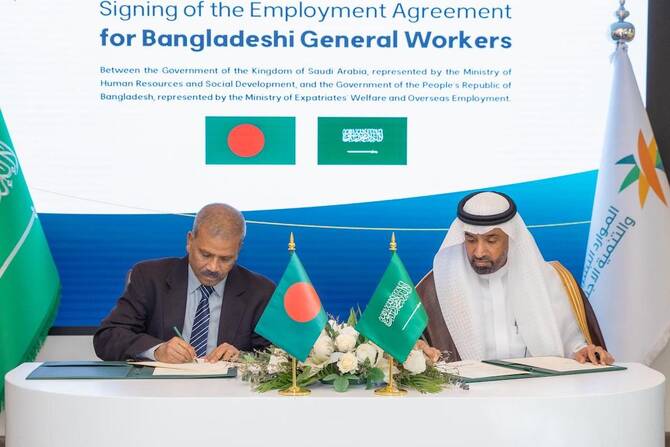
Saudi Human Resources and Social Development Minister Ahmad bin Sulaiman Al-Rajhi and Bangladesh’s Expatriates’ Welfare and Overseas Employment Adviser Asif Nazrul sign a labor recruitment agreement in Riyadh, Oct. 6, 2025. (Ministry of Expatriates’ Welfare and Overseas Employment)
Short Url
Updated 07 October 2025
Follow

Bangladesh to send skilled workers to Saudi Arabia under new recruitment deal

  • Agreement signed with Kingdom’s Human Resources and Social Development Ministry
  • Authorities try to meet the target of deploying 30,000 skilled workers every month

DHAKA: Bangladesh is preparing to send more skilled workers to Saudi Arabia, authorities said on Tuesday, following the signing of a new recruitment agreement in Riyadh.

Around 3 million Bangladeshi nationals live and work in Saudi Arabia. They are the largest expat group in the Kingdom and the biggest community outside their country.

Bangladeshi citizens have been working in Saudi Arabia since the 1970s but until now their employment was regulated by memoranda on specific labor deployment.

The new pact, signed on Monday by the Kingdom’s Human Resources and Social Development Minister Ahmad bin Sulaiman Al-Rajhi and Bangladesh’s Expatriates’ Welfare and Overseas Employment Adviser Asif Nazrul, is the first such agreement for general worker recruitment.

“With this agreement, it is expected that the recruitment of skilled workers from Bangladesh to Saudi Arabia across various professions will increase, and the rights and interests of both workers and employers will be better protected,” the Ministry of Expatriates’ Welfare and Overseas Employment said in a statement.

In the wake of numerous infrastructure projects underway in the Kingdom, the current demand is 30,000 certified workers per month, joint secretary of the ministry’s training wing, Mokhlesur Rahman Akand, told Arab News.

“We are taking all measures to meet the demand of the Saudi certification authorities, since sending more skilled workforces ensures better opportunities.”

Candidates are tested by the Saudi agency Takamol, which certifies workers according to standards and requirements of the Skill Verification Program. It is an initiative launched in 2021 under Vision 2030 to advance the professional competence of employees in the Kingdom’s labor market.

“They oversee everything online,” Akand said. “We provide the training in our Technical Training Centers, where computer-based tests are conducted. We have 104 TTCs across the country.”

Currently, many Bangladeshis are employed in the construction sector. And more are likely to find jobs in the industry in the next few years as the Kingdom prepares to host the AFC Asian Cup in 2027, the World Expo in 2030, and the World Cup in 2034.

“We are now working in line with Saudi demand,” Akand said.

“We hope that by early next year we will be able to meet the target set by the Takamol.”


Macron vows stronger cooperation with Nigeria after mass kidnappings

Updated 07 December 2025
Follow

Macron vows stronger cooperation with Nigeria after mass kidnappings

  • Macron wrote on X that France “will strengthen our partnership with the authorities and our support for the affected populations”

PARIS: French President Emmanuel Macron said Sunday that France will step up cooperation with Nigeria after speaking with his counterpart, as the West African country faces a surge in abductions.
Nigeria has been wracked by a wave of kidnappings in recent weeks, including the capture of over 300 school children two weeks ago that shook Africa’s most populous country, already weary from chronic violence.
Macron wrote on X that the move came at Nigerian President Bola Tinubu’s request, saying France “will strengthen our partnership with the authorities and our support for the affected populations,” while urging other countries to “step up their engagement.”
“No one can remain a spectator” to what is happening in Nigeria, the French president said.
Nigeria has drawn heightened attention from Washington in recent weeks, after US President Donald Trump said in November that the United States was prepared to take military action there to counter the killing of Christians.
US officials, while not contradicting Trump, have since instead emphasized other US actions on Nigeria including security cooperation with the government and the prospect of targeted sanctions.
Kidnappings for ransom by armed groups have plagued Nigeria since the 2014 abduction of 276 school girls in the town of Chibok by Boko Haram militants.
The religiously diverse country is the scene of a number of long-brewing conflicts that have killed both Christians and Muslims, often indiscriminately.
Many scholars say the reality is more nuanced, with conflicts rooted in struggles for scarce resources rather than directly related to religion.