DAMASCUS: Syria announced a comprehensive ceasefire with Kurdish forces after a meeting on Tuesday between Syrian President Ahmed Al-Sharaa and Kurdish leader Mazloum Abdi that followed deadly clashes in the northern city of Aleppo.
Syria’s authorities, who took power last year after overthrowing Bashar Assad, have rejected Kurdish demands for a decentralized government.
The issue has added to tensions with the Kurdish administration that controls swathes of the north and northeast, while differences between the two sides have held up implementation of a March 10 deal on integrating the Kurds’ civil and military institutions into the state.
In a statement on X, Syrian Defense Minister Murhaf Abu Qasra said he had met in Damascus with Abdi, head of the US-backed, Kurdish-led Syrian Democratic Forces (SDF).
“We agreed on a comprehensive ceasefire on all fronts, and on points for military deployment in north and northeast Syria,” Qasra said, adding that implementation of the deal would begin immediately.
A government source told AFP the meeting came after Sharaa met with Abdi, the first such encounter since July, and that the pair had discussed “security issues concerning the March 10 agreement.”
US envoy for Syria Tom Barrack and Admiral Brad Cooper, head of the US military’s Central Command, also attended, the source added, on condition of anonymity.
A Kurdish source who requested anonymity said that the meeting covered several topics, most notably “the integration of the SDF and Asayish into the Syrian army to build an organized Syrian army that protects all Syrians,” referring to the Kurdish security forces.
“There were positive talks regarding a constitutional amendment that would ensure representation of all Syrian components,” the source added.
Barrack posted on X on Monday that he and Cooper had visited northeast Syria for “substantive conversations” with Abdi.
The Kurdish leader said they had discussed “issues aimed at supporting the political integration in Syria, preserving the country’s territorial integrity, and creating a safe environment for all components of the Syrian people,” as well as ensuring continued efforts to combat Daesh group extremists in the region.
In a statement, the Syrian presidency said Sharaa met with Barrack and Cooper on Tuesday to discuss “the latest developments in Syria, ways to support the political process and enhance security and stability, and mechanisms for implementing the March 10 agreement to preserve Syria’s territorial integrity and sovereignty,” but did not mention Abdi.
Earlier on Tuesday, state media said fighting had stopped in Aleppo.
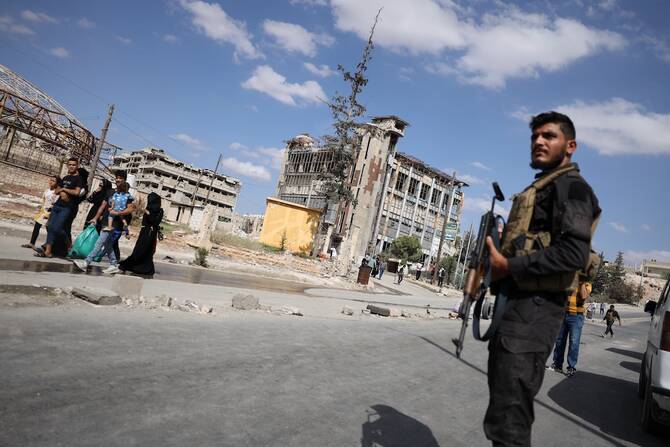
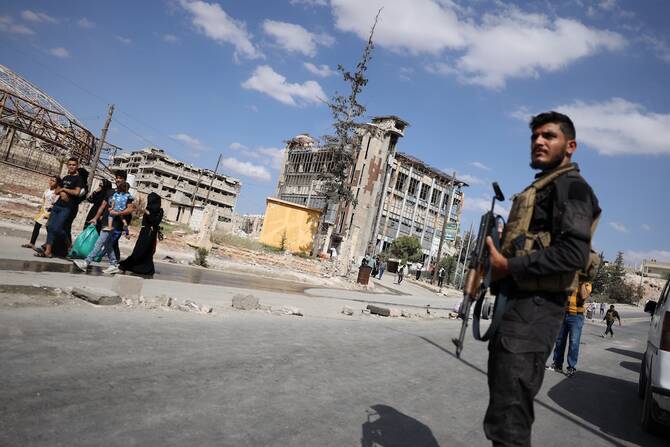
At least one member of Syria’s security forces and a civilian were killed in bombardment attributed to Kurdish forces that erupted late Monday in Aleppo’s Kurdish-majority Sheikh Maqsud and Ashrafiyeh neighborhoods, Syrian state television reported.
“We are afraid and decided this morning to leave our home in Sheikh Maqsud,” retiree Sinan Rajab Basha, 67, told AFP by telephone.
“We saw a large number of families flee Sheikh Maqsud and Ashrafiyeh,” he said, adding that the entrances of the districts were blocked and residents who left were not allowed back in.
The Kurds, who carved out their de facto autonomous administration in the chaos of Syria’s civil war, have repeatedly called for decentralization, a demand the new authorities in Damascus have rejected.
They have also criticized Syria’s temporary constitution as failing to reflect the country’s diversity, while Kurdish-held Raqqa and Hasakah provinces were excluded from a weekend ballot for members of Syria’s new parliament.
Syria’s new authorities have governed Aleppo city since the toppling of Assad in December.
But the Sheikh Maqsud and Ashrafiyeh neighborhoods have remained under the control of Kurdish units linked to the SDF and the Asayish, despite the SDF having officially withdrawn in April under a disengagement agreement reached with the government.
State news agency SANA reported that the SDF “targeted security checkpoints in the vicinity of Sheikh Maqsud” while dozens of families fled the districts.
The SDF denied attacking government security forces and accused pro-Damascus factions of mounting a siege of Kurdish neighborhoods in Aleppo and trying to push forward “with tanks.”
It said residents had taken up weapons to help the Asayish defend the districts.