

Disaster agency says Punjab rivers stable after monsoon rains, no immediate flood risk

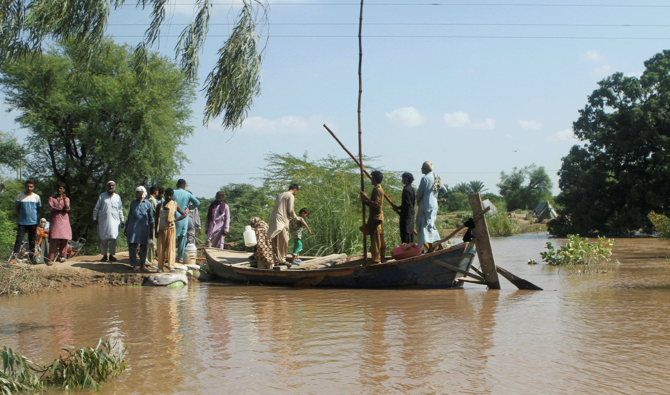
Residents board a boat while other wait for Rescue 1122 boat as they evacuate from the flooded area, following monsoon rains and rising water levels of the Chenab River, in Qasim Bela village on the outskirts of Multan in Punjab province, Pakistan, September 11, 2025. (Reuters/File)
Short Url
Updated 07 October 2025
Follow

Disaster agency says Punjab rivers stable after monsoon rains, no immediate flood risk

  • PDMA says water levels expected to rise in Sutlej, Ravi, Chenab and Jhelum but they remain within safe limits
  • Monsoon season since late July has killed more than 1,000 people in Pakistan, damaged homes and farmland

ISLAMABAD: River flows across Pakistan’s Punjab province remained normal on Tuesday despite rising water levels following a recent spell of monsoon rains, the Provincial Disaster Management Authority (PDMA) said, ruling out any immediate threat of flooding.

The update came as Pakistan continues to recover from weeks of torrential rains and riverine floods that inundated large parts of Punjab and Khyber Pakhtunkhwa, damaging homes, infrastructure and farmland. The monsoon season, which began in late July, has claimed at least 1,037 lives in incidents including roof collapses, landslides and flash floods.

Punjab, the country’s agricultural heartland, experienced one of its worst floods in years after neighboring India released excess water into three major rivers, affecting millions of people across the province.

“River flows in Punjab are currently normal,” said PDMA Punjab Director General Irfan Ali Kathia in a statement. “While rainfall has led to an increase in water levels, there is no risk of flooding at this stage.”

According to the PDMA, the flow in the Ravi River was recorded at 23,000 cusecs at Jassar, 22,000 cusecs at Shahdara, 55,000 cusecs at Balloki and 45,000 cusecs at Sidhnai.

The Sutlej River had flows of 59,000 cusecs at Ganda Singh Wala and 31,000 cusecs at Sulemanki, while the Chenab River recorded 31,000 cusecs at Marala, 17,000 at Khanki, 11,000 at Qadirabad and 11,000 at Trimmu.

At Panjnad, the flow stood at 30,000 cusecs.

The PDMA said water levels were expected to rise further in the next 24 hours in the Sutlej, Ravi, Chenab and Jhelum rivers, though all remained within safe limits.

It also reported that no water flow was observed in hill torrents across the Dera Ghazi Khan division, an area that often experiences flash flooding during heavy monsoon rains.

The statement said the PDMA’s control room continued to monitor the situation round the clock and coordinate with irrigation and district authorities to ensure timely alerts and preventive measures.


Pakistan warns 2026 monsoon season likely to be 22-26% more intense

Updated 6 sec ago
Follow

Pakistan warns 2026 monsoon season likely to be 22-26% more intense

  • Pakistan PM directs climate change ministry to begin preparations immediately for next year’s monsoon season
  • Pakistan suffered a deadly monsoon season this year which saw over 1,000 people killed due to torrential rains, floods

ISLAMABAD: The chairman of Pakistan’s National Disaster Management Authority (NDMA) warned on Wednesday that the 2026 monsoon season is expected to be more intense in the country, as Prime Minister Shehbaz Sharif directed authorities to start preparations immediately for a potential crisis next year. 

Pakistan suffered a deadly monsoon season this year, which saw over 1,000 people killed due to heavy rains and floods since late June. Deadly floods in Pakistan’s eastern Punjab province in late August killed over 130, affected over 4.5 million people and washed away large swathes of crops across the province. 

Experts attribute Pakistan’s irregular weather patterns, which include floods, droughts and heatwaves to climate change. Pakistan is counted among the world’s most vulnerable countries to climate change effects, where authorities say nearly 4,600 people have been killed in floods since 2010. 

“We think in the coming days, the 2026 monsoon is expected to be 22-26% more intense compared to this year’s monsoon,” NDMA Chairman Lt. Gen. Inam Haider Malik told reporters at a news conference. 

Malik said this meant glaciers would melt earlier next year or in higher quantity, pointing out that glacial lake outburst floods (GLOFs) and deluges were observed in the northern Gilgit-Baltistan (GB) region, Punjab and the southern Sindh province during 2025. 

“Pakistan bore all possible components of the monsoon this year,” Malik said, adding that over 3.1 million people were evacuated from high-risk riverine areas across the country. 

PM APPROVES SHORT-TERM PLAN

Separately, Sharif approved a short-term plan by the climate change ministry to induce climate-related losses for the next year’s monsoon, a statement by his office said, directing authorities to begin preparations to implement it immediately. 

The prime minister noted that a substantial amount of Pakistan’s GDP has to be spent every three years to mitigate the adverse impacts of climate change. 

Speaking to reporters alongside Malik, Climate Change Minister Musadik Maik said that as per the short-term plan, the government will fix all dams, embankments and floodgates that were damaged due to the recent floods in Pakistan in late August. 

“Whatever damage that has happened in the next 200 days it will be fixed,” Malik said. 

He pointed out that the prime minister has also directed authorities to ensure that an integrated early warning system is made functional and implemented in the country. 

Malik said at the moment, various government ministries and authorities, such as the Planning Ministry and the NDMA, had their own early warning systems. 

He said that as per one automatic and integrated warning system, the people and officials of the area where a natural calamity strikes will be warned first so that they can take precautionary measures before Islamabad is alerted. 
 
“The prime minister has issued an order and told us that you have to do both of these things immediately,” the minister said.