

Pakistan militant-linked violence soars in third quarter

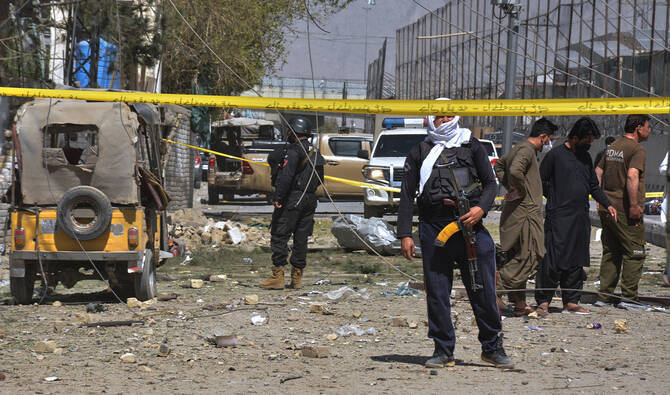
Security officials examine damaged vehicles at the site of a powerful car bombing, in Quetta, Pakistan, on September 30, 2025. (AP)
Short Url
Updated 06 October 2025
Follow

Pakistan militant-linked violence soars in third quarter

  • The country reports a 46 percent rise in fatalities, including civilians, security personnel and militants
  • This year is on track to be deadlier than 2024, which was already the most violent year in a decade

ISLAMABAD: Violence in Pakistan has surged over the past three months due to a spike in militant attacks and intensified counter-terrorism operations, an Islamabad-based think tank said Monday.

The Center for Research and Security Studies (CRSS) reported a 46 percent rise in fatalities, including civilians, security personnel and militants, compared to the previous quarter.

This year is on track to be deadlier than 2024 — already the most violent year in a decade.

Pakistan’s military is fighting militant groups along the length of its western border, with the Pakistani Taliban active in the northwest and Baloch separatist groups in the southwest behind the vast majority of attacks.

The surge reflects an “intensification of militant violence and the expanded scale of counter-terrorism operations,” CRSS said.

Attacks have increased since the withdrawal of US-led troops from neighboring Afghanistan in 2021, with Pakistan’s government accusing the Taliban authorities of sheltering militants — a charge they deny.

However, the United Nations has warned of a “permissive environment” for militant groups in Afghanistan.

Government officials told AFP in September on condition of anonymity that the presence of Pakistani Taliban militants had increased in recent months.

That same month, opposition lawmakers accused the Pakistani military of carrying out an air raid on militant hideouts that killed children. The army did not comment.

Local village councils have repeatedly warned that sweeping counter-terrorism operations would risk harming civilians.

There were 2,414 deaths in the first three quarters of 2025, nearing the 2,546 fatalities reported in 2024, according to the think tank.


Rating firm S&P says it won’t rush Iran war downgrades, sees risks for countries like Pakistan

Updated 12 March 2026
Follow

Rating firm S&P says it won’t rush Iran war downgrades, sees risks for countries like Pakistan

  • Agency says it is monitoring indebted energy importers as higher oil prices strain finances
  • Gulf economies seen better placed to weather shock, though Bahrain flagged as vulnerable

LONDON: S&P Global ‌said it would not make any knee-jerk sovereign rating cuts following the outbreak of war in the ​Middle East, but warned on Thursday that soaring oil and gas prices were putting a number of already cash-strapped countries at risk.

The firm’s top analysts said in a webinar that the conflict, which has involved US and Israeli strikes ‌against Iran and Iranian ‌strikes against Israel, ​US ‌bases ⁠and Gulf ​states, ⁠was now moving from a low- to moderate-risk scenario.

Most Gulf countries had enough fiscal buffers, however, to weather the crisis for a while, with more lowly rated Bahrain the only clear exception.

Qatar’s banking sector could ⁠also struggle if there were significant ‌deposit outflows in ‌reaction to the conflict, although there ​was no evidence ‌of such strains at the moment, they ‌said.

“We don’t want to jump the gun and just say things are bad,” S&P’s head global sovereign analyst, Roberto Sifon-Arevalo, said.

The longer the crisis ‌was prolonged, though, “the more difficult it is going to be,” he ⁠added.

Sifon-Arevalo ⁠said Asia was the second-most exposed region, due to many of its countries being significant Gulf oil and gas importers.

India, Thailand and Indonesia have relatively lower reserves of oil, while the region also had already heavily indebted countries such as Pakistan, Bangladesh and Sri Lanka whose finances would be further hurt by rising energy prices.

“We ​are closely monitoring ​these (countries) to see how the credit stories evolve,” Sifon-Arevalo said.