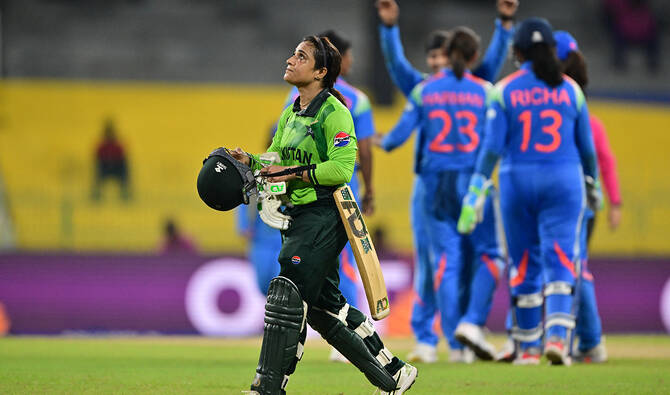
Pakistan’s Sidra Amin reprimanded for breaching ICC code of conduct against India

Pakistan's Sidra Amin leaves the ground after losing her wicket during the ICC Women's Cricket World Cup 2025 one-day international (ODI) match between India and Pakistan at the R. Premadasa International Cricket Stadium in Colombo on October 5, 2025. (AFP)
Short Url
Updated 06 October 2025
Follow

Pakistan’s Sidra Amin reprimanded for breaching ICC code of conduct against India

  • Amin top-scored with 81 runs, but her half century was not enough to save Pakistan from an 88-run defeat
  • It was Pakistan’s second successive loss in the tournament after it lost the opening game against Bangladesh

COLOMBO: Pakistan batter Sidra Amin has been reprimanded for breaching the ICC's code of conduct during a Women’s Cricket World Cup match against archrival India on Sunday.

Amin top-scored with 81 runs, but her half century was not enough to save Pakistan from an 88-run defeat. It was Pakistan’s second successive loss in the tournament after it lost the opening game against Bangladesh by seven wickets.

The ICC said in a statement on Monday that Amin breached its article 2.2 related to “abuse of cricket equipment or clothing, ground equipment or fixtures and fittings during an international match.”

Amin hit her bat forcefully onto the pitch after she was dismissed in the 40th over. She admitted her offense and accepted the sanction proposed by match referee Shandre Fritz.

It was Amin’s first offense in two years and she was given one demerit point for a Level 1 breach.

Pakistan next takes on defending champion Australia in Colombo on Wednesday.


IMF board to meet tomorrow to consider $1.2 billion disbursement for Pakistan

Updated 11 sec ago
Follow

IMF board to meet tomorrow to consider $1.2 billion disbursement for Pakistan

  • Pakistan, IMF reached a Staff-Level Agreement for second review of $7 billion loan program 
  • Economists view disbursement crucial for cash-strapped Pakistan as it tackles economic crisis

ISLAMABAD: The International Monetary Fund’s (IMF) Executive Board will meet tomorrow, Monday, to consider and approve a $1.2 billion disbursement for Pakistan, according to the global lender’s official schedule. 

The meeting takes place nearly two months after the Fund reached a Staff-Level Agreement (SLA) with Pakistan for the second review of its $7 billion Extended Fund Facility (EFF) and the first review of its $1.4 billion Resilience and Sustainability Facility (RSF). 

The SLA followed a mission led by IMF’s Iva Petrova, who held discussions with Pakistani authorities during a Sept. 24–Oct. 8 visit to Karachi, Islamabad and Washington, DC.

“The International Monetary Fund’s (IMF) Executive Board will convene on Dec. 8 to consider Pakistan’s request for a $1.2 billion disbursement under the Extended Fund Facility (EFF) and the Resilience and Sustainability Facility (RSF), according to the Fund’s updated schedule,” the state-run Pakistan TV reported on Sunday.

Economists view IMF’s bailout packages as crucial for cash-strapped Pakistan, which has relied heavily on financing from bilateral partners such as Saudi Arabia, China and the United Arab Emirates, as well as multilateral lenders including the IMF, World Bank, Asian Development Bank and Islamic Development Bank. 

The South Asian country has been grappling with a prolonged macroeconomic crisis that has drained its financial resources and triggered a balance of payments crisis. Islamabad, however, has recorded some financial gains since 2022, which include recording a surplus in its current account and bringing inflation down considerably. 

Speaking to Arab News last month, Pakistan’s former finance adviser Khaqan Najeeb said the $1.2 billion disbursement will further stabilize Pakistan’s near-term external position and unlock additional official inflows. 

“Continued engagement also reinforces macro stability, as reflected in recent improvements in inflation, the current account, and reserve buffers,” Najeeb said. 

Pakistan came close to sovereign default in mid-2023, when foreign exchange reserves fell below three weeks of import cover, inflation surged to a record 38 percent in May, and the country struggled to secure external financing after delays in its IMF program. Fuel shortages, import restrictions, and a rapidly depreciating rupee added to the pressure, while ratings agencies downgraded Pakistan’s debt and warned of heightened default risk.

The crisis eased only after Pakistan reached a last-minute Stand-By Arrangement with the IMF in June 2023, unlocking emergency support and preventing an immediate default.