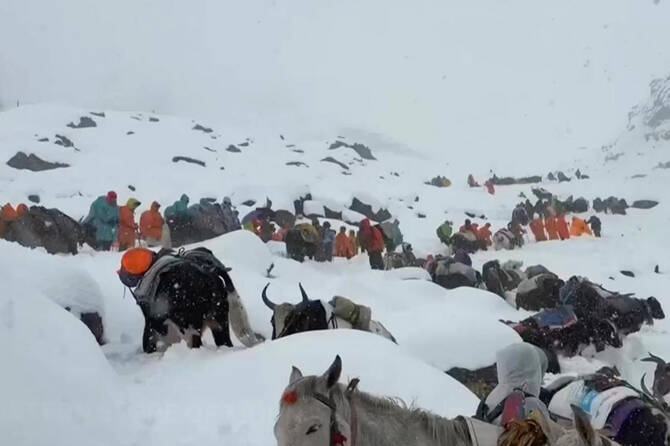
BEIJING: Rescuers were helping hundreds of hikers trapped by heavy snow at tourist campsites on a slope of Mount Everest in Tibet, Chinese state media said.
About 350 hikers had reached a meeting point in Tingri country and rescuers were in contact with another 200, state broadcaster CCTV said late Sunday. There was no immediate update on rescue efforts on Monday.
The hikers were trapped at an elevation of more than 4,900 meters (16,000 feet), according to an earlier report from Jimu News, a Chinese online site. Mount Everest is about 8,850 meters (29,000 feet) tall.
A hiker who rushed to descend before snow blocked the way told Jimu News that others still on the mountain told him the snow was 1 meter (3 feet) deep and had crushed tents.
Hundreds of rescuers headed up the mountain Sunday to clear paths so that trapped people could come down, the Jimu report said. A video shot by a villager showed a long line of people with horses and oxen moving up a winding path in the snow.
The snowstorm struck during a weeklong national holiday in China, when many travel at home and abroad.
In another mountainous region in western China, one hiker died of hypothermia and altitude sickness and 137 others were evacuated in the north part of Qinghai province, CCTV said Monday.
The search in an area in Menyuan county with an average altitude of more than 4,000 meters (13,100 feet) was complicated by the terrain, unpredictable weather and continuous snowfall, a CCTV online report said.
Mount Everest, known as Mount Qomolangma in Chinese, straddles the border between China and Nepal, where recent heavy rains have left more than 40 people dead.
Climbers attempt to scale the world’s tallest peak from base camps in both countries. The base camp for climbers is separate from the tourist camp where hikers were trapped by the snowfall.
A strong earthquake killed at least 126 people in the same area in January.
The Chinese side of Everest is in Tibet, a remote western region where the government has cracked down harshly on dissent and poured in funds for economic development including roads and tourism.
The Dalai Lama, the spiritual leader of Tibetan Buddhism, fled during a failed uprising in 1959 and lives in India, where some Tibetans have set up a government in exile.

Snowstorm traps hundreds of hikers on Mount Everest during China’s national holiday
https://arab.news/jhwav
Snowstorm traps hundreds of hikers on Mount Everest during China’s national holiday
- The snowstorm struck during a weeklong national holiday in China, when many travel at home and abroad
House votes to slap back Trump’s tariffs on Canada in rare bipartisan rebuke
WASHINGTON: The House voted Wednesday to slap back President Donald Trump’s tariffs on Canada, a rare if largely symbolic rebuke of the White House agenda as Republicans joined Democrats over the objections of GOP leadership.
The tally, 219-211, was among the first times the House, controlled by Republicans, has confronted the president over a signature policy, and drew instant recrimination from Trump himself. The resolution seeks to end the national emergency Trump declared to impose the tariffs, though actually undoing the policy would require support from the president, which is highly unlikely. It next goes to the Senate.
Trump believes in the power of tariffs to force US trade partners to the negotiating table. But lawmakers are facing unrest back home from businesses caught in the trade wars and constituents navigating pocketbook issues and high prices.
“Today’s vote is simple, very simple: Will you vote to lower the cost of living for the American family or will you keep prices high out of loyalty to one person — Donald J. Trump?” said Rep. Gregory Meeks of New York, the top Democrat on the House Foreign Affairs Committee, who authored the resolution.
Within minutes, as the gavel struck, Trump fired off a stern warning to those in the Republican Party who would dare to cross him.
“Any Republican, in the House or the Senate, that votes against TARIFFS will seriously suffer the consequences come Election time, and that includes Primaries!” the president posted on social media.
The high-stakes moment provides a snapshot of the House’s unease with the president’s direction, especially ahead of the midterm elections as economic issues resonate among voters. The Senate has already voted to reject Trump’s tariffs on Canada and other countries in a show of displeasure. But both chambers would have to approve the tariff rollbacks, and send the resolution to Trump for the president’s signature — or veto.
Six House Republicans voted for the resolution, and one Democrat voted against it.
From Canada, Ontario, Premier Doug Ford on social media called the vote “an important victory with more work ahead.” He thanked lawmakers from both parties “who stood up in support of free trade and economic growth between our two great countries. Let’s end the tariffs and together build a more prosperous and secure future.”
Trump recently threatened to impose a 100 percent tariff on goods imported from Canada over that country’s proposed China trade deal, intensifying a feud with the longtime US ally and Prime Minister Mark Carney.
GOP defections forced the vote
House Speaker Mike Johnson tried to prevent this showdown.
Johnson insisted lawmakers wait for a pending Supreme Court ruling in a lawsuit about the tariffs. He engineered a complicated rules change to prevent floor action. But Johnson’s strategy collapsed late Tuesday, as Republicans peeled off during a procedural vote to ensure the Democratic measure was able to advance.
“The president’s trade policies have been of great benefit,” Johnson, R-Louisiana, had said. “And I think the sentiment is that we allow a little more runway for this to be worked out between the executive branch and the judicial branch.”
Late Tuesday evening, Johnson could be seen speaking to holdout Republican lawmakers as the GOP leadership team struggled to shore up support during a lengthy procedural vote, but the numbers lined up against him.
“We’re disappointed,” Kevin Hassett, the director of the White House’s National Economic Council, told reporters at the White House on Wednesday morning. “The president will make sure they don’t repeal his tariffs.”
Terminating Trump’s emergency
The resolution put forward by Meeks would terminate the national emergency that Trump declared a year ago as one of his executive orders.
The administration claimed illicit drug flow from Canada constitutes an unusual and extraordinary threat that allows the president to slap tariffs on imported goods outside the terms of the US-Mexico-Canada trade agreement.
The Republican chairman of the House Foreign Affairs Committee, Rep. Brian Mast of Florida, said the flow of fentanyl into the US is a dire national emergency and the policy must be left in place.
“Let’s be clear again about what this resolution is and what it’s not. It’s not a debate about tariffs. You can talk about those, but that’s not really what it is,” Mast said. “This is Democrats trying to ignore that there is a fentanyl crisis.”
Experts say fentanyl produced by cartels in Mexico is largely smuggled into the US from land crossings in California and Arizona. Fentanyl is also made in Canada and smuggled into the US, but to a much lesser extent.
Torn between Trump and tariffs
Ahead of voting, some rank-and-file Republican lawmakers expressed unease over the choices ahead as Democrats — and a few renegade Republicans — impressed on their colleagues the need to flex their power as the legislative branch rather than ceding so much power to the president to take authority over trade and tariff policy.
Rep. Don Bacon, R-Nebraska, said he was unpersuaded by Johnson’s call to wait until the Supreme Court makes its decision about the legality of Trump’s tariffs. He voted for passage.
“Why doesn’t the Congress stand on its own two feet and say that we’re an independent branch?” Bacon said. “We should defend our authorities. I hope the Supreme Court does, but if we don’t do it, shame on us.”
Bacon, who is retiring rather than facing reelection, also argued that tariffs are bad economic policy.
Other Republicans had to swiftly make up their minds after Johnson’s gambit — which would have paused the calendar days to prevent the measure from coming forward — was turned back.
“At the end of the day, we’re going to have to support our president,” said Rep. Keith Self, R-Texas.
Rep. Darrell Issa, R-Calif., said he doesn’t want to tie the president’s hands on trade and would support the tariffs on Canada “at this time.”


