

Punjab issues fresh flood alert as river levels rise after heavy rains

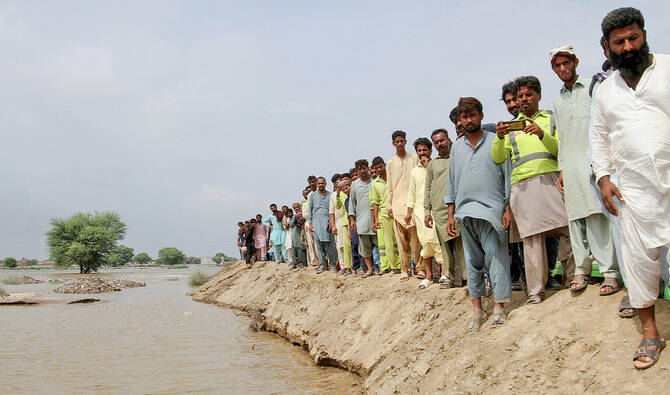
Residents stand at an embankment as they wait to be rescued from a flooded area, following monsoon rains and rising water levels of the Chenab River, in Jalalpur Pirwala, Punjab province, Pakistan, on September 8, 2025. (REUTERS/File)
Short Url
Updated 06 October 2025
Follow

Punjab issues fresh flood alert as river levels rise after heavy rains

  • PDMA warns of possible medium flood in River Jhelum, low flood in Sutlej within 24 hours
  • Over 1,000 people killed, 2.5 million acres of farmland damaged nationwide this monsoon

ISLAMABAD: The Punjab Provincial Disaster Management Authority (PDMA) on Monday issued a fresh flood alert, warning of rising river levels across the province that has already suffered weeks of rain-related damage and repeated flooding this monsoon season.

This year’s monsoon season, stretching from late June through September, has been one of the deadliest in recent years, killing at least 1,006 people nationwide and displacing tens of thousands, according to the National Disaster Management Authority (NDMA). The downpours have damaged hundreds of thousands of homes and large stretches of roads, while washing away livestock and destroying key crops — including cotton, rice, and maize — across the country’s agricultural heartland.

Punjab, Pakistan’s most populous and agriculturally vital province, has been hit by repeated flooding since August, with nearly 2.5 million acres of farmland destroyed. 

“Flows in River Jhelum at Mangla upstream are likely to rise, with a possibility of reaching medium flood level within the next 24 hours,” a PDMA spokesperson said. “There is also a likelihood of low flood conditions in River Sutlej at Ganda Singh Wala, depending on water releases from India.”

The PDMA said it had alerted all divisional commissioners and deputy commissioners to remain vigilant and ensure round-the-clock staffing in District Emergency Operation Centers (DEOCs). Departments of irrigation, health, livestock, communication and works and local government have been directed to mobilize resources for flood preparedness.

PDMA Director General Irfan Ali Kathia instructed officials to pre-position heavy machinery, strengthen embankments, and clear drainage channels to prevent breaches. 

“District administrations have been directed to stay alert as river flows and nullahs may rise due to ongoing rainfall,” he said.

Citizens were urged to exercise caution and follow safety adviseries during the wet spell. The PDMA said the wet spell is likely to subside within 36 hours, but monitoring and early warning systems would remain active.

Pakistan witnessed its most devastating monsoon season in 2022 when floods killed 1,739 people and caused an estimated $30 billion in damage.


Pakistan raises fuel prices by Rs55 per liter as Middle East conflict drives oil surge

Updated 06 March 2026
Follow

Pakistan raises fuel prices by Rs55 per liter as Middle East conflict drives oil surge

  • Government says adequate fuel stocks in place despite global energy shock
  • Oil prices jump from about $78 to over $106 per barrel amid regional conflict

ISLAMABAD: Pakistan on Friday increased petrol and diesel prices by Rs55 ($0.20) per liter each as escalating conflict in the Middle East sent global oil prices sharply higher and disrupted energy supply routes, officials said.

Global oil markets have been rattled since coordinated strikes by the United States and Israel against Iran began last week, triggering retaliatory attacks across the region, raising fears of disruption to key energy shipping routes and pushing petroleum prices sharply upward.

The price adjustment in Pakistan was announced after a joint press conference by Finance Minister Muhammad Aurangzeb, Deputy Prime Minister and Foreign Minister Ishaq Dar and Petroleum Minister Ali Pervaiz Malik, who said the government was monitoring international energy markets and domestic supply conditions amid the crisis.

“So, the decision we have made by changing the levy a little bit is that we are going ahead with increasing the price of both fuels, petrol and diesel, by Rs55 ($0.20),” Malik told reporters. 

“And as soon as this matter settles, we will revise the prices downward with the same speed and take steps on how to increase people’s income and purchasing power.”

He said Pakistan entered the crisis with “comfortable energy reserves” due to earlier planning but rising global prices had forced the government to adjust domestic fuel rates to maintain supply continuity.

He said international petrol prices had climbed from roughly $78 per barrel on March 1 to around $106.8 per barrel, while diesel prices had risen to about $150 per barrel.

Malik added that the government had taken steps to minimize the burden on consumers, noting diesel plays a critical role in agriculture, transportation and public mobility.

Malik also warned that authorities would take strict action against anyone attempting to hoard fuel or manipulate supply for profiteering.

The minister said Pakistan was working with international partners to secure additional energy supplies, including arrangements with Saudi Aramco and the use of Pakistan National Shipping Corporation vessels to transport crude oil imports.

Finance Minister Aurangzeb said a high-level government committee formed by Prime Minister Shehbaz Sharif had been meeting daily to review developments in global petroleum markets and their potential impact on Pakistan’s economy.

“Pakistan currently maintains adequate energy stocks and macroeconomic stability,” Aurangzeb said, adding that the government’s response was based on preparedness rather than panic.

He said the committee, which includes senior ministers, the governor of the State Bank of Pakistan and other officials, was assessing short-, medium- and long-term implications of the crisis for inflation, foreign exchange reserves and broader economic indicators.

Deputy PM Dar said the regional conflict had significantly disrupted global energy markets, with international petroleum prices rising by as much as 50–70 percent in recent days.

The deputy prime minister added that Pakistan was also engaged in diplomatic efforts aimed at de-escalating tensions and restoring stability in the region.

Petroleum prices will now be reviewed more frequently, potentially on a weekly basis, and any reduction in global oil prices would be passed on to consumers.

Pakistan, which relies heavily on imported fuel to meet its energy needs, is particularly vulnerable to global oil price shocks that can quickly feed into inflation and pressure the country’s external accounts.