

Freed hostage recounts captivity as Israel faces mounting pressure over Gaza

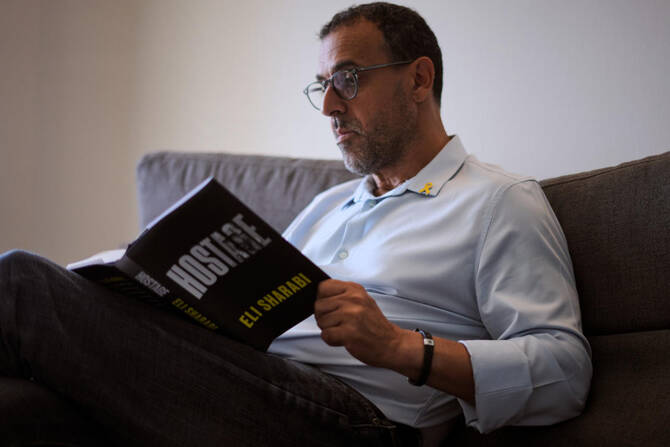
Eli Sharabi, who was abducted during the cross-border attack on Israel on Oct. 7, 2023, and held hostage by Hamas for 16 months, poses with his new book "Hostage" for a photo in Herzliya, Israel, Thursday, September 18, 2025. (AP)
Short Url
Updated 06 October 2025
Follow

Freed hostage recounts captivity as Israel faces mounting pressure over Gaza

  • Inside Israel, pressure has been building on Prime Minister Benjamin Netanyahu’s government to end the war and secure the release of those still held captive

HERZLIYA: Two years after the Oct. 7, 2023, Hamas-led attack that triggered the war in Gaza, Israel has yet to recover 48 of the hostages taken that day, around 20 of whom are believed to be alive. A new US-supported peace initiative has renewed hopes of securing their release.

Among those freed earlier this year is Eli Sharabi, 53, who said he was held for 16 months in tunnels under Gaza. He was released in February as part of a ceasefire agreement.

Only after his release did Sharabi learn that his wife and two teenage daughters had been killed during the Oct. 7 assault on Kibbutz Be’eri. “There can be no closure,” he said, “until all the hostages return.”

According to Israeli officials, Hamas-led militants killed about 1,200 people and abducted 251 others during the Oct. 7 attack. Most hostages have since been freed through ceasefires or negotiated exchanges.

Israeli Police and military inquiries have confirmed that some Israeli civilians were unintentionally killed by Israeli forces during the initial fighting, as troops attempted to repel the Hamas-led attackers and prevent abductions during the Oct. 7 attack. Officials have said the deaths occurred amid crossfire and confusion during the surprise assault.

Inside Israel, pressure has been building on Prime Minister Benjamin Netanyahu’s government to end the war and secure the release of those still held captive. Tens of thousands of Israelis have joined mass demonstrations in Tel Aviv, Jerusalem, and other cities, calling for a ceasefire and hostage exchange deal. Protesters say continued military operations in Gaza endanger the hostages’ lives and deepen Israel’s international isolation.

The Israel Defense Forces have also admitted to mistakenly killing three Israeli hostages - Yotam Haim, Samer Talalka, and Alon Shamriz - in December 2023 in Gaza’s Sheijaiyah neighborhood. Troops misidentified the men as a threat amid heavy fighting. The military called the incident a “tragic mistake” and launched an internal investigation.

Sharabi’s account appears in Hostage, a memoir published in Hebrew earlier this year and released in English on Tuesday. In the book, he describes confinement in underground tunnels with limited access to washing and food, and occasional beatings by guards. He said meals consisted mainly of bread and that he weighed 44 kilograms (97 pounds) upon his release.

The war has drawn extensive international criticism. The United Nations and several human rights organizations have accused Israel of committing acts of genocide in Gaza, citing the scale of civilian deaths, destruction, and humanitarian collapse.

Israel’s military response has killed more than 67,000 people in Gaza, according to health authorities in the Hamas-run territory. Large parts of the enclave have been destroyed, and international organizations report that most residents have been displaced and face severe shortages of food, water, and medicine. The United Nations has warned that ongoing blockades and destruction of infrastructure have created conditions of famine in parts of Gaza, with millions at risk of severe food insecurity.

Sharabi said he was initially held in an apartment before being moved underground, where he was detained with three other hostages, including 24-year-old Alon Ohel. The group, he said, developed routines to maintain morale and physical activity.

Sharabi now advocates for the release of remaining hostages and has met with international officials, including former US President Donald Trump, to raise awareness. His efforts, he said, are motivated by concern for Ohel, who appeared in a recent video released by Hamas.

“I hope those in positions of power will act to end the war and bring the captives home,” Sharabi said.

(With AP)


Washington presses Syria to shift from Chinese telecom systems

Updated 26 February 2026
Follow

Washington presses Syria to shift from Chinese telecom systems

  • Syria is exploring the possibility of procuring Chinese technology
  • It was unclear whether the United States ⁠pledged financial or logistical support to Syria to do so

DAMASCUS: The United States has warned Syria against relying on Chinese technology in its telecommunications sector, arguing it conflicts with US interests and threatens US national security, according to three sources familiar with the matter.
The message was conveyed during an unreported meeting between a US State Department team and Syrian Communications Minister Abdulsalam Haykal in San Francisco on Tuesday. Washington has been coordinating closely with Damascus since 2024, when Syria’s now President Ahmed Al-Sharaa ousted longtime leader Bashar Assad, who had a strategic partnership with China.
Syria is exploring the possibility of procuring Chinese technology to support its telecommunications towers and the infrastructure of local Internet service providers, according to a Syrian businessman involved in the procurement talks.
“The US side asked for clarity on the ministry’s plans regarding Chinese telecom equipment,” said ⁠another source briefed on ⁠the talks.
But Syrian officials said infrastructure development projects were time-critical and that Damascus was seeking greater vendor diversity, the source added.
SYRIAN OFFICIALS CITE US EXPORT CONTROLS AS TELECOMS BARRIER
Syria is open to partnering with US firms but the matter was urgent and export controls and “over-compliance” remained an issue, according to person familiar with the meeting in San Francisco.
A US diplomat familiar with the discussions told Reuters that the US State Department “clearly urged Syrians to use American technology or technology from allied countries in the telecoms sector.”
It was unclear whether the United States ⁠pledged financial or logistical support to Syria to do so.
Responding to Reuters questions, a US State Department spokesperson said: “We urge countries to prioritize national security and privacy over lower-priced equipment and services in all critical infrastructure procurement. If it seems too good to be true, it probably is.”
The spokesperson added that Chinese intelligence and security services “can legally compel Chinese citizens and companies to share sensitive data or grant unauthorized access to their customers’ systems” and promises by Chinese companies to protect customers’ privacy were “entirely inconsistent with China’s own laws and well-established practices.”
China has repeatedly rejected allegations of it using technology for spying purposes.
The Syrian Ministry of telecommunications told Reuters any decisions related to equipment and infrastructure are made “in accordance with national technical and security standards, ensuring data protection and service continuity.”
The ministry said it is also prioritizing the diversification of partnerships and technology sources to ⁠serve the national interest.
Syria’s telecom ⁠infrastructure has relied heavily on Chinese technology due to US sanctions imposed on successive Assad governments over the civil war that grew from a crackdown on anti-government protests in 2011.
Huawei technology accounts for more than 50 percent of the infrastructure of Syriatel and MTN, the country’s only telecom operators, according to a senior source at one of the companies and documents reviewed by Reuters. Huawei did not immediately respond to a request for comment.
Syria is seeking to develop its private telecommunications sector, devastated by 14 years of war, by attracting foreign investment.
In early February, Saudi Arabia’s largest telecom operator, STC, announced it would invest $800 million to “strengthen telecommunications infrastructure and connect Syria regionally and internationally through a fiber-optic network extending over 4,500 kilometers.”
The ministry of telecommunications says that US restrictions “hinder the availability of many American technologies and services in the Syrian market,” emphasizing that it welcomes expanding cooperation with US companies when these restrictions are lifted.
Syria has inadequate telecommunications infrastructure, with network coverage weak outside city centers and connection speeds in many areas barely exceeding a few kilobits per second.