WASHINGTON: Republican and Democratic lawmakers at an impasse on reopening the federal government provided few public signs Sunday of meaningful negotiations taking place to end what has so far been a five-day shutdown.
Leaders in both parties are betting that public sentiment has swung their way, putting pressure on the other side to cave. Democrats are insisting on renewing subsidies to cover health insurance costs for millions of households, while President Donald Trump wants to preserve existing spending levels and is threatening to permanently fire federal workers if the government remains closed.
The squabble comes at a moment of troubling economic uncertainty. While the US economy has continued to grow this year, hiring has slowed and inflation remains elevated as Trump’s import taxes have created a series of disruptions for businesses and hurt confidence in his leadership. At the same time, there is a recognition that the nearly $2 trillion annual budget deficit is financially unsustainable, yet there has to be a coalition around the potential tax increases and spending cuts to reduce borrowing levels.
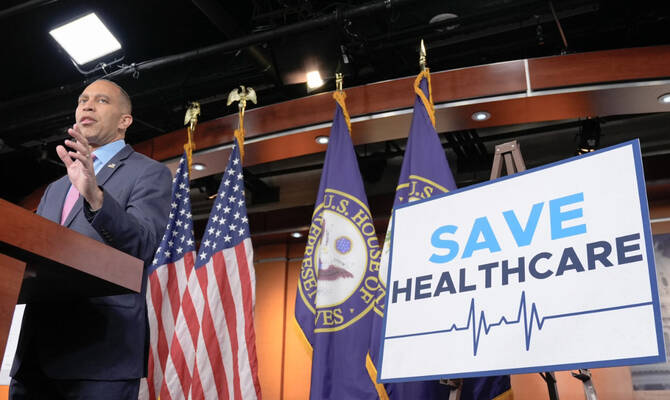
House Democratic leader Hakeem Jeffries, among those appearing on the Sunday news shows, said there have been no talks with Republican leaders since their White House meeting Monday.
“And, unfortunately, since that point in time, Republicans, including Donald Trump, have gone radio silent,” Jeffries said. “And what we’ve seen is negotiation through deepfake videos, the House canceling votes, and of course President Trump spending yesterday on the golf course. That’s not responsible behavior.”
Trump was asked via text message by CNN’s Jake Tapper about shutdown talks. The Republican president responded with confidence but no details.
“We are winning and cutting costs big time,” Trump said in a text message, according to CNN.
His administration sees the shutdown as an opening to wield greater power over the budget, with multiple officials saying they will save money as workers are furloughed by imposing permanent job cuts on thousands of government workers, a tactic that has never been used before.
Even though it would be Trump’s choice to cut jobs, he believes he can put the blame on the Democrats because of the shutdown.
“It’s up to them,” Trump told reporters on Sunday morning before boarding the presidential helicopter. “Anybody laid off that’s because of the Democrats.”
While Trump rose to fame on the TV show “The Apprentice” with its catchphrase of “You’re fired,” Republicans on Sunday claimed that the administration would take no pleasure in letting go federal workers, even though they have put funding on hold for infrastructure and energy projects in Democratic areas.
“We haven’t seen the details yet about what’s happening” with layoffs, House Speaker Mike Johnson said on NBC. “But it is a regrettable situation that the president does not want.”
Kevin Hassett, director of the White House National Economic Council, said the administration wants to avoid the layoffs. It had indicated they could start on Friday, a deadline that came and went without any decisions being announced.
“We want the Democrats to come forward and to make a deal that’s a clean, continuing resolution that gives us seven more weeks to talk about these things,” Hassett said on CNN. “But the bottom line is that with Republicans in control, the Republicans have a lot more power over the outcome than the Democrats.”
Democratic Sen. Adam Schiff of California defended his party’s stance on the shutdown, saying on NBC that the possible increase in health care costs for “millions of Americans” would make insurance unaffordable in what he called a “crisis.”
But Schiff also noted that the Trump administration has stopped congressionally approved spending from being used, essentially undermining the value of Democrats’ seeking compromises on the budget as the White House could decline to honor Congress’ wishes. The Trump administration sent Congress roughly $4.9 billion in ” pocket rescissions ” on foreign aid, a process that meant the spending was withheld without time for Congress to weigh in before the previous fiscal year ended last month.
“We need both to address the health care crisis and we need some written assurance in the law — I won’t take a promise — that they’re not going to renege on any deal we make,” Schiff said.
The television appearances indicated that Democrats and Republicans are busy talking, deploying Internet memes against each other that have raised concerns about whether it’s possible to negotiate in good faith.
Vice President JD Vance said a video putting Jeffries in a sombrero and thick mustache was simply a joke, even though it came across as mocking people of Mexican descent as Republicans insist that the Democratic demands would lead to health care spending on immigrants in the country illegally, a claim that Democrats dispute.
Immigrants in the US illegally are not eligible for any federal health care programs, including insurance provided through the Affordable Care Act and Medicaid. Still, hospitals do receive Medicaid reimbursements for emergency care that they are obligated to provide to people who meet other Medicaid eligibility requirements but do not have an eligible immigration status.
The challenge, however, is that the two parties do not appear to be having productive conversations with each other in private, even as Republicans insist they are in conversation with their Democratic colleagues.
On Friday, a Senate vote to advance a Republican bill that would reopen the government failed to notch the necessary 60 votes to end a filibuster. Johnson said the House would close for legislative business next week, a strategy that could obligate the Senate to work with the government funding bill that was passed by House Republicans.
“Johnson’s not serious about this,” Senate Democratic leader Chuck Schumer said on CBS. “He sent all his congressmen home last week and home this week. How are you going to negotiate?”
Senate Majority Leader John Thune said Sunday that the shutdown on discretionary spending, the furloughing of federal workers and requirements that other federal employees work without pay will go on so long as Democrats vote no.
“They’ll get another chance on Monday to vote again,” Thune said on Fox News Channel’s “Sunday Morning Futures.”
“And I’m hoping that some of them have a change of heart,” he said.


![]()


Government shutdown enters fifth day as Democrats and Republicans remain at an impasse
Short Url
https://arab.news/p6wvn
Government shutdown enters fifth day as Democrats and Republicans remain at an impasse
- House Democratic leader Hakeem Jeffries, among those appearing on the Sunday news shows, said there have been no talks with Republican leaders since their White House meeting Monday


Myanmar expels East Timor envoy after rights group complaint against junta
- Myanmar has been in turmoil since 2021, when the military ousted the elected government led by Nobel laureate Aung San Suu Kyi
Myanmar has ordered the head of East Timor’s diplomatic mission to leave the country within seven days, state media quoted the foreign ministry as saying on Monday, in an escalating row over a criminal complaint filed by a rights group against Myanmar’s armed forces.
Myanmar has been in turmoil since 2021, when the military ousted the elected government led by Nobel laureate Aung San Suu Kyi, sparking a wave of anti-junta protests that have morphed into a nationwide civil war.
Myanmar’s Chin state Human Rights Organization (CHRO) last month filed a complaint with the justice department of East Timor, also known as Timor-Leste, alleging that the Myanmar junta had carried out war crimes and crimes against humanity since the 2021 coup.
In January, CHRO officials also met East Timor President Jose Ramos-Horta, who last year led the tiny Catholic nation’s accession into the Association of Southeast Asian Nations (ASEAN), of which Myanmar is also a member.
CHRO filed the complaint in East Timor because it was seeking an ASEAN member with an independent judiciary as well as a country that would be sympathetic to the suffering of Chin State’s majority Christian population, the group’s Executive Director Salai Za Uk said.
“Such unconstructive engagement by a Head of State of one ASEAN Member State with an unlawful organization opposing another ASEAN Member State is totally unacceptable,” the state-run Global New Light of Myanmar quoted the foreign ministry as saying.
A spokesman for the Myanmar junta did not respond to calls seeking comment.
In early February, CHRO said East Timor’s judicial authorities had opened legal proceedings against the Myanmar junta, including its chief Min Aung Hlaing, following the complaint filed by the rights group.
Myanmar’s foreign ministry said East Timor’s acceptance of the case and the country’s appointment of a prosecutor to look into it resulted in “setting an unprecedented practice, negative interpretation and escalation of (public) resentments.”
East Timor’s embassy in Myanmar did not immediately respond to a request for comment sent via email.
The diplomatic spat comes as the Myanmar military faces international scrutiny for its role in an alleged genocide against the minority Muslim Rohingya in a case being heard at the International Court of Justice.
Myanmar has denied the charge.
Myanmar has been in turmoil since 2021, when the military ousted the elected government led by Nobel laureate Aung San Suu Kyi, sparking a wave of anti-junta protests that have morphed into a nationwide civil war.
Myanmar’s Chin state Human Rights Organization (CHRO) last month filed a complaint with the justice department of East Timor, also known as Timor-Leste, alleging that the Myanmar junta had carried out war crimes and crimes against humanity since the 2021 coup.
In January, CHRO officials also met East Timor President Jose Ramos-Horta, who last year led the tiny Catholic nation’s accession into the Association of Southeast Asian Nations (ASEAN), of which Myanmar is also a member.
CHRO filed the complaint in East Timor because it was seeking an ASEAN member with an independent judiciary as well as a country that would be sympathetic to the suffering of Chin State’s majority Christian population, the group’s Executive Director Salai Za Uk said.
“Such unconstructive engagement by a Head of State of one ASEAN Member State with an unlawful organization opposing another ASEAN Member State is totally unacceptable,” the state-run Global New Light of Myanmar quoted the foreign ministry as saying.
A spokesman for the Myanmar junta did not respond to calls seeking comment.
In early February, CHRO said East Timor’s judicial authorities had opened legal proceedings against the Myanmar junta, including its chief Min Aung Hlaing, following the complaint filed by the rights group.
Myanmar’s foreign ministry said East Timor’s acceptance of the case and the country’s appointment of a prosecutor to look into it resulted in “setting an unprecedented practice, negative interpretation and escalation of (public) resentments.”
East Timor’s embassy in Myanmar did not immediately respond to a request for comment sent via email.
The diplomatic spat comes as the Myanmar military faces international scrutiny for its role in an alleged genocide against the minority Muslim Rohingya in a case being heard at the International Court of Justice.
Myanmar has denied the charge.
Latest updates


Recommended



© 2026 SAUDI RESEARCH & PUBLISHING COMPANY, All Rights Reserved And subject to Terms of Use Agreement.