

Somali government forces end a 6-hour siege at a major prison, killing all 7 attackers

1 / 2
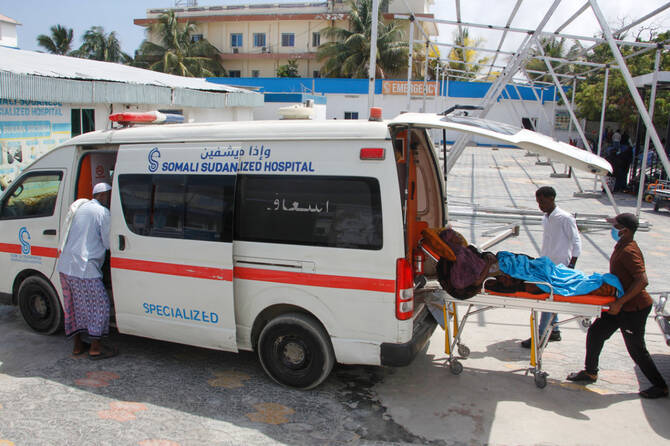
A patient is helped into an ambulance after an hours-long militant attack in Mogadishu, Somalia, on Oct. 5, 2025. (AP Photo/Farah Abdi Warsameh)
2 / 2
A patient receives treatment at a hospital after an hours-long militant attack in Mogadishu, Somalia, on Oct. 5, 2025. (AP Photo/Farah Abdi Warsameh)
Short Url
Updated 05 October 2025
Follow

Somali government forces end a 6-hour siege at a major prison, killing all 7 attackers

  • Saturday’s attack came just hours after the federal government lifted several long-standing roadblocks in Mogadishu
  • Al-Qaeda-linked Al-Shabab militant group that has in the past staged numerous attacks in Somalia

MOGADISHU: Somali government forces successfully ended a six-hour siege by militants at a major prison located near the president’s office in the capital, Mogadishu, killing all seven attackers, the government said Sunday.

The government said no civilian or security officers were killed in the Saturday attack, which was claimed by the Al-Qaeda-linked Al-Shabab militant group that has in the past staged numerous attacks in Somalia.

Saturday’s attack came just hours after the federal government lifted several long-standing roadblocks in Mogadishu. The barriers had been in place for years to safeguard critical government sites, but many residents argued that they obstructed traffic and commerce.

The attack on the Godka Jilicow detention facility holding some of the group’s militants lasted for hours and epitomises a worsening situation for Somalia, a poor and unstable country in the Horn of Africa.

“The security forces succeeded in ending the terrorist attack, shooting all seven gunmen who were involved,” the Somali interior ministry said in a statement.

Local residents said they could hear sporadic gunfire for more than three hours after the assault began.

The government has not indicated how many of its security forces were killed during the incident.

A private ambulance owner, Abdulkadir Adam, said his vehicles had transported almost 25 patients from the scene to various hospitals.

A private hospital director, Abdulkadir Yousuf Abdullahi, said his facility received an unspecified number of patients, provided emergency and life-saving care, and was working on identifying the patients and connecting them to their loved ones.

Somalia’s state media reported that the militants used a vehicle disguised to look like those of the intelligence unit’s security forces.

Mogadishu had been relatively calm in recent months as government forces, backed by local militias and African Union troops, pushed Al-Shabab fighters out of several areas in central and southern Somalia.

But the country has witnessed a resurgence in attacks from the Al-Qaeda affiliated group.

The group has seized control of dozens of towns and villages since the beginning of the year, undoing nearly all governmental progress made during a 2022-2023 military campaign.

Despite the tense situation, Somali President Hassan Sheikh Mohamud is pushing for the country to hold its first direct elections next year.

The head of state also visited the province of Jubaland on Sunday, where recent clashes, primarily over electoral disagreements, have occurred between the army and regional forces.


New ‘superfood’ transforms livelihoods in India’s rural east

A farmer harvests makhana, or lotus seeds, in Kapchhahi village in India’s eastern state of Bihar. (Mahesh Mukhia)
Updated 5 sec ago
Follow

New ‘superfood’ transforms livelihoods in India’s rural east

  • Known as fox nut or lotus seed, makhana is rich in protein, dietary fiber, minerals
  • Most of the world’s makhana production is in Bihar, one of India’s poorest states

BIHAR: Wading through knee-deep, stagnant water, Mahesh Mukhia plunges his hands into the mud, pulling up handfuls of sludge that he and others toss into a large, partially submerged basket.

After a while, they shake the basket to drain away the water and debris. What remains is makhana — round black seeds that have lately gained popularity as India’s new superfood.

A regional Indian snack, also known as fox nut or lotus seed, makhana is the edible seed of the prickly waterlily. The plant grows in freshwater ponds and wetlands in southern and eastern Asia.

After makhana seeds are handpicked from pond beds, cleaned, and sun-dried, they are roasted at high heat so their hard black shells crack open and release the white, popcorn-like puffed kernels, which are eaten as snacks or used in dishes.

It has long been known for its nutritional value — high in plant-based protein and dietary fiber, the seeds are also rich in minerals and gluten-free — which over the past few years have helped it gain global attention and are transforming farmlands in Bihar, one of India’s poorest states.

“Earlier, people were not researching it but now, after research, makhana’s nutritional values have been highlighted. Now this is a superfood. That’s why demand is growing everywhere,” said Mahesh Mukhia, a farmer in Kapchhahi village in Bihar’s Darbhanga district, whose family has been harvesting the seeds for generations.

“The difference is that my forefathers did farming in a traditional way, but we’ve learnt to do it in a scientific way,” Mukhia told Arab News.

“There is Bhola Paswan Shastri Agricultural College in the neighboring Purnea district. I went there for training. After I started practicing farming the way I learnt, the yield increased by more than 30 percent.”

Makhana farming is highly labor-intensive, starting with the cultivation of water lilies in shallow ponds. The plants require constant monitoring as they are sensitive to water levels and pests.

Harvesting takes place between August and October. Workers pluck the seeds by hand and then dry them under the sun for several days before they can be processed.

The processing and roasting of makhana also require significant effort. The dried seeds are first de-shelled by manually cracking them, followed by multiple rounds of roasting to make them crisp.

Whole families are involved in the production, which has been expanding since 2020, when the state government introduced the Makhana Development Scheme.

Besides training in farming and processing, growers who cultivate fox nut receive $820 per hectare.

“The rate has also gone up. The makhana that we used to sell at 200-300 ($2-$3) rupees per kg is now selling at 1,000 ($12) or 1,500 rupees per kg,” Mukhia said.

“Makhana farmers are now making a profit. Those who are growing makhana are earning well, those who are popping it are also doing well, and those involved in trading are making profits too. We are getting good demand from everywhere. I just received an order for 25 tonnes recently.”

Bihar currently produces over 85 percent of India’s makhana and accounts for most of the world’s production, according to Ministry of Commerce and Industry estimates.

According to reports by the Indian Brand Equity Foundation and the Agricultural and Processed Food Products Export Development Authority, India accounts for roughly 85 to 90 percent of the world’s production.

Farmland where the crop is grown has increased many times over the past decade and can now be compared to the area covering half of New York City.

More than 600,000 people are involved in the makhana industry in Bihar, according to Niraj Kumar Jha, Darbhanga district’s horticulture officer.

“Earlier, we were cultivating 5,000 hectares in the Kosi and Mithlanchal regions. But now it has expanded to 35,000 hectares, and with many supportive schemes, farmers are increasingly encouraged to grow makhana,” he said.

“We are strengthening our marketing channels. We’ll reach the metro cities as well as world markets ... We can see that makhana is growing very popular, not only in India.”