

Islamabad to crack down on smoke-emitting vehicles from Nov. 17

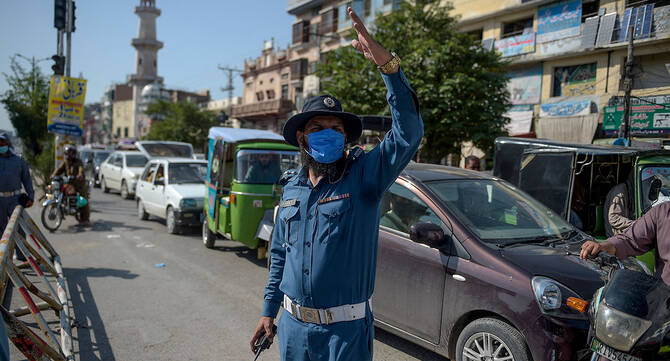
In this picture taken on July 22, 2020, a traffic policeman (C) wearing a facemask as a preventive measure against the COVID-19 coronavirus gestures to motorists along a road outside the Raja Bazar in Rawalpindi. (AFP/ file)
Short Url
Updated 05 October 2025
Follow

Islamabad to crack down on smoke-emitting vehicles from Nov. 17

  • Vehicular emissions remain top contributors to air pollution in Pakistan
  • Unfit vehicles will be fined or impounded during surprise emission checks

ISLAMABAD: Pakistan’s Environmental Protection Agency (EPA) will launch a crackdown on smoke-emitting vehicles in the federal capital of Islamabad from Nov. 17 to curb air pollution ahead of the smog season, state media reported on Sunday.

Smog is caused by crop burning, vehicular emissions and industrial pollution. It harms health, reduces visibility and degrades air quality. The smog season begins in late October, peaks from November to January and lasts through February.

In June, Pakistan began emission testing for vehicles entering Islamabad to curb air pollution by measuring exhaust pollutants such as carbon monoxide, hydrocarbons and nitrogen oxides for compliance with environmental standards.

Authorities will fine and impound vehicles during surprise inspections and on-the-spot emission tests during the crackdown across the federal capital, according to the Associated Press of Pakistan (APP).

“This campaign is not only about enforcement but also awareness,” Muhammad Saleem Shaikh, a climate change ministry spokesperson, was quoted as saying.

“Public education efforts are underway to encourage voluntary compliance and ensure cleaner air for Islamabad’s residents. Protecting ourselves, our families and our environment from the harmful effects of air pollution and smog is a collective responsibility.”

Pakistan’s urban centers routinely rank among the most polluted cities in the world, with vehicular emissions remaining one of the top contributors to urban air pollution, according to the report. This severe air pollution poses a serious threat to public health, undermines economic productivity and diminishes the quality of life for millions of residents.

Shaikh urged all vehicle drivers and owners to cooperate with EPA teams, get their vehicles tested before the crackdown begins next month, and obtain official clearance to avoid penalties.

“We urge citizens to avoid unnecessary use of vehicles, use public transport, ensure regular maintenance to minimize smoke emissions and refrain from burning waste or leaves in open spaces,” he said.


Pakistani forces kill 24 militants in restive province bordering Afghanistan

Updated 06 February 2026
Follow

Pakistani forces kill 24 militants in restive province bordering Afghanistan

  • The militants were killed in separate intelligence-based operations in Orakzai and Khyber districts of the Khyber Pakhtunkhwa province
  • Pakistan witnessed a 28 percent increase in militant attacks in Jan., with Khyber Pakhtunkhwa accounting for 38 out of 87 attacks nationwide

ISLAMABAD: Security forces have killed 24 Pakistani Taliban militants in two separate engagements in Pakistan’s northwestern Khyber Pakhtunkhwa (KP) province, the Pakistani military said on Friday.

In recent years, Pakistan has witnessed a surge in militant attacks, mainly by the Pakistani Taliban, or the Tehreek-e-Taliban Pakistan (TTP), targeting security forces and police in KP, which borders Afghanistan.

The militants were killed in intelligence-based operations in KP’s Orakzai and Khyber districts conducted on reports about their presence, according to the Inter-Services Public Relations (ISPR), the military’s media wing.

“Sanitization operations are being conducted to eliminate any other Indian-sponsored kharji [TTP militant] found in the area,” the ISPR said.

There was no immediate response by New Delhi to the Pakistani military’s statement.

Pakistan recorded a 28 percent increase in militant attacks in Jan. as compared to the previous month, with 87 incidents occurring across the country, the Islamabad-based Pakistan Institute for Conflict and Security Studies (PICSS) said in its report this month. Of these, 38 attacks took place in Khyber Pakhtunkhwa, 27 in Balochistan, where authorities have been battling a separatist insurgency, and two in the Punjab province.

Islamabad has frequently accused Afghanistan of allowing its soil and India of backing militant groups, including the TTP, for attacks against Pakistan. Kabul and New Delhi have consistently denied this.
