TOKYO: In a country that ranks poorly internationally for gender equality, the new president of Japan’s long-governing Liberal Democrats, and likely next prime minister, is an ultra-conservative star of a male-dominated party that critics call an obstacle to women’s advancement.
Sanae Takaichi, 64. admires former British Prime Minister Margaret Thatcher and is a proponent of former Prime Minister Shinzo Abe’s conservative vision for Japan.
Takaichi is the first female president of Japan’s predominantly male ruling party that has dominated Japan’s postwar politics almost without interruption.
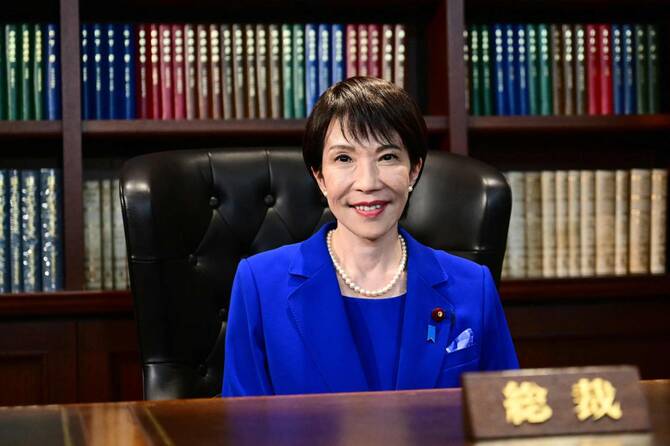
She hardly touched on gender issues during the campaign, but on Saturday, as she tried out the party president’s chair and posed for a photo as is customary for the newly elected leader, Takaichi said: ”Now that the LDP has its first female president, its scenery will change a little.”
First elected to parliament from her hometown of Nara in 1993, she has served in key party and government posts, including minister of economic security, internal affairs and gender equality.
Female lawmakers in the conservative Liberal Democratic Party who were given limited ministerial posts have often been shunned as soon as they spoke up about diversity and gender equality. Takaichi has stuck with old-fashioned views favored by male party heavyweights.
Takaichi also admits she is a workaholic who would rather study at home instead of socializing. After unsuccessfully running for party presidency twice in the past, she made efforts to be more sociable to build connections as advised, she said.
But on Saturday, as she called for an all-out effort to rebuild the party and regain public support, she asked all party lawmakers to “work like a horse.” Then she added, “I will abandon the word ‘work-life balance.’ I will work, work, work and work.”
The “work-life balance” quickly trended on social media, triggering mixed reactions — support for her enthusiasm and concern about her work ethic.
Women comprise only about 15 percent of Japan’s lower house, the more powerful of the two parliamentary chambers. Only two of Japan’s 47 prefectural governors are women.
A drummer in a heavy-metal band and a motorbike rider as a student, Takaichi has called for a stronger military, more fiscal spending for growth, promotion of nuclear fusion, cybersecurity and tougher policies on immigration.
She vowed to drastically increase female ministers in her government. But experts say she might actually set back women’s advancement because as leader she would have to show loyalty to influential male heavyweights. If not, she risks a short-lived leadership.
Takaichi has backed financial support for women’s health and fertility treatment as part of the LDP policy of having women serve in their traditional roles of being good mothers and wives. But she also recently acknowledged her struggles with menopausal symptoms and stressed the need to educate men about female health to help women at school and work.
Takaichi supports the imperial family’s male-only succession, opposes same-sex marriage and a revision to the 19th-century civil law that would allow separate surnames for married couples so that women don’t get pressured into abandoning theirs.
She is a wartime history revisionist and China hawk. She regularly visits Yasukuni Shrine, which Japan’s neighbors consider a symbol of militarism, though she has declined to say what she would do as prime minister.
Political watchers say her revisionist views of Japan’s wartime history may complicate ties with Beijing and Seoul.
Her hawkish stance is also a worry for the LDP’s longtime partnership with Komeito, a Buddhist-backed moderate party. While she has said the current coalition is crucial for her party, she says she is open to working with far-right groups.


![]()

Japan’s first female governing-party leader is an ultra-conservative star in a male-dominated group
Short Url
https://arab.news/64ebr
Japan’s first female governing-party leader is an ultra-conservative star in a male-dominated group
- Sanae Takaichi, 64. admires former British Prime Minister Margaret Thatcher
- She hardly touched on gender issues during the campaign


Latest updates


© 2026 SAUDI RESEARCH & PUBLISHING COMPANY, All Rights Reserved And subject to Terms of Use Agreement.