

Riyadh International Book Fair 2025 in full swing with Uzbekistan as guest of honor

1 / 4
The Riyadh International Book Fair 2025 began on Thursday at Princess Nourah bint Abdulrahman University. (AN Photo/Rahaf Jambi)
2 / 4
The Riyadh International Book Fair 2025 began on Thursday at Princess Nourah bint Abdulrahman University. (AN Photo/Rahaf Jambi)
3 / 4
The Riyadh International Book Fair 2025 began on Thursday at Princess Nourah bint Abdulrahman University. (AN Photo/Rahaf Jambi)
4 / 4
The Riyadh International Book Fair 2025 began on Thursday at Princess Nourah bint Abdulrahman University. (AN Photo/Rahaf Jambi)
Short Url
Updated 04 October 2025
Follow

Riyadh International Book Fair 2025 in full swing with Uzbekistan as guest of honor

  • The festival has significant representation from the Institute of Public Administration, showcasing its scientific and legal publications
  • Book fair is one of the longest-running events in Riyadh’s cultural calendar

RIYADH: The Riyadh International Book Fair 2025 began on Thursday at Princess Nourah bint Abdulrahman University.

More than 2,000 publishing houses from over 25 countries are taking part in the two-week-long event, which is organized by the Literature, Publishing and Translation Commission.

The fair serves as a platform for publishers, writers, and cultural institutions to connect with readers and industry professionals.

Abdullatif Al-Wasel, CEO of the commission, said the event “reflects the Kingdom’s strategy to strengthen its cultural leadership regionally and globally, while also contributing to community awareness and economic growth in line with Vision 2030.”

The Saudi Institute of Public Administration has a significant presence at the event, showcasing its range of scientific, legal, and management publications.

This year, Uzbekistan is the fair’s guest of honor. Al-Wasel highlighted the country’s “significant cultural role and strong ties with the Kingdom,” noting that the partnership underscores the event’s contribution to cultural exchange.

Uzbekistan’s pavilion showcases rare manuscripts, literary works, and a cultural program that includes performances and artistic displays. The collaboration also features joint activities with the Theater and Performing Arts Commission, including stage performances and artistic exchanges.

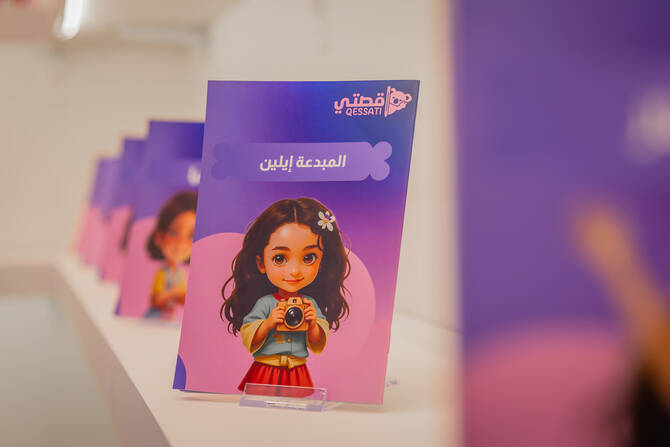
Beyond the international showcases, local creativity is also in the spotlight. One of the standout booths this year is Qessati (My Story), an initiative founded by Saudi entrepreneur Omar Tayeb in March 2024, which creates personalized books by inserting a child’s photograph, name, hobbies and interests into an illustrated story.

“We turn them into a cartoony character inside their very own story,” Tayeb told Arab News. “The idea started when I wrote a story for my daughter, and I saw how much it changed her behavior. That’s when I realized this could be a project for every child, not just my own.”

Qessati has already produced more than 1,000 books in Arabic and English and has expanded across the Gulf and North Africa.

“Our goal is to make learning and reading an enjoyable part of a child’s daily life,” Tayeb said. “By connecting the story with the child’s identity, values, and imagination, we create something that stays with them.”

The booth also features a children’s prayer book designed with illustrated characters to help young readers memorize daily supplications.

In addition to exhibition booths, the fair offers a wide-ranging cultural program, including seminars, lectures, poetry evenings and workshops. An expanded business zone is also part of this year’s edition, aimed at strengthening the publishing sector and facilitating partnerships across the industry.

The fair is open daily from 11 a.m. to midnight, with Friday opening hours starting at 2 p.m.


Saudi researchers develop AI system for camel herders

Updated 14 November 2025
Follow

Saudi researchers develop AI system for camel herders

  • AI-powered drone system can recognize and track camels from the air 
  • Prof. Basem Shihada and his team at KAUST developed the low-cost system

RIYADH: A research team at King Abdullah University of Science and Technology has created a low-cost, AI-powered drone system that can recognize and track camels from the air.

The system promises an affordable option for camel herders to continue one of Saudi Arabia’s oldest labors and for scientists to learn more about camel migration patterns and habits, according to a KAUST press release.

Created by Professor Basem Shihada and his labmates, the system uses inexpensive commercial drones and cameras to enable camel herders to track their camels in real time without relying on expensive GPS collars or satellite connections.

The team used a single drone-mounted camera to capture aerial footage of small camel herds in Saudi Arabia, then trained their AI model using machine learning. The model revealed new insights into the animals’ behaviors.

“We found their migration patterns were not random but showed identifiable patterns,” said KAUST scientist Chun Pong Lau, who was also involved in the project.

The release added that camels, especially elders, showed coordinated grazing migration, covering long distances throughout the day, but always returned to their herder by sunset. They also showed high sensitivity to the drone’s sound, which is why the KAUST scientists kept the drone at least 120 meters above the ground.

For centuries, camels have been central to Arabian life by providing transport, food and a cultural link to the desert. Today, they contribute more than SR2 billion ($534 million) annually to the Saudi economy through industries such as food, textiles and tourism.

However, herding remains a challenge, with camels roaming up to 50 km a day across isolated terrain. This mobility often leads to road accidents, overgrazing and loss of livestock.

As a next step, Shihada and his colleagues plan to collect video of larger camel herds of more heterogeneous sizes and colors to train their AI system for higher performance.