


TEL AVIV: Israel’s army said Saturday that it would advance preparations for the first phase of US President Donald Trump’s plan to end the war in Gaza and return all the remaining hostages, after Hamas said it accepted parts of the deal while others still needed to be negotiated.
The army said it was instructed by Israel’s leaders to “advance readiness” for the implementation of the plan. An official who was not authorized to speak to the media on the record said that Israel has moved to a defensive-only position in Gaza and will not actively strike. The official said no forces have been removed from the strip.
This announcement came hours after Trump ordered Israel to stop bombing Gaza once Hamas said it had accepted some elements of his plan. Trump welcomed the Hamas statement, saying: “I believe they are ready for a lasting PEACE.”
Trump appears keen to deliver on pledges to end the war and return dozens of hostages ahead of the second anniversary of the attack on Tuesday. His proposal unveiled earlier this week has widespread international support and was also endorsed by Israeli Prime Minister Benjamin Netanyahu.
On Friday, Netanyahu’s office said Israel was committed to ending the war, without addressing potential gaps with the militant group. Netanyahu has come under increasing pressure from the international community and Trump to end the conflict. The official told the AP that Netanyahu put out the rare late-night statement on the sabbath saying that Israel has started to prepare for Trump’s plan due to pressure from the US administration.
The official also said that a negotiating team was getting ready to travel, but there was no date specified.
A senior Egyptian official says talks are underway for the release of hostages, as well as hundreds of Palestinian prisoners in Israeli detention. The official, who is involved in the ceasefire negotiations, also said Arab mediators are preparing for a comprehensive dialogue among Palestinians. The talks are aimed at unifying the Palestinian position toward Gaza’s future.
On Saturday, the Palestinian Islamic Jihad, the second most powerful militant group in Gaza, said it accepted Hamas’ response to the Trump plan. The group had previously rejected the proposal days earlier.
Progress, but uncertainty ahead
Yet, despite the momentum, a lot of questions remain.
Under the plan, Hamas would release the remaining 48 hostages — around 20 of them believed to be alive — within three days. It would also give up power and disarm.
In return, Israel would halt its offensive and withdraw from much of the territory, release hundreds of Palestinian prisoners and allow an influx of humanitarian aid and eventual reconstruction.
Hamas said it was willing to release the hostages and hand over power to other Palestinians, but that other aspects of the plan require further consultations among Palestinians. Its official statement also didn’t address the issue of Hamas demilitarizing, a key part of the deal.
Amir Avivi, a retired Israeli general and chairman of Israel’s Defense and Security Forum, said while Israel can afford to stop firing for a few days in Gaza so the hostages can be released, it will resume its offensive if Hamas doesn’t lay down its arms.
Others say that while Hamas suggests a willingness to negotiate, its position fundamentally remains unchanged.
This “yes, but” rhetoric “simply repackages old demands in softer language,” said Oded Ailam, a researcher at the Jerusalem Center for Security and Foreign Affairs. The gap between appearance and action is as wide as ever and the rhetorical shift serves more as a smokescreen than a signal of true movement toward resolution, he said.
Unclear what it means for Palestinians suffering in Gaza
The next steps are also unclear for Palestinians in Gaza who are trying to piece together what it means in practical terms.
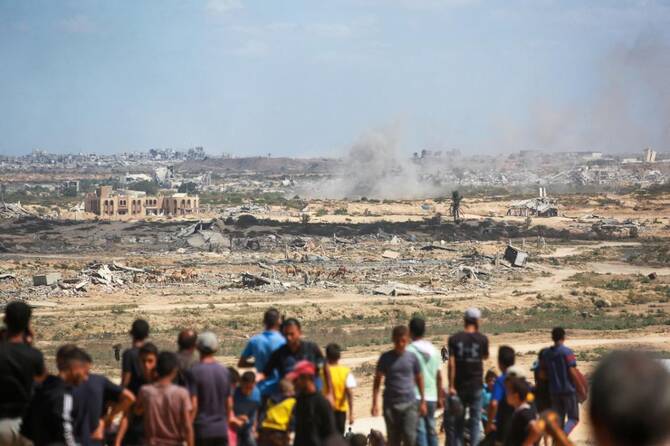
Israeli troops are still laying siege to Gaza City, which is the focus of its latest offensive. On Saturday Israel’s army warned Palestinians against trying to return to the city calling it a “dangerous combat zone.”
Experts determined that Gaza City had slid into famine shortly before Israel launched its major offensive there aimed at occupying it. An estimated 400,000 people have fled the city in recent weeks, but hundreds of thousands more have stayed behind.
Families of the hostages are also cautious about being hopeful.
There are concerns from all sides, said Yehuda Cohen, whose son Nimrod is held in Gaza. Hamas and Netanyahu could sabotage the deal or Trump could lose interest, he said. Still, he says, if it’s going to happen it will be because of Trump.“We’re putting our trust in Trump, because he’s the only one who’s doing it. ... And we want to see him with us until the last step,” he said.


