

Sindh vows action against parents refusing polio vaccination as cases rise across Pakistan

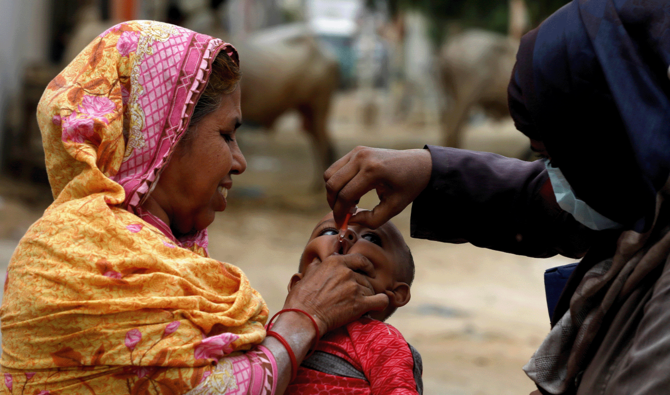
A boy receives polio vaccine drops during an anti-polio campaign in Karachi, Pakistan, on July 20, 2020. (Reuters/File)
Short Url
Updated 03 October 2025
Follow

Sindh vows action against parents refusing polio vaccination as cases rise across Pakistan

  • Authorities may block IDs, SIM cards and passports of parents turning away inoculation teams
  • Over 216,000 children in Sindh missed September vaccination, with 35,000 whose parents refused

KARACHI: The provincial administration of Sindh on Friday announced tough measures against parents refusing polio vaccination for their children, as the country grapples with a rising number of cases of the crippling disease.

Last month, the National Institute of Health confirmed two poliovirus cases in the province, raising the nationwide tally to 29 this year. Pakistan remains one of the two countries, alongside Afghanistan, where polio is still endemic.

Efforts to eradicate the virus have been undermined by parental refusals, misinformation and militant attacks on vaccination workers. In some areas, inoculation teams operate under police protection, but security personnel have also been targeted and killed.

“I have no other option but to penalize those who shirk their national responsibility of eradicating polio,” Shah Chief Minister Murad Ali Shah told officials at a meeting in Karachi, according to a statement circulated by his office. “This responsibility begins at home and affects the entire province and the country.”

The statement said Shah’s administration was considering blocking national identity cards, mobile SIM cards and passports of parents refusing vaccination to deny them travel and communication privileges.

The chief minister also ordered the establishment of a polio refusal cell, directing the health authorities to provide detailed data on refusing parents at the union council level so refusals can be countered through social, political and administrative channels.

He also instructed that vaccination be ensured in all such households.

Shah asked the provincial chief secretary to prepare a plan to block IDs, SIMs and passports, adding that the forthcoming Oct. 13 vaccination campaign should be run like a “war strategy” and warning that negligence would not be tolerated.

Some health and administrative officials have already been removed for poor performance, he said, and more could follow.

Polio is a highly infectious and incurable disease that can cause lifelong paralysis. The only protection is repeated doses of the Oral Polio Vaccine for every child under five, alongside routine immunizations.

Pakistan recorded 74 cases in 2024, up from six in 2023 and just one in 2021.

The official statement said Sindh had reported nine cases so far this year, with many of the infections, particularly in Karachi and Malir, linked to parental refusals.

Environmental samples from several Karachi neighborhoods have also tested positive for the virus.

During the September campaign, over 216,000 children in the province missed vaccination, including 35,000 whose parents refused.


Death toll in Pakistan shopping plaza fire rises to 67, officials say

Updated 22 January 2026
Follow

Death toll in Pakistan shopping plaza fire rises to 67, officials say

  • Rescue teams still searching for damaged Gul Plaza in Karachi where blaze erupted on Saturday, says police surgeon
  • Karachi has a long history of deadly fires, often linked to poor safety standards, weak regulatory enforcement

KARACHI: The death toll from a devastating fire at a shopping plaza in Pakistan’s southern port city of Karachi jumped to 67 on Thursday after police and a hospital official confirmed that the remains of dozens more people had been found.

Police surgeon Dr. Summaiya Syed said rescue teams were still searching the severely damaged Gul Plaza in the Karachi, where the blaze erupted on Saturday.

Most remains were discovered in fragments, making identification extremely difficult, but the deaths of 67 people have been confirmed, she said. Asad Raza, a senior police official in Karachi, also confirmed the death toll. Authorities previously had confirmed 34 deaths.

Family members of the missing have stayed near the destroyed plaza and hospital, even after providing their DNA for testing. Some have tried to enter the building forcibly, criticizing the rescue efforts as too slow.

“They are not conducting the search properly,” said Khair-un-Nisa, pointing toward the rescuers. She stood outside the building in tears, explaining that a relative who had left to go shopping has been missing since the blaze.

Another woman, Saadia Saeed, said her brother has been trapped inside the building since Saturday night, and she does not know what has happened to him.

“I am ready to go inside the plaza to look for him, but police are not allowing me,” she said.

There was no immediate comment from authorities about accusations they have been too slow.

Many relatives of the missing claim more lives could have been saved if the government had acted more swiftly. Authorities have deployed police around the plaza to prevent relatives from entering the unstable structure, while rescuers continue their careful search.

Investigators say the blaze erupted at a time when most shop owners were either closing for the day or had already left. Since then, the Sindh provincial government has said around 70 people were missing after the flames spread rapidly, fueled by goods such as cosmetics, clothing, and plastic items.

The cause of the fire remains under investigation, though police have indicated that a short circuit may have triggered the blaze.

Karachi has a long history of deadly fires, often linked to poor safety standards, weak regulatory enforcement, and illegal construction.

In November 2023, a shopping mall fire killed 10 people and injured 22. One of Pakistan’s deadliest industrial disasters occurred in 2012, when a garment factory fire killed at least 260 people.