Pakistan, Saudi Arabia discuss expanding cooperation in digital infrastructure and services

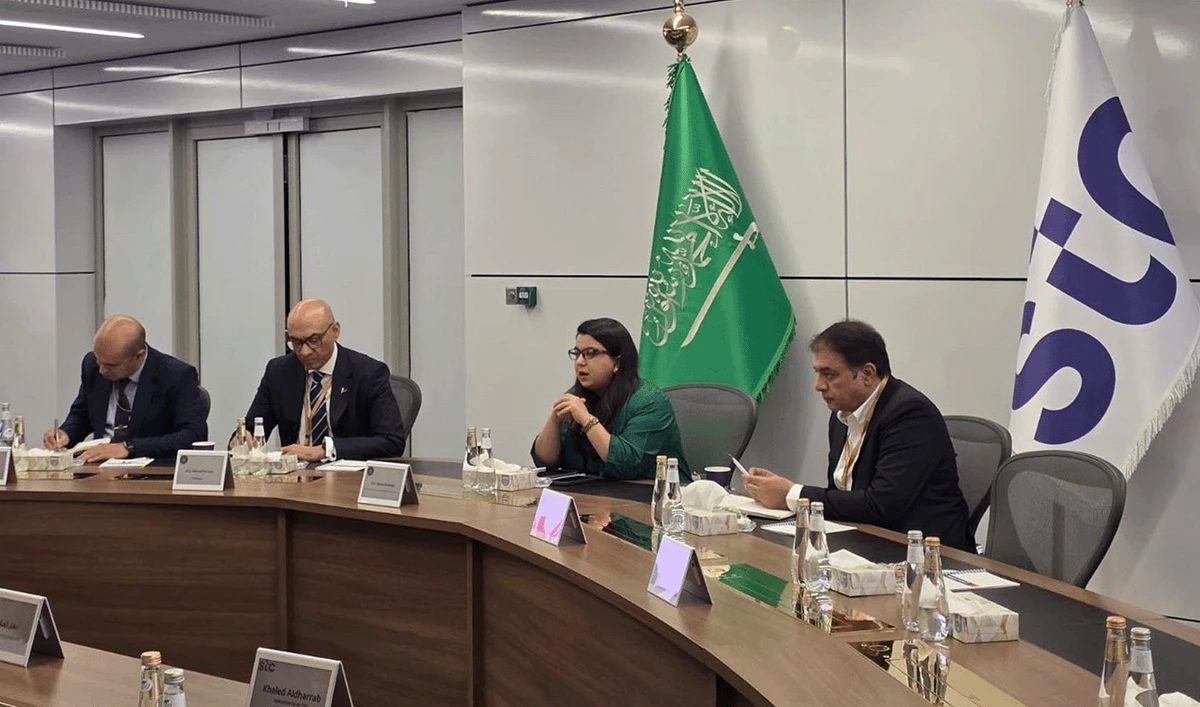
Pakistan's IT Minister Shaza Fatima (second-right) in conversation with Saudi Telecom Company in Riyadh, Saudi Arabia, on October 3, 2025. (PID)
Short Url
Updated 03 October 2025
Follow

Pakistan, Saudi Arabia discuss expanding cooperation in digital infrastructure and services

  • IT minister meets STC officials in Riyadh to explore investment in Pakistan’s $3.8 billion IT market
  • Bilateral ties have deepened after $2.8 billion MoUs, new defense pact to strengthen joint deterrence

KARACHI: Pakistan and Saudi Arabia on Friday discussed expanding cooperation in digital infrastructure and services during a meeting between Pakistan’s IT minister Shaza Fatima Khawaja and officials of the Saudi Telecom Company (STC) in Riyadh, as both nations push to diversify their decades-long partnership.

The two countries have long enjoyed close ties, but in recent years have sought to broaden and deepen their cooperation further. During Prime Minister Shehbaz Sharif’s visit to Riyadh in October 2024, they signed 34 memoranda of understanding worth $2.8 billion across multiple sectors.

Last month, they went a step further by signing a bilateral defense pact that treats aggression against one country as an attack on both, a move aimed at strengthening joint deterrence and cementing decades of military and security collaboration.

“Partnership with STC was discussed in the context of the Connect Pakistan 2030 policy,” the IT ministry said in a statement issued after the meeting, referring to a proposed five-year strategy to accelerate the country’s digital transformation.

“The talks focused on cooperation in fiber networks, cloud, cybersecurity and fintech,” it added. “Pakistan’s $3.8 billion IT export market and 200 million mobile users were described as attractive for investment.”

STC is the largest telecom operator in Saudi Arabia and the Gulf Cooperation Council (GCC) region, playing a central role in the Kingdom’s Vision 2030 digital agenda.

During the meeting, the two sides explored business and investment opportunities and discussed ways to strengthen Pakistan’s role as a regional transit hub, connecting the Gulf states with other countries.

They also examined potential partnerships in submarine cables and digital connectivity projects, underscoring Pakistan’s strategic importance in regional data corridors.

Beyond telecom, Pakistan and Saudi Arabia are also seeking to deepen agricultural cooperation, with Pakistan’s food security minister telling Arab News this week that Prime Minister Sharif is expected to visit the Kingdom later this month, when key announcements on enhanced bilateral ties are likely to be made.


Pakistan telecom regulator urges restraint on social media amid regional tensions

Updated 28 February 2026
Follow

Pakistan telecom regulator urges restraint on social media amid regional tensions

  • PTA warns against sharing unverified content, says legal action may follow ‘fake news’
  • Advisory comes as Pakistan strikes targets in Afghanistan and Iran faces US, Israeli attacks

ISLAMABAD: Pakistan’s telecom regulator on Saturday urged citizens to avoid sharing “unverified or inflammatory” content online, warning that legal action could be taken against those spreading misinformation amid what it described as a “sensitive national situation.”

The advisory from the Pakistan Telecommunication Authority (PTA) comes as Islamabad says it is targeting militant positions inside Afghanistan following a recent flareup between the two neighbors, while Iran is under attack by the United States and Israel in an escalating regional conflict that has heightened security concerns across South and West Asia.

“In view of the prevailing sensitive national situation, Pakistan Telecommunication Authority (PTA) urges all citizens to be responsible while using social media and digital platforms,” the regulator said in a statement posted on X.

The PTA advised citizens “not to share, disseminate, forward, or upload any unverified, inflammatory, or misleading information/content that may directly or indirectly harm the national interest, public order, or state institutions.”

It said people should instead rely on authentic information based on official sources and refrain from spreading rumors and “fake news.”

“Sharing any fake news/information is liable to legal action in accordance with applicable laws,” the authority said, calling on citizens to act with “caution, maturity, and a strong sense of national responsibility” to help maintain stability and public confidence.

Pakistan in recent years has witnessed increasingly stringent implementation of the Prevention of Electronic Crimes Act (PECA), a cybercrime law that has drawn criticism from rights groups, with journalists and activists arrested and prosecuted under its provisions.