NEAR RAMALLAH, West Bank: As US President Donald Trump announced a plan this week to end the Gaza war and suggested a possible path to a Palestinian state, Ashraf Samara in the Israeli-occupied West Bank watched bulldozers around his village help bury his hopes for statehood.
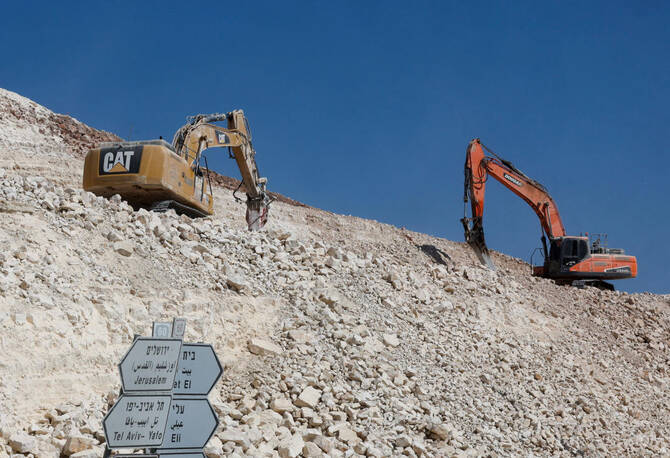
Surrounded by armed security guards, the Israeli machinery shoved aside earth to create new routes for Jewish settlements, carving up the land around Samara’s village of Beit Ur Al-Fauqa and creating new barriers to movement for Palestinians.
“This is to prevent the residents from reaching and using this land,” said Samara, a member of his village council.
He said the move would “trap the villages and the residential communities” by confining them exclusively to the areas they live in.
With each new road that makes movement for Jewish settlers easier, Palestinians in the West Bank who are usually barred from using the routes face fresh hurdles in reaching nearby towns, workplaces or agricultural land.
More nations recognize Palestinian state as settlements expand
While several major European countries, including Britain and France, in September joined an expanding list of nations recognizing a Palestinian state, Israeli settlements on the West Bank have been expanding at an increasingly rapid pace under Prime Minister Netanyahu’s government as the Gaza war has raged.
Palestinians and most nations regard settlements as illegal under international law. Israel disputes this.
Hagit Ofran, a member of the Israeli activist group Peace Now, said new roads being bulldozed around Beit Ur Al-Fauqa and beyond were a bid by Israel to control more Palestinian land.
“They are doing it in order to set facts on the ground. As much as they have the power, they will spend the money,” she said, adding that Israel had allocated seven billion shekels ($2.11 billion) to build roads in the West Bank since the October 2023 Hamas attacks that sparked Israel’s war in Gaza.
Israeli settlements, which have grown in size and number since Israel captured the West Bank in the 1967 war, stretch deep into the territory, backed by a system of roads and other infrastructure under Israeli control.
Israeli rights group B’Tselem, in a 2004 report, described this network of roads and bypasses to settlements built over several decades as “Israel’s Discriminatory Road Regime.” The group said some roads aimed to place a physical barrier to stifle Palestinian urban development.
Netanyahu’s office and the Israeli military did not immediately respond to requests for comment. The Yesha Council, a body that represents West Bank settlers, also did not immediately reply to a request for comment.
Before Trump’s Gaza plan was announced, Netanyahu declared: “There will never be a Palestinian state,” speaking as he approved a project last month to expand construction between the West Bank settlement of Maale Adumim and Jerusalem.
His finance minister, Bezalel Smotrich, said of the same project that it would “bury” the idea of a Palestinian state.
Trump’s Gaza plan to end the war, which Netanyahu approved, outlines a potential pathway to Palestinian statehood, but the conditions it lays down to achieve that mean such an outcome is far from guaranteed, analysts say.
“What the government is now doing is setting the infrastructure for the million settlers that they want to attract to the West Bank,” Ofran said. “Without roads, they cannot do it. If you have a road, eventually, almost naturally, the settlers will come.”


Israeli bulldozers in West Bank carve up hopes for Palestinian state
https://arab.news/85k2m
Israeli bulldozers in West Bank carve up hopes for Palestinian state

- Israel builds bypass roads, isolating Palestinian villages
- New roads seen as land grab, expanding occupation


Bahrain arrests four for spying for Iran’s IRGC as Gulf attacks intensify
- Investigators said the suspects were found to have sent pictures and coordinates of vital locations in Bahrain to the IRGC via encrypted software
MANAMA: Bahrain has detained four citizens suspected of spying for Iran’s Islamic Revolutionary Guard Corps (IRGC), as Tehran’s retaliatory strikes on Gulf states show no signs of letting up.
Bahrain’s General Directorate of Criminal Investigation and Forensic Science identified the four detainees as Murtadha Hussain Awal, 25; Ahmed Isa Al Haiki, 34; Sarah Abdulnabi Marhoon, 36; and Elias Salman Mirza, 22. A fifth suspect, Ali Mohammed Hassan Al Shaikh, 25, remains at large abroad.
Investigators said Murtadha Hussain and his cohorts, acting on IRGC instructions, used high-resolution equipment to photograph and record coordinates of vital locations in Bahrain, transmitting the data to the IRGC via encrypted software.
The arrests come as Iran escalates attacks across the Gulf. Bahrain’s Interior Ministry issued an advisory urging residents in Hidd, Arad, Qalali and Samaheej to stay indoors and seal windows against smoke from fires sparked by Iranian strikes. Fuel tanks at a facility in Muharraq Governorate, northeast of Manama, were among the targets. Oman’s Port of Salalah also battled blazes at fuel storage tanks following separate Iranian drone strikes.
Elsewhere in the region, two Iranian drones struck near Dubai International Airport, wounding four people, though flights continued uninterrupted. A fire broke out at a luxury apartment tower in Dubai Creek Harbour after another drone hit — extinguished by Thursday morning.
Iran also targeted commercial ships and struck what officials described as the world’s busiest international airport on Wednesday, as US and Israeli strikes continued to pound Tehran.
A war now 12 days old — and costly
The conflict began on February 28, when US and Israeli forces launched coordinated strikes on Iran. Tehran has since retaliated by targeting Gulf states, US and Israeli assets, and critical energy infrastructure.
Iran has declared a blockade on energy shipments through the Strait of Hormuz, a vital chokepoint for global oil and gas flows, sending commodity prices surging and rattling international markets.
The Pentagon told Congress this week that the first week of war cost the United States $11.3 billion — including $5 billion in munitions in the conflict’s opening weekend alone.
The UN Security Council on Wednesday voted to approve a resolution demanding a halt to Iran’s attacks on its Gulf neighbors. Bahrain’s UN Ambassador Jamal Alrowaiei welcomed the move.
“The international community is resolute in rejecting these Iranian attacks against sovereign countries that are threatening the stability of the peoples, especially in a region of strategic importance to global economy, energy security and global trade,” he said.
Despite the resolution, there were no immediate signs the conflict was easing.
(With AP)