

Six protesters, three policemen killed in Azad Kashmir unrest as government calls for dialogue

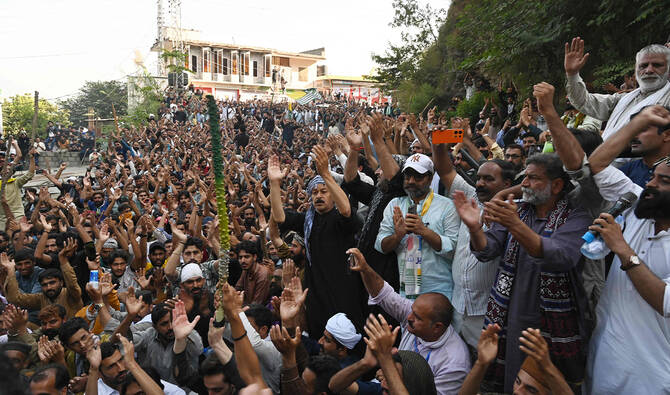
Awami Action Committee (AAC) activists shout slogans during a demonstration in Muzaffarabad, capital of Pakistan-administered Kashmir, on October 1, 2025. (AFP)
Short Url
Updated 03 October 2025
Follow

Six protesters, three policemen killed in Azad Kashmir unrest as government calls for dialogue

  • The Azad Jammu and Kashmir government’s call to resume dialogue follows shutter-down strikes, wheel-jam protests and clashes across the disputed northern region
  • The protesters demand an end to special allowances for government officials, electricity and wheat at discounted rates, similar to subsidies in other parts of Pakistan

ISLAMABAD: At least six protesters and three policemen have been killed in days of protests in Azad Kashmir, the region’s Press Information Department (PID) said on Wednesday, with the government urging the demonstrators to return to dialogue with authorities.

The statement came hours after Azad Jammu and Kashmir (AJK) Prime Minister Chaudhry Anwar ul Haq appealed for an end to protests organized by the Jammu Kashmir Joint Awami Action Committee (JKJAAC) in the disputed northern region since Sept. 29, saying the government is ready to talk to the protesters.

The call to resume dialogue followed shutter-down strikes, wheel-jam protests and clashes across Azad Kashmir. The JKJAAC civil rights alliance is demanding an end to special allowances for government officials and the supply of electricity and wheat at discounted rates, similar to subsidies in other parts of Pakistan.

The protests have turned violent over the course of the last three days as protesters and police came face to face and clashed at various locations. JKJAAC leaders accuse the government of reneging on promises and say at least 12 people have been killed, claims denied by regional authorities.

“As a result of the violent protests of the Joint Awami Action Committee in Azad Kashmir, six civilians and three police personnel have been killed so far,” the AJK PID said in a statement. “About 172 police personnel have been injured, of which 12 police personnel are seriously wounded. Fifty civilians have also been injured in the violent protests.”

The statement appealed to the public to remain peaceful, not to listen to “fake news on social media under a specific agenda” and to share only authentic and verified news.

Kashmir is divided between India and Pakistan, but both claim it in its entirety. Azad Kashmir is the part administered by Pakistan.

“For resolving any conflict, the best and most well-known way in the world, which has been used continuously and will continue to be used, is through dialogue,” AJK PM Haq said at a press conference on Wednesday.

“The government is ready to talk to you [JKJAAC], your legitimate demands will be resolved as soon as possible. The path of violence will only go toward the loss of human lives.”

The JKJAAC rejected the government’s claims and its member, Syed Hafeez Hamdani, said in a written statement that 12 of its supporters had been killed in the protests and more than 200 injured.

“All have suffered gunshot wounds,” the statement read. “The claim that our demands have been accepted is contrary to the facts… If our demands had been accepted, we would have had no reason to keep protesting.”

Meanwhile, Pakistan PM Shehbaz Sharif expressed concern over the situation in Azad Kashmir and decided to expand the negotiation committee for a peaceful resolution of the issue at the government level, according to his office.

The committee includes Senator Rana Sanaullah, federal ministers Sardar Yousaf and Ahsan Iqbal, former AJK president Masood Khan and Qamar Zaman Kaira.

“The Prime Minister directed that the law enforcement agencies should exercise restraint and tolerance with the protesters,” Sharif’s office said. “The Prime Minister said that public sentiments should be respected and any unnecessary harshness should be avoided.”

He said his government was always ready to resolve the problems of its Kashmiri brothers.

“The Prime Minister, expressing deep concern over the unpleasant incidents that took place during the protests, has ordered a transparent investigation into the incident,” it added.

In May 2024, a similar wave of protests paralyzed the region. After six days of strikes and violent clashes that left at least four dead, PM Sharif approved a grant of Rs 23 billion ($86 million) for subsidies on flour and electricity, and a judicial commission to review elite privileges.

Protest leaders suspended their campaign at that time but warned that failure to implement the package would fuel fresh unrest.


Pakistan opposition to continue protest over ex-PM Khan’s health amid conflicting reports

Updated 16 February 2026
Follow

Pakistan opposition to continue protest over ex-PM Khan’s health amid conflicting reports

  • Pakistan’s government insists that the ex-premier’s eye condition has improved
  • Khan’s personal doctor says briefed on his condition but cannot confirm veracity

ISLAMABAD: Pakistan’s opposition alliance on Monday vowed to continue their protest sit-in at parliament and demanded “clarity” over the health of jailed former prime minister Imran Khan, following conflicting medical reports about his eye condition.

The 73-year-old former cricket star-turned-politician has been held at the high-security Adiala prison in Rawalpindi since 2023. Concerns arose about his health last week when a court-appointed lawyer, Barrister Salman Safdar, was asked to visit Khan at the jail to assess his living conditions. Safdar reported that Khan had suffered “severe vision loss” in his right eye due to central retinal vein occlusion (CRVO), leaving him with just 15 percent sight in the affected eye.

On Sunday, a team of doctors from various hospitals visited the prison to examine Khan’s eye condition, according to the Adiala jail superintendent, who later submitted his report in the court. On Monday, a Supreme Court bench led by Chief Justice Yahya Afridi observed that based on reports from the prison authorities and the amicus curiae, Khan’s “living conditions in jail do not presently exhibit any perverse aspects.” It noted that Khan had “generally expressed satisfaction with the prevailing conditions of his confinement” and had not sought facilities beyond the existing level of care.

Having carefully perused both reports in detail, the bench observed that their general contents and the overall picture emerging therefrom are largely consistent. The opposition alliance, which continued to stage its sit-in for a fourth consecutive day on Monday, held a meeting at the parliament building on Monday evening to deliberate on the emerging situation and discuss their future course of action.

“The sit-in will continue till there is clarity on the matter of [Khan's] health,”  Sher Ali Arbab, a lawmaker from Khan's Pakistan Tehreek-e-Insaf (PTI) party who has been participating in the sit-in, told Arab News, adding that PTI Chairman Gohar Ali Khan and Opposition Leader in Senate Raja Nasir Abbas had briefed them about their meeting with doctors who had visited Khan on Sunday.

Speaking to reporters outside parliament, Gohar said the doctors had informed them that Khan’s condition had improved.

“They said, 'There has been a significant and satisfactory improvement.' With that satisfactory improvement, we also felt satisfied,” he said, noting that the macular thickness in Khan’s eye had reportedly dropped from 550 to 300 microns, a sign of subsiding swelling.

Gohar said the party did not want to politicize Khan’s health.

“We are not doctors, nor is this our field,” he said, noting that Khan’s personal physician in Lahore, Dr. Aasim Yusuf, and his eye specialist Dr. Khurram Mirza had also sought input from the Islamabad-based medical team.

“Our doctors also expressed satisfaction over the report.”

CONFLICTING ACCOUNTS

Despite Gohar’s cautious optimism, Khan’s personal physician, Dr. Yusuf, issued a video message on Monday, saying he could neither “confirm nor deny the veracity” of the government’s claims.

“Because I have not seen him myself and have not been able to participate in his care... I’m unable to confirm what we have been told,” Yusuf said.

He appealed to authorities to grant him or fellow physician, Dr. Faisal Sultan, immediate access to Khan, arguing that the ex-premier should be moved to Shifa International Hospital in Islamabad for specialist care.

Speaking to Arab News, PTI’s central information secretary Sheikh Waqas Akram said Khan’s sister and their cousin, Dr. Nausherwan Burki, will speak to media on Tuesday to express their views about the situation.

The government insists that Khan’s condition has improved.

“His eye [condition] has improved and is better than before,” State Minister Talal Chaudhry told the media in a brief interaction on Monday.

“The Supreme Court of Pakistan is involved, and doctors are involved. What medicine he receives, whether he needs to be hospitalized or sent home, these decisions are made by doctors. Neither lawyers nor any political party will decide this.”