Militant violence in Pakistan jumps 46% in third quarter of 2025 — report

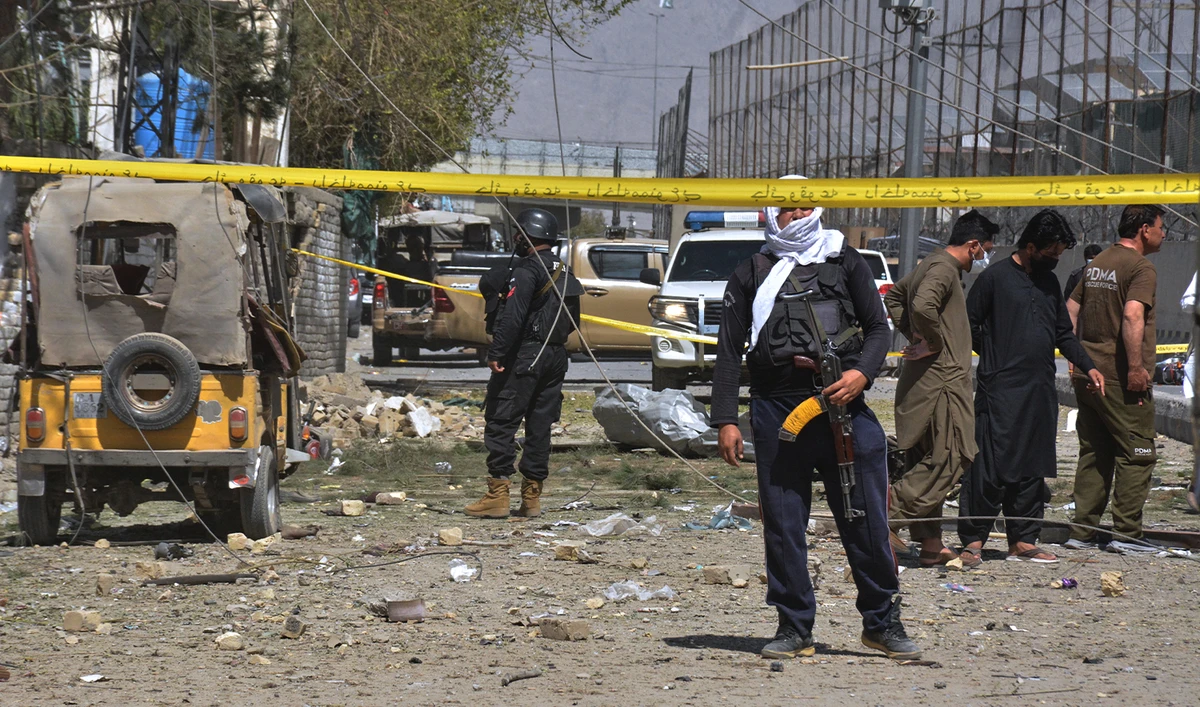
Security officials examine damaged vehicles at the site of a powerful car bombing, in Quetta, Pakistan, on September 30, 2025. (AP)
Short Url
Updated 01 October 2025
Follow

Militant violence in Pakistan jumps 46% in third quarter of 2025 — report

  • About 900 deaths were recorded from July to September, mostly in KP and Balochistan
  • CRSS says civilians were targeted most during the period, facing 123 militant attacks

KARACHI: Pakistan witnessed a 46 percent surge in militant violence during the third quarter of 2025, resulting in 901 deaths, an Islamabad-based think tank said on Tuesday, adding that most fatalities were reported in the country’s Khyber Pakhtunkhwa (KP) and Balochistan provinces bordering Afghanistan.

The Pakistani Taliban, known as Tehreek-e-Taliban Pakistan (TTP), regularly target security forces and their installations in KP, while separatists like the Baloch Liberation Army (BLA) demand independence for Balochistan, accusing the central government of exploiting the province’s natural resources, a charge Islamabad denies.

The Center for Research and Security Studies (CRSS) said in its latest security report the number of casualties during the third quarter jumped to 901 from 616 in the second quarter.

“With at least 901 fatalities and 599 injuries — among civilians, security personnel and outlaws — resulting from 329 incidents of violence, including terror attacks and counter-terror operations, Pakistan witnessed an over 46 percent surge in overall violence in its security landscape for the third quarter of 2025,” the report said.

It noted this year had already proven as deadly as the whole of 2024, with 2,414 recorded deaths so far, making 2025 the deadliest year in a decade if the current trend continues.

It highlighted that Pakistan intensified its response to militants in the third quarter of 2025, with security forces inflicting heavier losses on them.

“Accounting for over 96 percent of the country’s violence in this quarter, KP and Balochistan stood out as the most volatile provinces,” the report said.

“KP was the worst-hit region, suffering nearly 71 percent of the total violence-linked fatalities and over 67 percent of the incidents of violence, followed by Balochistan, with over 25 percent fatalities and incidents.”

The report said 516 militants were killed in the third quarter of 2025, compared with 385 security personnel and civilians killed altogether.

Civilians were the most targeted this quarter in almost 123 militant attacks while security forces were targeted 106 times, it added.

The think tank warned that escalating violence could further strain Pakistan’s fragile security environment unless Islamabad strengthened counterterrorism measures.

CRSS shared its findings on a day when a powerful suicide blast targeting the Frontier Corps headquarters in Balochistan’s capital Quetta killed at least 10 people and triggered a shootout in which four militants were killed.
Pakistan reports current account surplus in Jan. owing to improved trade, remittances

Updated 17 February 2026
Follow

Pakistan reports current account surplus in Jan. owing to improved trade, remittances

  • Pakistan’s exports crossed the $3 billion mark in Jan. as the country received $3.5 billion in remittances
  • Last month, IMF urged Pakistan to accelerate pace of structural reforms to strengthen economic growth

ISLAMABAD: Pakistan recorded a current account surplus of more than $120 million in January, the country’s finance adviser said on Tuesday, attributing it to improved trade balance and remittance inflows.

Pakistan’s exports rebounded in January 2026 after five months of weak performance, rising 3.73 percent year on year and surging 34.96 percent month on month, according to data released by the country’s statistics bureau.

Exports crossed the $3 billion mark for the first time in January to reach $3.061 billion, compared to $2.27 billion in Dec. 2025. The country received $3.5 billion in foreign remittances in Jan. 2026.

Khurram Schehzad, an adviser to the finance minister, said Pakistan reported a current account surplus of $121 million in Jan., compared to a current account deficit of $393 million in the same month last year.

“Improved trade balance in January 2026, strong remittance inflows, and sustained momentum in services exports (IT/Tech) continue to reinforce the country’s external account position,” he said on X.

Pakistan has undergone a difficult period of stabilization, marked by inflation, currency depreciation and financing gaps, and international rating agencies have acknowledged improvements after Islamabad began implementing reforms such as privatizing loss-making, state-owned enterprises (SOEs) and ending subsidies as part of a $7 billion International Monetary Fund (IMF) loan program.

Late last month, the IMF urged Pakistan to accelerate the pace of these structural reforms to strengthen economic growth.

Responding to questions from Arab News at a virtual media roundtable on emerging markets’ resilience, IMF’s director of the Middle East and Central Asia Jihad Azour said Islamabad’s implementation of the IMF requirements had been “strong” despite devastating floods that killed more than 1,000 people and devastated farmland, forcing the government to revise its 4.2 percent growth target to 3.9 percent.

“What is important going forward in order to strengthen growth and to maintain the level of macroeconomic stability is to accelerate the structural reforms,” he said at the meeting.

Azour underlined Pakistan’s plans to privatize some of the SOEs and improve financial management of important public entities, particularly power companies, as an important way for the country to boost its capacity to cater to the economy for additional exports.

“This comes in addition to the effort that the authorities have made in order to reform their tariffs, which will allow the private sector of Pakistan to become more competitive,” the IMF official said.