

Jeddah Historic District partners with Google to launch AI-powered cultural tours

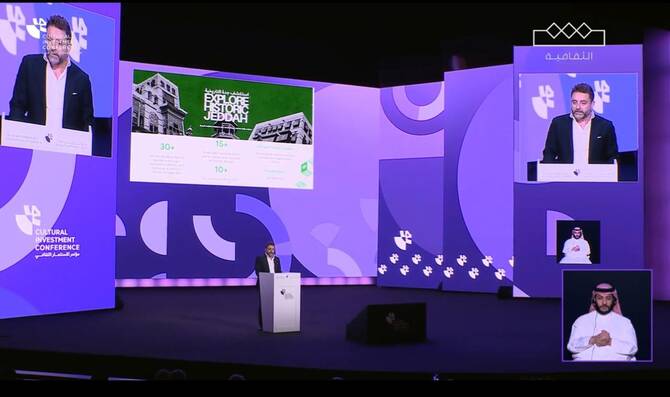
The partnership was announced during the Cultural Investment Conference in Riyadh. Screenshot
Short Url
Updated 30 September 2025
Follow

Jeddah Historic District partners with Google to launch AI-powered cultural tours

RIYADH: Jeddah Historic District has partnered with Google Arts & Culture to launch Saudi Arabia’s first AI-powered digital tours, offering immersive virtual experiences of the city’s cultural heritage. 

Announced during the Cultural Investment Conference in Riyadh, the initiative aims to digitally map and showcase Jeddah’s historical landmarks using artificial intelligence, providing virtual experiences accessible to audiences worldwide. 

The project supports the Kingdom’s Vision 2030 goals to use advanced technologies in cultural preservation and tourism, while highlighting Google’s role in Saudi Arabia’s digital transformation. 

Charbel Sarkis, country director at Google Saudi Arabia, said: “Google Arts & Culture provides the digital infrastructure and the distribution network, in addition to the technological innovation that the cultural sector needs to remain vibrant and relevant as we move forward.”   

He added: “Google has been a proud partner of Saudi Arabia’s bold digital transformation. All our efforts and investments have been geared towards empowering individuals, businesses and communities.”  

As part of the collaboration, the Explore Historic Jeddah platform will offer an immersive digital experience that brings the city's cultural legacy to life. 

The initiative will feature more than 30 stories detailing Jeddah’s historical significance, restoration projects, and its designation as a UNESCO World Heritage site. 

Users can explore over 15 Street View captures of key landmarks — including traditional houses, mosques, and pathways — and access more than 10 AI-powered walking tours. 

The platform will also include a Virtual Pocket Gallery showcasing archival photos and regeneration efforts, along with interactive features such as “Puzzle Party” to engage broader audiences. 

Through the Google Arts & Culture platform — a nonprofit initiative partnering with over 3,000 cultural institutions globally — the collaboration will provide free digital infrastructure and advanced digitization tools to preserve and showcase Jeddah’s cultural assets. 

“Being part of this incredible transformation of Saudi Arabia under Vision 2030 is just so inspiring,” Sarkis said.  

He emphasized that Google’s support for Saudi Arabia’s economic and digital ecosystem spans more than a decade, including local initiatives like the 2011 Google Forum in Saudi Arabia and the launch of the Google Cloud region in Dammam in 2023.   

“Since 2018, Google has trained more than 590,000 individuals on digital skills,” Sarkis added, highlighting the company’s ongoing investment in human capital development and local partnerships.   

He also pointed to the broader economic impact of Google’s operations in the Kingdom. “Last year, a report by Public First assessed Google’s economic contribution to the Kingdom north of SR30 billion,” Sarkis said. “The power of marrying technology and local partnership is just magical.” 


Saudi Arabia, WEF launch initiative to reshape global travel landscape

Updated 11 November 2025
Follow

Saudi Arabia, WEF launch initiative to reshape global travel landscape

  • ‘Beyond Tourism’ is global framework advancing sustainability, inclusivity, and resilience in the sector

RIYADH: Saudi Arabia has partnered with the World Economic Forum to launch the “Beyond Tourism” initiative, a global framework designed to drive a more sustainable, inclusive, and resilient future for the travel and tourism sector.

Announcing the initiative on his X account, Saudi Minister of Tourism Ahmed Al-Khateeb said he was “thrilled to announce the launch,” noting that it is “dedicated to shaping the future of travel and tourism and is built around 10 core principles.”

Al-Khateeb emphasized that Beyond Tourism underscores the sector’s vital role as “a bridge between cultures, a means to empower communities, and a source of opportunities for future generations.”

The initiative comes as the global travel and tourism industry undergoes a major structural shift — moving away from fragmented, business-as-usual models toward integrated, ecosystem-based strategies.

According to the World Economic Forum, the sector is projected to reach 30 billion tourist visits and contribute $16 trillion to global gross domestic product by 2034. Yet, it continues to face complex challenges including rising tension between visitors and residents, environmental pressures, workforce shortages, and exposure to geopolitical and climate disruptions.

“The global travel and tourism sector is entering a period of profound transformation, moving decisively from a fragmented, business-as-usual operating model to a holistic, ecosystem-based paradigm,” the WEF said in a statement.

The forum noted that past reliance on siloed policies — a weakness underscored during the COVID-19 pandemic — has proven insufficient to address today’s global challenges.

Its proposed ecosystem approach focuses on five key enablers: infrastructure, finance, technology and innovation, people and skills, and policy and governance. The model aims to convert systemic challenges into opportunities for inclusive and sustainable growth.

Several destinations have already demonstrated the benefits of this approach. Countries such as Portugal, New Zealand, Costa Rica, Singapore, and Indonesia have leveraged it to improve conservation outcomes, diversify economies, and strengthen sustainable tourism development.

By promoting global cooperation among governments, private-sector leaders, and local communities, the Beyond Tourism initiative seeks to unlock the full potential of the industry while safeguarding cultural and natural heritage for generations to come.