

Pakistani stocks breach 165,000 mark on optimism over IMF tranche, Saudi inflows

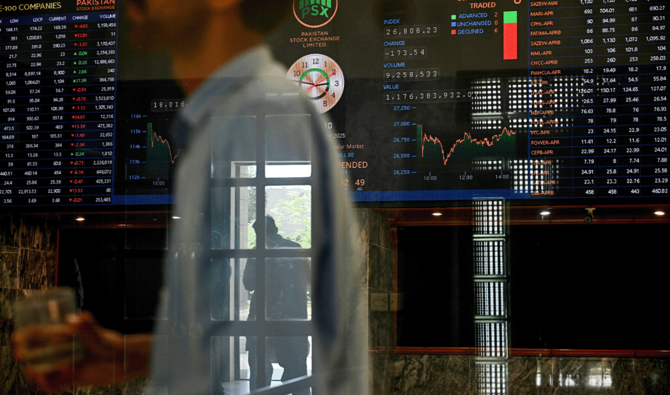
A stockbroker walks past share prices on a financial market board during a trading session at the Pakistan Stock Exchange (PSX) in Karachi on April 9, 2025. (AFP/File)
Short Url
Updated 30 September 2025
Follow

Pakistani stocks breach 165,000 mark on optimism over IMF tranche, Saudi inflows

  • The KSE-100 Index rose by one percent, or 1,645.90 points, to close at 165,493.58
  • IMF mission is in Islamabad to hold second review of i$7 billion Extended Fund Facility

ISLAMABAD: The Pakistan Stock Exchange (PSX) surged past the 165,000 mark for the first time ever, with analysts attributing the record high to expectations of the next International Monetary Fund (IMF) tranche and investment from Saudi Arabia.

The benchmark KSE-100 index rose by one percent or 1,645.90 points to close at 165,493.58 points as compared to the previous close of 163,847.68 points, according to the PSX website.

“Stocks reached a new all-time high at the quarter end close as investor weigh upbeat US-Pakistan relations and expected release of IMF EFF tranche,” Ahsan Mehanti, Chief Executive Officer of Arif Habib Commodities, told Arab News.

The IMF mission is currently in Islamabad to hold the second review of its $7 billion External Fund Facility (EFF) and the first review of the $1.4 billion Resilience and Sustainability Facility (RSF) loan programs for the country.

Mehanti said the resolution of the Rs1.2 trillion circular debt issue and stability in the rupee also played a part in the bullish trend.

He added that expectations of Saudi foreign direct investment after the Pakistan-Saudi defense pact also contributed to the bullish momentum.

Pakistan and Saudi Arabia last week strengthened joint deterrence and decades of military cooperation by signing a “Strategic Mutual Defense Agreement,” pledging that an attack on one would be considered an attack on both.

Sana Tawfiq, Head of Research at Arif Habib Limited, said media reports indicated that the IMF was now looking at a major flood impact on the economy.

“Plus, once the IMF review is successful, foreign reserves will be built following the IMF disbursement,” she said.

“Our expectation is that the inflation will be low and remain in single digits below six percent,” she continued. “It is expected at 5.5-6 percent despite food inflation month-on-month uptick due to flood factor.”

Pakistan, in its economic outlook released earlier today, warned that recent floods may drive food prices up in the coming weeks, though inflation is projected to remain under 4.5 percent this month.


Pakistan terms climate change, demographic pressures as ‘pressing existential risks’

Updated 4 sec ago
Follow

Pakistan terms climate change, demographic pressures as ‘pressing existential risks’

  • Pakistan has suffered frequent climate change-induced disasters, including floods this year that killed over 1,000
  • Pakistan finmin highlights stabilization measures at Doha Forum, discusses economic cooperation with Qatar 

ISLAMABAD: Pakistan’s Finance Minister Muhammad Aurangzeb on Saturday described climate change and demographic pressures as “pressing existential risks” facing the country, calling for urgent climate financing. 

The finance minister was speaking as a member of a high-level panel at the 23rd edition of the Doha Forum, which is being held from Dec. 6–7 in the Qatari capital. Aurangzeb was invited as a speaker on the discussion titled: ‘Global Trade Tensions: Economic Impact and Policy Responses in MENA.’

“He reaffirmed that while Pakistan remained vigilant in the face of geopolitical uncertainty, the more pressing existential risks were climate change and demographic pressures,” the Finance Division said. 

Pakistan has suffered repeated climate disasters in recent years, most notably the 2022 super-floods that submerged one-third of the country, displaced millions and caused an estimated $30 billion in losses. 

This year’s floods killed over 1,000 people and caused at least $2.9 billion in damages to agriculture and infrastructure. Scientists say Pakistan remains among the world’s most climate-vulnerable nations despite contributing less than 1 percent of global greenhouse-gas emissions.

Aurangzeb has previously said climate change and Pakistan’s fast-rising population are the only two factors that can hinder the South Asian country’s efforts to become a $3 trillion economy in the future. 

The finance minister noted that this year’s floods in Pakistan had shaved at least 0.5 percent off GDP growth, calling for urgent climate financing and investment in resilient infrastructure. 

When asked about Pakistan’s fiscal resilience and capability to absorb external shocks, Aurangzeb said Islamabad had rebuilt fiscal buffers. He pointed out that both the primary fiscal balance and current account had returned to surplus, supported significantly by strong remittance inflows of $18–20 billion annually from the Middle East and North Africa (MENA) and Gulf Cooperation Council (GCC) regions. 

Separately, Aurangzeb met his Qatari counterpart Ali Bin Ahmed Al Kuwari to discuss bilateral cooperation. 

“Both sides reaffirmed their commitment to strengthening economic ties, particularly by maximizing opportunities created through the newly concluded GCC–Pakistan Free Trade Agreement, expanding trade flows, and deepening energy cooperation, including long-term LNG collaboration,” the finance ministry said. 

The two also discussed collaboration on digital infrastructure, skills development and regulatory reform. They agreed to establish structured mechanisms to continue joint work in trade diversification, technology, climate resilience, and investment facilitation, the finance ministry said.