

Pakistan test-fires Fatah-4 missile, boosting conventional strike capability

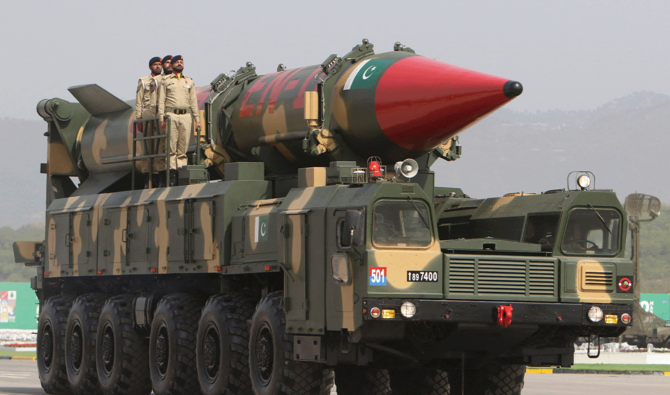
A Pakistan's military vehicle carries a long-range ballistic missile Shaheen during the Pakistan Day parade in Islamabad on March 23, 2022. (AFP/File)
Short Url
Updated 30 September 2025
Follow

Pakistan test-fires Fatah-4 missile, boosting conventional strike capability

  • Army says terrain-hugging missile can evade defenses, strike targets with high precision
  • Indigenously built missile now part of Pakistan Army’s Rocket Force Command

ISLAMABAD: Pakistan’s army said on Tuesday it had successfully test-fired the Fatah-4, a newly inducted ground-launched cruise missile with a range of 750 kilometers, describing it as a major boost to the country’s conventional strike capabilities.

Developed indigenously and now part of the Pakistan Army’s Rocket Force Command, the Fatah-4 is designed to fly at low altitudes along the contours of the terrain, a capability known as “terrain hugging,” to help it evade enemy air defense and missile interception systems.

Pakistan’s newly established Army Rocket Force Command was announced in August 2025 to consolidate the country’s conventional missile and rocket capabilities under a single structure. 

The command is aimed at improving operational readiness and coordination in conventional missile warfare, while nuclear-capable systems remain under the separate Strategic Plans Division. Analysts see the new formation as part of Islamabad’s effort to strengthen conventional deterrence amid regional security tensions, particularly the brief but bruising war with India in May. 

“A successful training launch of newly inducted indigenously developed Fatah-4, Ground Launched Cruise Missile was conducted today by Pakistan Army at a range of 750 Kilometers,” the military’s media wing, Inter-Services Public Relations (ISPR), said in a statement.

“Equipped with advanced avionics and state of the art navigational aids, this weapon system is capable of evading enemy’s missile defense system due to terrain hugging features and engaging targets with high precision.”

The statement said the Fatah-4 would “further enhance the reach, lethality and survivability of Pakistan Army’s conventional missile systems,” referring to weapons designed for use with conventional, rather than nuclear, warheads.

Cruise missiles like the Fatah-4 are powered throughout their flight, unlike ballistic missiles which follow a fixed arc, allowing them to maneuver in the air and fly under radar coverage. 

A 750-kilometer range enables Pakistan to target military installations or strategic infrastructure deep inside neighboring territory, while the missile’s ground-launched design means it can be deployed and fired from mobile launchers on land.

Pakistan and India, both nuclear-armed neighbors with a history of wars and border skirmishes, have long sought to modernize their missile arsenals to maintain credible deterrence. 

While Pakistan says such developments are aimed at strengthening its conventional and defensive capabilities, analysts view systems like the Fatah-4 as part of Islamabad’s effort to narrow the conventional gap with New Delhi, which has continued to expand its missile defense network and develop longer-range strike systems in recent years.


Pakistan, global crypto exchange discuss modernizing digital payments, creating job prospects 

Updated 05 December 2025
Follow

Pakistan, global crypto exchange discuss modernizing digital payments, creating job prospects 

  • Pakistani officials, Binance team discuss coordination between Islamabad, local banks and global exchanges
  • Pakistan has attempted to tap into growing crypto market to curb illicit transactions, improve oversight

ISLAMABAD: Pakistan’s finance officials and the team of a global cryptocurrency exchange on Friday held discussions aimed at modernizing the country’s digital payments system and building local talent pipelines to meet rising demand for blockchain and Web3 skills, the finance ministry said.

The development took place during a high-level meeting between Finance Minister Muhammad Aurangzeb, Pakistan Virtual Assets Regulatory Authority (PVARA) Chairman Bilal bin Saqib, domestic bank presidents and a Binance team led by Global CEO Richard Teng. The meeting was held to advance work on Pakistan’s National Digital Asset Framework, a regulatory setup to govern Pakistan’s digital assets.

Pakistan has been moving to regulate its fast-growing crypto and digital assets market by bringing virtual asset service providers (VASPs) under a formal licensing regime. Officials say the push is aimed at curbing illicit transactions, improving oversight, and encouraging innovation in blockchain-based financial services.

“Participants reviewed opportunities to modernize Pakistan’s digital payments landscape, noting that blockchain-based systems could significantly reduce costs from the country’s $38 billion annual remittance flows,” the finance ministry said in a statement. 

“Discussions also emphasized building local talent pipelines to meet rising global demand for blockchain and Web3 skills, creating high-value employment prospects for Pakistani youth.”

Blockchain is a type of digital database that is shared, transparent and tamper-resistant. Instead of being stored on one computer, the data is kept on a distributed network of computers, making it very hard to alter or hack.

Web3 refers to the next generation of the Internet built using blockchain, focusing on giving users more control over their data, identity and digital assets rather than big tech companies controlling it.

Participants of the meeting also discussed sovereign debt tokenization, which is the process of converting a country’s debt such as government bonds, into digital tokens on a blockchain, the ministry said. 

Aurangzeb called for close coordination between the government, domestic banks and global exchanges to modernize Pakistan’s payment landscape.

Participants of the meeting also discussed considering a “time-bound amnesty” to encourage users to move assets onto regulated platforms, stressing the need for stronger verifications and a risk-mitigation system.

Pakistan has attempted in recent months to tap into the country’s growing crypto market, crack down on money laundering and terror financing, and promote responsible innovation — a move analysts say could bring an estimated $25 billion in virtual assets into the tax net.

In September, Islamabad invited international crypto exchanges and other VASPs to apply for licenses to operate in the country, a step aimed at formalizing and regulating its fast-growing digital market.