

Pakistan picks uncapped spinners for two home tests against South Africa

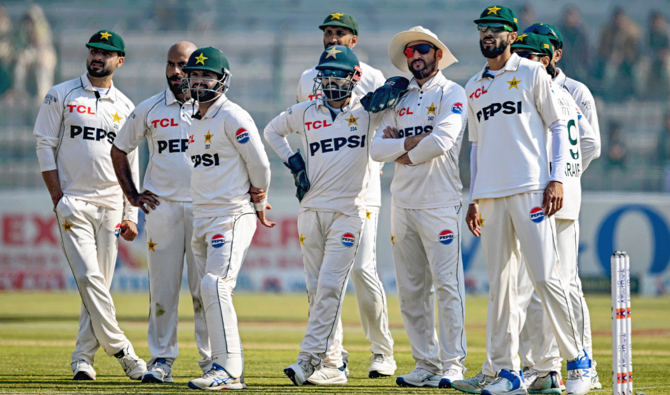
Pakistan's players wait for the third umpire decision against West Indies' Amir Jangoo (not in picture) during the second day of the second Test cricket match between Pakistan and West Indies at the Multan Cricket Stadium in Multan on January 26, 2025. (AFP/File)
Short Url
Updated 30 September 2025
Follow

Pakistan picks uncapped spinners for two home tests against South Africa

  • First test against South Africa starts in Lahore on Oct. 12, followed by the second in Rawalpindi from Oct. 20
  • Despite finishing at the bottom of the WTC table in the last cycle, Pakistan have kept Shan Masood as captain

ISLAMABAD: Pakistan named two uncapped spinners in its 18-man squad to face titleholder South Africa next month at the start of its World Test Championship cycle.

The 38-year-old spin allrounder Asif Afridi and wrist spinner Faisal Akram were picked in an expanded squad on Tuesday. It will be trimmed closer to the first test in Lahore starting on Oct. 12. Rawalpindi hosts the second test from Oct. 20-24.

Afridi has 198 wickets in 57 first-class games while Akram, since his first-class debut in 2023, has 44 wickets in nine games.

Test regulars retained included off-spinner Sajid Khan, left-arm spinner Noman Ali and leg-spinner Abrar Ahmed.

Despite finishing at the bottom of the WTC table in the last cycle, Pakistan kept Shan Masood as the captain.

A training camp for the test squad began in Lahore on Tuesday and will run until Oct. 8. Abrar, Hasan Ali, Salman Ali Agha and Shaheen Shah Afridi, who all participated in the Asia Cup, will join the camp on Saturday.

Also picked was 23-year-old uncapped wicketkeeper-batter Rohail Nazir as backup for Mohammad Rizwan.

The test series will be followed by three Twenty20s, one in Rawalpindi and two in Lahore. Faisalabad will host all the three ODIs.

Pakistan: Shan Masood (captain), Imam-ul-Haq, Abdullah Shafique, Babar Azam, Saud Shakeel, Kamran Ghulam, Salman Ali Agha, Mohammad Rizwan, Abrar Ahmed, Asif Afridi, Faisal Akram, Hasan Ali, Khurram Shahzad, Aamir Jamal, Noman Ali, Rohail Nazir, Sajid Khan, Shaheen Shah Afridi.


Pakistan says UN liquidity crisis undermining peacekeeping, urges predictable financing

Updated 7 sec ago
Follow

Pakistan says UN liquidity crisis undermining peacekeeping, urges predictable financing

  • Pakistan is one of world’s top troop-contributing countries and has deployed more than 250,000 peacekeepers to 48 UN missions
  • If financial commitments wane, the readiness of troop contributing countries to maintain forces can also be affected, envoy warns

ISLAMABAD: Pakistan has warned that a liquidity crisis at the United Nations (UN) is undermining the effectiveness of peacekeeping missions, warning of its “serious consequences” for mandate delivery, civilian protection and deterrence against violence.

Pakistan is one of the world’s top troop-contributing countries and has deployed more than 250,000 peacekeepers to 48 UN missions across four continents over the past eight decades. A total of 182 of its peacekeepers have also lost their lives while serving under the UN flag.

Speaking at the opening of the Special Committee on Peacekeeping Operations, Pakistan’s Permanent Representative to the UN, Asim Iftikhar Ahmad, said several missions have transitioned or drawn down in recent years and no new UN peacekeeping mission has been established in over a decade, despite rising global instability and the highest levels of conflict since World War-II.

“If financial commitments wane and missions continue to contract without clear strategic direction, the readiness of troop contributing countries to maintain forces earmarked for UN deployment could also be affected, including standby arrangements, rapid deployment capabilities and specialized units,” Ahmad said, calling for a “serious and structured review” of financial architecture underpinning UN peacekeeping.

The liquidity crisis has reduced patrols, mobility and field presence, according to the Pakistani envoy. UN peacekeeping must become more agile, focused and better equipped to address evolving threats, including through technology and stronger partnerships.

“Protection of civilians, deterrence against violations, and ceasefire monitoring and verification remain foundational tasks,” he said. “Lack of political progress should not be used as a pretext for withdrawing missions.”

Pakistan has contributed both military and police personnel to UN operations, deploying more than 50 formed police units to missions including Haiti, Darfur, Timor-Leste and Côte d’Ivoire, according to Pakistan’s UN mission.

Pakistan’s top diplomat at the UN also flagged the issue at a UN Security Council briefing on peacekeeping police components this month.