

Pakistan delegation in Riyadh to draft economic roadmap after landmark defense pact

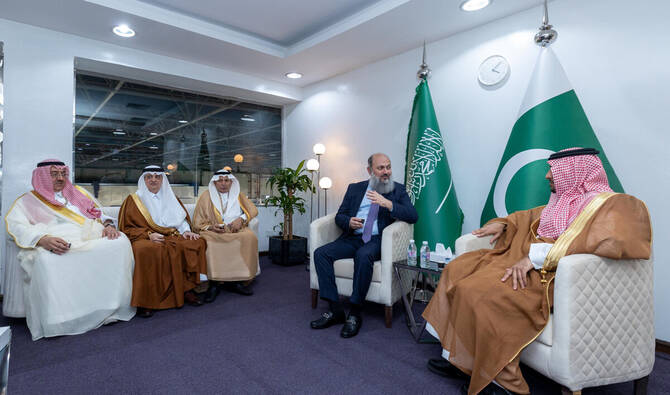
Pakistan Minister of Commerce Jam Kamal Khan (2R) gestures during a meeting Abdul Aziz Omar Alsakran, deputy governor of international relations in foreign trade authority, and the Council of Saudi Chambers Chairperson Hassan Moejeb Alhwaizy and other delegates in Jeddah on February 6, 2025. (Jam Kamal Khan/File)
Short Url
Updated 30 September 2025
Follow

Pakistan delegation in Riyadh to draft economic roadmap after landmark defense pact

  • High-level team led by commerce and food security ministers working on two-month plan to boost trade and investment
  • Visit comes after Pakistan, Saudi Arabia signed landmark defense pact seen as opening door to deeper economic cooperation

ISLAMABAD: A high-level Pakistani delegation is currently visiting Saudi Arabia to advance Islamabad-Riyadh economic ties in a “structured and result-oriented manner,” Pakistan’s Ambassador to Saudi Arabia Ahmad Farooq said on Monday.

The delegation, led by Commerce Minister Jam Kamal Khan and National Food Security Minister Rana Tanveer Hussain along with officials from Pakistan’s Special Investment Facilitation Council (SIFC), arrived on Sept. 25 and is reportedly working on a two-month plan to shape bilateral cooperation. Formed in 2023, the SIFC is a civil-military body that aims to attract foreign investment, especially from Gulf countries.

Pakistan has tried to strengthen its business-to-business (B2B) relations with the Kingdom in recent years, with both sides signing 34 memorandums of understanding and agreements worth $2.8 billion during Prime Minister Shehbaz Sharif’s visit to Riyadh last October. The agreements aimed to enhance private sector collaboration and commercial partnerships.

The visit of the Pakistani delegation comes after Pakistan and Saudi Arabia signed a landmark defense pact during Sharif’s state visit to Riyadh this month. While the pact is meant to enhance joint deterrence and deepen decades of military and security cooperation, many analysts believe the agreement will likely open new avenues of economic cooperation between the two nations.

“The visit comes within the framework of the High-Level Taskforce for Economic Cooperation between Pakistan and Saudi Arabia, which provides an institutional mechanism to advance bilateral economic ties in a structured and result-oriented manner,” Ambassador Farooq told Arab News.

“These meetings are part of the ongoing efforts to further deepen cooperation between the two countries across a wide spectrum of sectors, including trade, investment, energy, infrastructure, technology, and human resource development.”

Arab News reached out to Pakistan’s commerce and food security ministries as well as the SIFC for more details on the visit but did not receive a response to its queries.

Pakistan and Saudi Arabia have close religious, cultural, diplomatic and strategic ties, particularly in trade and defense. The Kingdom is home to over two million Pakistani expatriates, who are the largest source of remittances to the South Asian country.

Saudi Arabia has also provided substantial support to Pakistan during its prolonged economic challenges in recent years, including oil cargoes on deferred payments as well as external financing and assistance with International Monetary Fund loan programs.

On Monday, PM Sharif said Pakistan’s defense agreement with the Kingdom formalized Islamabad’s longstanding fraternal ties with Riyadh, adding that it was signed in accordance with the wishes of the people of both nations.

“We have formalized it [through defense pact],” the Pakistani premier told reporters in London. “And the bottom line of the agreement is that if anyone attacks one of the brother countries, the attack will be seen as against the other. And both will combat it together with consultation.”


’Super Flu’: Pakistan confirms presence of fast-spreading H3N2 influenza strain

Updated 4 sec ago
Follow

’Super Flu’: Pakistan confirms presence of fast-spreading H3N2 influenza strain

  • Health authorities say virus is not new but shows higher transmission rate
  • WHO reports global rise in seasonal influenza cases, especially in Europe

ISLAMABAD: Pakistani health authorities on Monday confirmed the presence of the H3N2 influenza strain, often referred to as a fast-spreading “super flu,” in the country, but stressed there was no cause for panic, saying the virus is not new and remains manageable with standard treatment and vaccination.

Officials said the strain is part of seasonal influenza viruses that circulate globally each year and has undergone genetic changes that make it spread more quickly, a pattern health experts say is common for influenza.

The confirmation comes as the World Health Organization (WHO) reports a global increase in seasonal influenza activity in recent months, with a growing proportion of influenza A(H3N2) cases detected, particularly across several European countries, including the United Kingdom.

“Yes, we have witnessed confirmed cases of H3N2 influenza (super Flu) in Pakistan since November this year. Out of total around 1,691 cases reported throughout Pakistan since last month, 12 percent are of the so called super flu,” Dr. Shafiq-Ur-Rahman, Senior Scientific Officer at Pakistan’s Center for Disease Control (CDC), told Arab News.

He said the virus had undergone a genetic drift, a gradual mutation that is typical of influenza viruses. 

“The symptoms are similar to other influenza strains, but speed of transmission is high for H3N2,” Rahman said, adding that treatment remains the same as for other flu types and vaccination is critical to limiting spread.

Seasonal influenza is an acute respiratory infection caused by influenza viruses that circulate year-round worldwide. The WHO has stressed that influenza continues to evolve through gradual genetic changes, making ongoing surveillance and regular vaccine updates essential.

Influenza spreads easily through droplets when infected people cough or sneeze. While most individuals recover within a week without medical treatment, the illness can range from mild to severe and may result in hospitalization or death, particularly among high-risk groups such as young children, older adults, pregnant women and people with underlying health conditions.

Doctors say early symptoms of the flu can resemble those of the common cold, but the progression often differs. Colds typically develop gradually, beginning with a runny or blocked nose, sneezing and sore throat, followed by mild coughing and fatigue.

Flu symptoms, however, tend to appear suddenly and more intensely, with patients often experiencing high fever, extreme tiredness, body aches, headaches and a dry cough.

Health experts say this abrupt and severe onset is usually the clearest indication that an illness is influenza rather than a common cold, which is generally milder and slower to develop.