

Pakistan September inflation seen rising to 5.1% as food prices surge — report

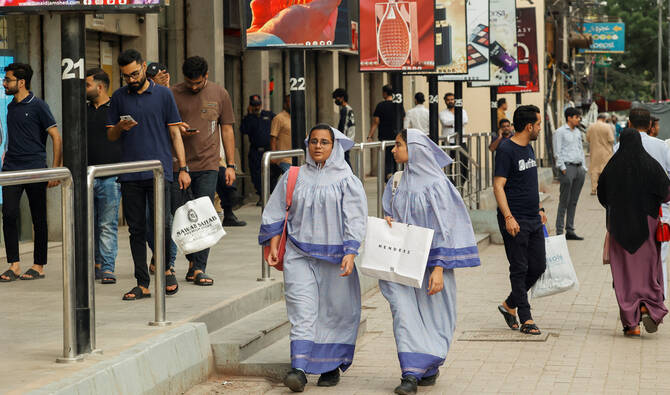
People walk outside shopping mall in Karachi, Pakistan on September 23, 2025. (REUTERS/File)
Short Url
Updated 29 September 2025
Follow

Pakistan September inflation seen rising to 5.1% as food prices surge — report

  • CPI expected to rise from 3.0% in August as tomatoes, wheat and onions drive food costs
  • Inflation down sharply from May 2023’s record 37.97% amid IMF-led fiscal reforms

ISLAMABAD: Pakistan’s headline inflation is projected to reach about 5.1 percent in September 2025, up from 3.0 percent in August, driven largely by a surge in food prices, brokerage firm Insight Securities said in a research note on Monday.

The estimate, compared with 6.9 percent in the same month last year, comes as Pakistan is pushing through a series of economic reforms under a $7 billion International Monetary Fund program, including a contractionary government budget passed in June that slashes spending to curb the fiscal deficit.

Inflation has fallen sharply from a record 37.97 percent in May 2023, when global commodity shocks, energy price hikes and currency depreciation sent prices soaring. By late 2024 and early 2025, headline inflation had fallen into single digits on monthly measures, aided by tight monetary policy, base effects and external stabilization efforts.

“Preserving macroeconomic stability and keeping the current account deficit within a manageable level of less than 1 percent of GDP is essential,” Insight Research said in a note on Monday.

“Although the evolving diplomatic landscape may provide a ramp for growth, the priority for now should be to consolidate stabilization before pursuing a growth path.”

Prices of key food staples rose sharply in September, with tomatoes surging 96.6 percent, wheat flour up 36.9 percent, onions climbing 34.2 percent, and fresh vegetables and potatoes gaining 5.6 and 5.4 percent, respectively. These increases pushed overall food inflation about 5.2 percent higher month-on-month. Prices of fresh fruits, chicken, and motor fuel fell, partially offsetting the impact.

The central bank is expected to keep interest rates unchanged at its next monetary policy meeting in October, as policymakers weigh the impact of earlier aggressive rate cuts that are still filtering into the real economy.

Insight noted that rising credit offtake and improvements in high-frequency indicators point to early signs of recovery, though flood-related disruptions, wheat prices rebounding from a low base, and higher import volumes pose upside risks to inflation in the coming months.

While initial data suggest the recent monsoon floods caused far less damage than the catastrophic 2022 disaster, policymakers remain cautious about their lingering economic effects.

Authorities have emphasized that continued fiscal discipline, a contained current account deficit and a stable macroeconomic environment are key to sustaining the disinflation trend and paving the way for growth once stabilization is firmly secured.


Pakistan army chief assumes role as first Chief of Defense Forces, signaling unified command

Updated 5 sec ago
Follow

Pakistan army chief assumes role as first Chief of Defense Forces, signaling unified command

  • New role is held simultaneously with Gen Asim Munir’s existing position as Chief of Army Staff
  • It is designed to centralize operational planning, war-fighting doctrine, modernization across services

ISLAMABAD: Pakistan’s most senior military officer, Field Marshal Syed Asim Munir, formally took charge as the country’s first Chief of Defense Forces (CDF) on Monday, marking a structural change in Pakistan’s defense command and placing the army, navy and air force under a single integrated leadership for the first time.

The new role, held simultaneously with Munir’s existing position as Chief of Army Staff, is designed to centralize operational planning, war-fighting doctrine and modernization across the services. It reflects a trend seen in several advanced militaries where a unified command oversees land, air, maritime, cyber and space domains, rather than service-level silos.

Pakistan has also established a Chief of Defense Forces Headquarters, which Munir described as a “historic” step toward joint command integration.

In remarks to officers from all three forces after receiving a tri-services Guard of Honor at the General Headquarters (GHQ) in Rawalpindi, Munir said the military must adapt to new theaters of conflict that extend far beyond traditional ground warfare.

He stressed the need for “a formalized arrangement for tri-services integration and synergy,” adding that future war will involve emerging technologies including cyber operations, the electromagnetic spectrum, outer-space platforms, information warfare, artificial intelligence and quantum computing.

“He termed the newly instituted CDF Headquarters as historic, which will afford requisite integration, coherence and coordination to meet the dynamics of future threat spectrum under a tri-services umbrella,” the military quoted Munir as saying in a statement. 

The ceremony also included gallantry awards for Pakistan Navy and Air Force personnel who fought in Marka-e-Haq, the brief May 2025 conflict between Pakistan and India, which Pakistan’s military calls a model for integrated land, air, maritime, cyber and electronic combat. During his speech, Munir paid tribute to the personnel who served in the conflict, calling their sacrifice central to Pakistan’s defense narrative.

The restructuring places Pakistan closer to command models used by the United States, United Kingdom and other nuclear-armed states where a unified chief directs inter-service readiness and long-range war planning. It also comes at a time when militaries worldwide are re-engineering doctrine to counter threats spanning satellites, data networks, information space and unmanned strike capabilities.