

Pakistan offers refunds, substitutes to Hajj applicants unable to proceed in 2026

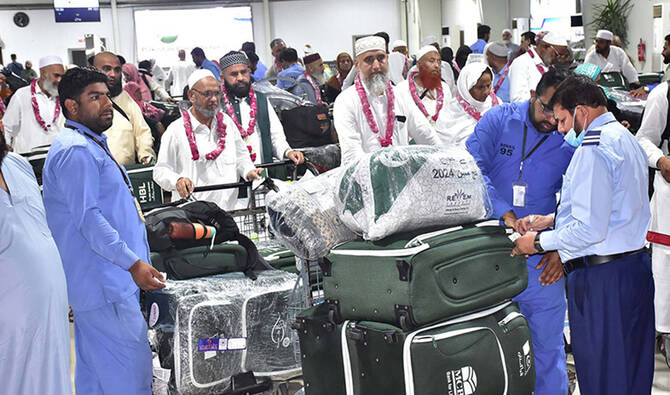
Officials check baggage of Hajj pilgrims as they arrive at the Sialkot International Airport in Sialkot on June 20, 2024. (APP/File)
Short Url
Updated 28 September 2025
Follow

Pakistan offers refunds, substitutes to Hajj applicants unable to proceed in 2026

  • Reasons for a refund or substitute under government scheme include death of an applicant, illness or an unavoidable commitment
  • Pakistan has a quota of 179,210 pilgrims for Hajj 2026, of which, around 118,000 seats have been allocated to government scheme

ISLAMABAD: Hajj applicants can seek a refund or nominate a blood relative to perform the next year’s pilgrimage in their stead if they are unable to proceed further due to any emergencies, Pakistan’s religious affairs ministry announced on Sunday, in major relief for intending pilgrims.

Pakistan has been allocated a quota of 179,210 pilgrims for Hajj 2026. Of these, around 118,000 seats have been allocated to the government scheme and the rest to private tour operators.

Earlier this month, Pakistan’s religious affairs minister Sardar Muhammad Yousaf said the country has filled its entire quota of 179,210 Hajj pilgrims under both the government and private schemes.

Under the government scheme, applicants deposited a first installment of Rs500,000 ($1,764) or Rs550,000 ($1,941) depending on the package in August while the remaining dues will be collected in November.

“The ministry has uploaded the forms on its website for refund or nominating a substitute for any of the 118,000 government scheme Hajj pilgrims who have already submitted their first installment but are unable to travel due to death or any other serious and valid reason,” Muhammad Umer Butt, a religious affairs ministry spokesperson, told Arab News.

Such applicants may request a refund before paying the second installment or nominate a blood relative, according to Butt. This facility was available because visas or bookings have not been finalized at this stage, giving the ministry time to manage such cases.

“The form outlines certain conditions that must be fulfilled for a substitute, and for refunds, solid reasons must be provided,” he said. “However, if more time passes and the ministry has already spent money on the applicants, those expenses will be deducted from the refund.”

He said deductions are only made when preparations are in advanced stages and someone withdraws, but at present, applicants can claim their full amount by providing a valid reason.

“Valid reasons include death of an applicant, illness or other health issues, or an unavoidable commitment such as examinations that became known after the application was filed,” the spokesperson added.

According to the form seen by Arab News, the ministry will evaluate the case once submitted and upon approval, issue an authority letter for refund which the applicant can present to the bank to receive the payment.

Last year, around 63,000 Pakistani pilgrims were unable to perform Hajj under the private scheme due to delays in payments and mismanagement by private Hajj operators. As a result, Islamabad was forced to surrender these slots to Saudi Arabia.

For the private scheme, the spokesperson said, the ministry has instructed operators to give priority to more than 21,000 pilgrims who could not perform the pilgrimage last year.

“They have been given Oct. 17 deadline to complete bookings so that Saudi timelines can be met,” Butt said, adding that private operators have already uploaded data for over 24,000 pilgrims on the ministry’s portal, and the remaining entries will be completed before the deadline.


Pakistan to introduce new navigation system to cut flight delays at Skardu, Gilgit and Chitral

Updated 5 sec ago
Follow

Pakistan to introduce new navigation system to cut flight delays at Skardu, Gilgit and Chitral

  • Pakistan Airports Authority says satellite-guided RNP-AR procedures will be in place by June 2026, pending a feasibility study
  • The system is expected to reduce weather-related delays and cancelations in Pakistan’s most popular mountain destinations

KARACHI: Pakistan said on Sunday it would introduce a new satellite-guided navigation system for flights to Skardu, Gilgit and Chitral by June 2026, aiming to curb chronic weather-related delays and cancelations at the three remote northern airports.

The destinations are among Pakistan’s most visited tourist sites and serve as gateways to the Himalayan and Karakoram ranges. Gilgit-Baltistan, which borders China, also holds strategic significance as part of the northern corridor linking the two neighbors.

Marking International Civil Aviation Day, the Pakistan Airports Authority (PAA) said it was accelerating aviation-sector upgrades, including the rollout of Required Navigation Performance – Authorization Required (RNP-AR) procedures.

RNP-AR is a high-precision, satellite-based approach system that enables aircraft to fly accurate, terrain-avoiding paths in low visibility, reducing weather-related disruptions at mountain airports.

“Pakistan Airports Authority is rapidly working on major projects for safe, efficient and modern aviation in the country,” the PAA said.

It added that RNP-AR flight procedures for Skardu, Gilgit and Chitral “will be implemented by June 2026,” subject to the findings of a consultant’s feasibility study.

The authority said the system would “significantly reduce weather-related flight delays and cancelations.”

The PAA also announced timelines for several other major upgrades, including terminal expansion at Lahore’s Allama Iqbal International Airport by September 2026 and runway modernization at Karachi’s Jinnah International Airport by January 2026.

Further works include the next upgrade phase at Skardu Airport and phase two of Muridke General Aviation Aerodrome, both due to begin next year.

New greenfield airports in Dera Ismail Khan, Sukkur and Faisalabad have also entered planning stages, the statement said.

Final sites have been approved for a new air-traffic control tower and rescue fire station at Karachi Airport, infrastructure the PAA said would strengthen air-traffic management and safety.

“Pakistan Airports Authority is leading the aviation sector toward a safer and more accessible future,” it said.