

UK’s Starmer hopes a vision of ‘renewal’ can silence doubts about his leadership

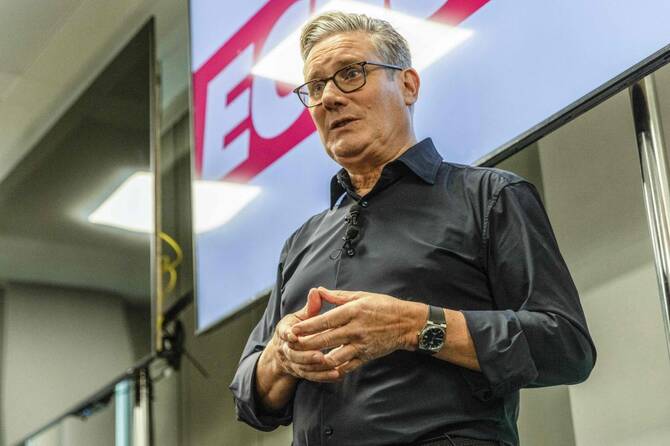
Britain's Prime Minister Keir Starmer speaks to secondary school students at the Liverpool Echo ahead of his Party’s conference in Liverpool, north-west England on September 27, 2025. (AFP)
Short Url
Updated 28 September 2025
Follow

UK’s Starmer hopes a vision of ‘renewal’ can silence doubts about his leadership

LONDON: Keir Starmer never had much of a political honeymoon. Now some members of his political party are considering divorce.
Little more than a year after winning power in a landslide, Britain’s prime minister is fighting to keep the support of his party, and to fend off Nigel Farage, whose hard-right Reform UK has a consistent lead in opinion polls
The next election is as much as four years away, but as thousands of Labour Party members gather Sunday for their annual conference beside the River Mersey in Liverpool, lawmakers are growing anxious. A potential leadership rival has emerged in Andy Burhnam, the ambitious mayor of Manchester.
Tim Bale, professor of politics at Queen Mary University of London, said the party’s mood is “febrile.”
“They’ve only been in government a year and they’ve got a big majority, but most voters seem to be quite disappointed and disillusioned with the government,” he said. “And they also have a very low opinion of Keir Starmer.”


Government rocked by setbacks
Since ending 14 years of Conservative rule with his July 2024 election victory, Starmer has struggled to deliver the economic growth he promised. Inflation remains stubbornly high and the economic outlook subdued, frustrating efforts to repair tattered public services and ease the cost of living.
A global backdrop of Russia’s war in Ukraine and US President Donald Trump’s tariffs hasn’t helped. Even though Britain managed to secure a trade deal easing import duties on some UK goods, the autumn budget statement in November looks set to be a grim choice between tax increases and spending cuts – maybe both.
Starmer acknowledged on Friday that the government has to “speed up” and do better. In his big conference speech on Tuesday, he’ll try to set out a sweeping vision to energize Labour’s grassroots, something critics say has been lacking under his managerial command. He’ll also seek to persuade party members, and voters, that he has learned from his mistakes and stabilized a sometimes wobbly government.
In the last few weeks Starmer has lost his deputy prime minister, Angela Rayner, who quit over a tax error on a home purchase, and fired Britain’s ambassador to Washington, Peter Mandelson, after revelations about his past friendship with convicted sex offender Jeffrey Epstein. There have also been several exits from his backroom team, adding to a sense of disarray.
Now Burnham, a former Labour lawmaker turned big-city mayor, is emerging as a nascent rival. He told the New Statesman magazine that Labour needs to offer “wholesale change” to fend off a threat from the right.
“Business as usual … ain’t gonna do it. The plan has to change quite radically,” Burnham said. He added that “it’s the plan that matters most, rather than me,” but acknowledged some lawmakers had approached him about a potential leadership bid.
That could be some way off, as he is not currently a member of Parliament.

Immigration is a flashpoint
The government has also struggled to ease growing divisions over immigration, fueled in part by the arrival of thousands of migrants in small boats across the English Channel. More than 30,000 people have made the dangerous crossing from France so far this year despite efforts by authorities in Britain, France and other countries to crack down on people-smuggling gangs.
Far-right activists have been involved in protests outside hotels housing asylum-seekers across the UK, and a march organized by anti-immigration campaigner Tommy Robinson attracted more than 100,000 people in London this month.
Starmer has acknowledged voters’ concerns about migration but condemned Robinson’s anti-immigrant rhetoric and accused Farage of sowing division.
Farage’s party has only five lawmakers in the 650 seat House of Commons, and Labour has more than 400. Nonetheless Starmer said Friday that Reform, and not the main opposition Conservatives, is now Labour’s chief opponent.
He said the defining political battle of our times is between a “politics of predatory grievance” that seeks to foster division and “patriotic renewal … underpinned by the values of dignity and respect, equality and fairness.”
“There’s a battle for the soul of this country now as to what sort of country we want to be,” he said.
The government does not have to call an election until 2029, but pressure will mount on Starmer if, as many predict, Labour does badly in local and regional elections in May.
Bale said that, for now, the best policy for the government is to “keep calm and carry on.”
“Over time, greater investment in public services, in particular the health service, will probably begin to show some fruit,” he said. “The economy may turn around as the government’s policies have some effect. They may get the small boats problem under control over time.
“But it really is a case of just kind of waiting it out – and perhaps hoping that Nigel Farage and Reform’s bubble will burst.”


Fear grips Congo’s Uvira as M23 rebels take control, displacing 200,000

Updated 4 sec ago
Follow

Fear grips Congo’s Uvira as M23 rebels take control, displacing 200,000

  • On Saturday, the situation in Uvira still had not returned to normal
  • “Some people left the city, but we stayed,” Maria Esther, a 45-year-old mother of 10, told AP

UVIRA, CONGO: A climate of fear reigned Saturday in Uvira, a strategic city in eastern Congo, days after it fell to the Rwanda -backed M23 group, as fighting in the region escalated despite a US mediated peace deal.
The Associated Press gained rare access to the city, which was the Congo government’s last major foothold in South Kivu province after the provincial capital of Bukavu fell to the rebels in February. Its capture allows the rebels to consolidate a broad corridor of influence across the east.
M23 said it took control of Uvira earlier this week, following a rapid offensive launched at the start of the month. Along with the more than 400 people killed, about 200,000 have been displaced, regional officials say.
On Saturday, the situation in Uvira still had not returned to normal. There was absolute silence and no traffic, apart from military jeeps circulating on the empty streets. The banks were closed and people have not resumed their jobs — only a few dared to go out during the day, and no one ventured outside after sunset, with armed M23 fighters patrolling the city.
“Some people left the city, but we stayed,” Maria Esther, a 45-year-old mother of 10, told AP. “But the situation hasn’t returned to normal, we haven’t resumed our usual activities because there’s no money circulating.”
Joli Bulambo, another resident of Uvira, said: “People thought that the situation that had happened in Goma with the deaths would be the same here in Uvira, but fortunately, there were not many deaths because God helped.”
M23’s latest push
The rebels’ latest offensive comes despite a US-mediated peace agreement signed last week by the Congolese and Rwandan presidents in Washington.
The United States accused Rwanda of violating the agreement by backing a deadly new rebel offensive in the mineral-rich eastern Congo, and warned that the Trump administration will take action against “spoilers” of the deal.
The accord didn’t include the rebel group, which is negotiating separately with Congo and agreed earlier this year to a ceasefire that both sides accuse the other of violating. However, it obliges Rwanda to halt support for armed groups like M23 and work to end hostilities.
Marco Rubio, US Secretary of State, said on X on Saturday: “Rwanda’s actions in eastern DRC are a clear violation of the Washington Accords signed by President Trump, and the United States will take action to ensure promises made to the President are kept.”
There was no immediate reaction from Rwanda.
The rebels’ advance pushed the conflict to the doorstep of neighboring Burundi, which has maintained troops in eastern Congo for years, heightening fears of a broader regional spillover.
A struggle for mineral rich territory
More than 100 armed groups are vying for a foothold in mineral-rich eastern Congo, near the border with Rwanda, most prominently M23. The conflict has created one of the world’s most significant humanitarian crises, with more than 7 million people displaced, according to the UN agency for refugees.
Local UN partners report that more than 200,000 people have been displaced across the province since Dec. 2. Civilians also have crossed into Burundi, and there have been reports of shells falling in the town of Rugombo, on the Burundian side of the border, raising concerns about the conflict spilling over into Burundian territory.
Congo, the US and UN experts accuse Rwanda of backing M23, which has grown from hundreds of members in 2021 to around 6,500 fighters, according to the UN
Rwanda, Congo and M23 trade accusations

Congo’s Foreign Minister Thérèse Kayikwamba Wagner on Friday accused Rwanda of trampling on the peace agreement, which she described as bringing “hope of a historic turning point.”
She warned, however, that the “entire process … is at stake,” and urged the Security Council to impose sanctions against military and political leaders responsible for the attacks, ban mineral exports from Rwanda and prohibit it from contributing troops to UN peacekeeping missions.
“Rwanda continues to benefit, especially financially but also in terms of reputation, from its status as a troop-contributing country to peacekeeping missions,” Wagner told AP.
Bertrand Bisimwa, deputy coordinator of the AFC/M23 rebel movement told AP in an exclusive interview Friday that peace commitments have remained largely theoretical. “Regardless of the ceasefire agreements we sign and the mutual commitments we make, nothing is implemented on the ground,” he said.
Asked about the expansion of M23 operations toward the Uvira region, Bisimwa said the region was a long-standing hot spot of ethnic tensions and violence. “For a long time, people were attacked and killed because of their community affiliation,” he said.
On Friday, Rwanda’s Foreign Minister Olivier Nduhungirehe told diplomats that Congo had declared it would continue fighting in M23 recaptured territories and it was only after M23 retaliated that the international community “suddenly woke up.”
“The DRC has openly declared that it would not observe any ceasefire and would instead continue fighting to recapture territories held by the AFC/M23, even as the peace process unfolded,” he said.
While Rwanda denies the claim that it backs M23, it acknowledged last year that it has troops and missile systems in eastern Congo, allegedly to safeguard its security. UN experts estimate there are up to 4,000 Rwandan forces in Congo.