

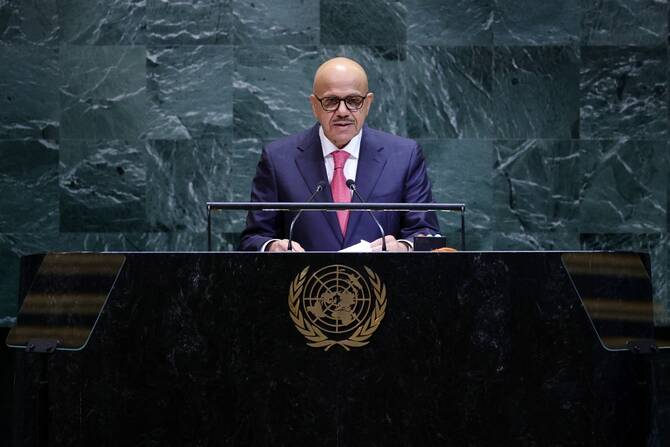

NEW YORK: The Middle East must avoid an arms race amid one of its most crisis-ridden periods in recent history, Bahrain’s foreign minister told the 80th UN General Assembly on Friday.
Abdullatif bin Rashid Al-Zayani also praised Saudi-French efforts to bring about a two-state solution to the Israeli-Palestinian conflict.
“The world is facing accelerating transformations and complex challenges. This includes geopolitical tensions, armed conflicts, climate change and major political and economic crises,” he said.
“The situation requires collective effort to strengthen international solidarity, to deepen dialogue and understanding, and to uphold international law for a brighter future for humanity.”
Bahrain is committed to multilateralism, and welcomes its new two-year period as a non-permanent member of the UN Security Council, he added.
It also hopes to be a partner in “advancing regional and international peace, security and coexistence within stable, sustainable and prosperous societies,” Al-Zayani said.
He outlined Bahrain’s vision for regional peace: a commitment to the peaceful settlement of conflicts, a comprehensive and lasting ceasefire in Gaza, the protection of civilians and the immediate release of hostages, the sustained delivery of humanitarian aid, and the implementation of the Arab-Islamic plan for recovery and reconstruction in Gaza.
Bahrain rejects “any settlement expansion or attempts to alter the historical and religious status quo of Jerusalem, a city that has embraced divine faiths throughout history,” Al-Zayani said.
He welcomed the UNGA’s endorsement of the Saudi- and French-led New York Declaration on reaching a two-state solution.
“Bahrain further emphasizes the need for peaceful solutions to the crises in Syria, Lebanon, Sudan, Libya, Yemen, Somalia and beyond in a manner that guarantees their sovereignty, unity and territorial integrity,” he said.
Countries in the Middle East and beyond must take joint action to rid the region of weapons of mass destruction, he added, warning against any “arms race or military escalation.” Bahrain supports the resumption of US-Iran nuclear talks, Al-Zayani said.
He highlighted his country’s signing of the C-SIPA cooperation framework with the US and UK.
The agreement includes military guarantees that come close to replicating NATO’s Article 5 collective defense policy.
“My country seeks to enhance partnership with states, organizations and regional and international groupings,” Al-Zayani said.
“This aims at combating terrorism, strengthening cybersecurity, and ensuring food and water security.”
The UN system must be reformed to ensure the representation of developing countries in decision-making so as to “enhance its effectiveness and transparency,” and “to maintain international peace and security,” he said.
Al-Zayani called on member states to make the 80th UNGA a “turning point” toward a “more just and humane international order.”
He added: “The coming generations deserve a world that embraces their dreams, unrestrained by fear and unburdened by conflict.
“We pray to almighty God to guide us all to outcomes which bring goodness and progress for all humanity in a world that’s safer, more just, more sustainable and more prosperous.”


