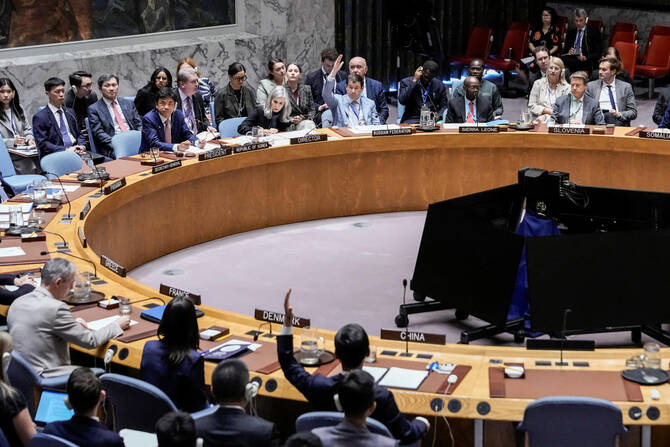
UNITED NATIONS: The UN Security Council on Friday rejected another last-ditch effort to delay the reimposition of sanctions on Iran over its nuclear program a day before the deadline and after Western countries claimed that weeks of meetings failed to result in a “concrete” agreement.
The resolution put forth by Russia and China — Iran’s most powerful and closest allies on the 15-member council — failed to garner support from the nine countries required to halt the series of UN sanctions from taking effect Saturday, as outlined in Iran’s 2015 nuclear deal with world powers.
“We had hoped that European colleagues and the US would think twice, and they would opt for the path of diplomacy and dialogue instead of their clumsy blackmail, which merely results in escalation of the situation in the region,” Dmitry Polyanskiy, the deputy Russian ambassador to the UN, said during the meeting.
Barring an eleventh-hour deal, the reinstatement of sanctions — triggered by Britain, France and Germany — will once again freeze Iranian assets abroad, halt arms deals with Tehran and penalize any development of Iran’s ballistic missile program, among other measures. That will further squeeze the country’s reeling economy.
The move is expected to heighten already magnified tensions between Iran and the West. It’s unclear how Iran will respond, given that in the past, officials have threatened to withdraw from the Nuclear Nonproliferation Treaty, potentially following North Korea, which abandoned the treaty in 2003 and then built atomic weapons.
Four countries — China, Russia, Pakistan and Algeria — once again supported giving Iran more time to negotiate with the European countries, known as the E3, and the United States, which unilaterally withdrew from the accord with world powers in 2018.
“The UShas betrayed diplomacy, but it is the E3 which have buried it,” Iranian Foreign Minister Abbas Araghchi said after the vote. “This sordid mess did not come about overnight. Both the E3 and the US have consistently misrepresented Iran’s peaceful nuclear program.”
The European leaders triggered the so-called “snapback” mechanism last month after accusing Tehran of failing to comply with the conditions of the accord and when weeks of high-level negotiations failed to reach a diplomatic resolution.
Lots of diplomacy as deadline nears
Since the 30-day clock began, Araghchi, has been meeting with his French, British and German counterparts to strike a last-minute deal, leading up to this week’s UN General Assembly gathering. But those talks appeared futile, with one European diplomat telling the Associated Press on Wednesday that they “did not produce any new developments, any new results.”
Therefore, European sources “expect that the snapback procedure will continue as planned.”
Even before Araghchi and Iranian President Masoud Pezeshkian arrived in New York on Tuesday for the annual gathering, remarks from Iran’s supreme leader, Ayatollah Ali Khamenei, that peace talks with the United States represent “a sheer dead end” constrained any eleventh-hour diplomatic efforts from taking place.
Iranian officials have defended their position over the last several weeks, saying that they’ve put forward “multiple proposals to keep the window for diplomacy open.” On Friday, Araghchi said in a social media post that “the E3 has failed to reciprocate” efforts, “while the US has doubled down on its dictates.” He urged the Security Council to vote in favor of an extension to provide the “time and space for diplomacy.”
European nations have said they would be willing to extend the deadline if Iran complies with a series of conditions. Those include resumption of direct negotiations with the US over its nuclear program, allowing UN nuclear inspectors access to its nuclear sites, and accounts for the more than 400 kilograms (880 pounds) of highly enriched uranium the UN watchdog says it has.
Nuclear inspectors said to be currently in Iran
Of all the nations in the world that don’t have nuclear weapons programs, Iran is the only nation in the world that enriches uranium up to 60 percent — a short, technical step from weapons-grade levels.
Earlier this month, the UN nuclear watchdog and Iran signed an agreement mediated by Egypt to pave the way for resuming cooperation, including on ways of relaunching inspections of Iran’s nuclear facilities. However, Iran has threatened to terminate that agreement and cut all cooperation with the IAEA should UN sanctions be reimposed.
Iran has been wary of giving full access to inspectors following the 12-day war with Israel in June that saw both the Israelis and the Americans bomb Iranian nuclear sites, throwing into question the status of Tehran’s stockpile of uranium enriched nearly to weapons-grade levels.
But a diplomat close to the IAEA confirmed on Friday that inspectors are currently in Iran where they are inspecting a second undamaged site, and will not leave the country ahead of the expected reimposition of sanctions this weekend. IAEA inspectors earlier watched a fuel replacement at the Bushehr Nuclear Power Plant on Aug. 27 and 28.
The Europeans have said this action alone is not enough to halt the sanctions from coming into place Saturday.


![]()

UN Security Council rejects Russia and China’s last-ditch effort to delay Iran sanctions
Short Url
https://arab.news/nm4bh
UN Security Council rejects Russia and China’s last-ditch effort to delay Iran sanctions
- Western countries claim weeks of meetings failed to result in a “concrete” agreement
- Series of UN sanctions due to take effect Saturday, as per 2015 nuclear deal


Latest updates


© 2026 SAUDI RESEARCH & PUBLISHING COMPANY, All Rights Reserved And subject to Terms of Use Agreement.