

Pakistan urges UN governance of military AI, warns of risks from unregulated use

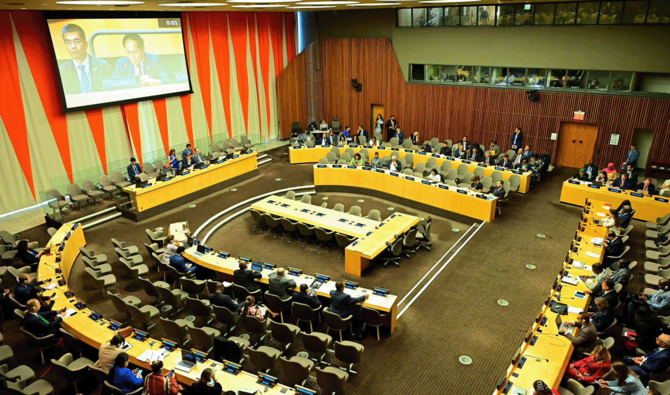
An overview of the United Nations General Assembly on September 24, 2025. (@ForeignOfficePk/X)
Short Url
Updated 25 September 2025
Follow

Pakistan urges UN governance of military AI, warns of risks from unregulated use

  • Pakistan’s defense minister says AI without human control could destabilize global order
  • UN chief urges ban on lethal autonomous weapons by 2026, says ‘window is closing’

ISLAMABAD: Pakistan said on Wednesday unregulated artificial intelligence (AI), particularly in military applications, posed grave risks and must be fully governed by the United Nations Charter and international law, according to a state media report.

Defense Minister Khawaja Muhammad Asif told a Security Council debate on AI that applications without “meaningful human control” should be prohibited.

He maintained that AI had the potential to accelerate socio-economic progress but could also deepen inequalities and destabilize the international order.

Asif particularly cited the use of autonomous munitions and high-speed cruise missiles in a recent military exchange between India and Pakistan as an example of the dangers.

“AI must not become a tool of coercion or technological monopoly,” he said, according to the Associated Press of Pakistan (APP) news agency, adding that it “lowers the threshold for use of force, making wars more politically and operationally feasible.”

The defense minister urged states to commit to measures that prevent the destabilizing use of AI, stressing that human judgment must remain central in matters of war and peace.

“We must ensure that AI is harnessed to promote peace and development, not conflict and instability,” he added.

Earlier, UN Secretary-General Antonio Guterres said while opening the debate that AI was already transforming daily life and the global economy “at breathtaking speed.”

While it can be used responsibly for prevention and protection, “without guardrails, it can also be weaponized,” he cautioned, renewing calls for a ban on lethal autonomous weapons without human control by 2026 while pointing out the “window is closing” for timely decisions.

The meeting, chaired by South Korean President Lee Jae Myung, was held on the margins of the 80th UN General Assembly Session.

It also featured global leaders, academics and experts who urged stronger international governance, broader access to AI development and safeguards to preserve human authority over life-and-death decisions.


Afghans in Pakistan say resettlement hopes dashed after US froze visa applications

Updated 10 sec ago
Follow

Afghans in Pakistan say resettlement hopes dashed after US froze visa applications

  • Thousands fleeing Taliban rule in 2021 now face stalled US immigration cases, uncertain legal status in Pakistan
  • Refugees fear policy shift could trigger deportations as Islamabad pressures undocumented Afghans to leave

ISLAMABAD: Afghans stranded in Pakistan while awaiting US resettlement said on Thursday Washington’s decision to pause immigration applications has shattered their expectations of relocation and left them vulnerable to possible mass deportations by Islamabad.

 The policy, announced by the Trump administration earlier this week, halts processing of green cards, citizenship petitions and Special Immigrant Visas (SIV) from 19 countries already under a partial travel ban, including Afghanistan and Somalia.

For thousands who fled Afghanistan after the Taliban seized power in 2021, the move has upended years of waiting.

 “It was very shocking, a traumatic situation, what we had hoped for, it went against our aspirations,” said Ihsan Ullah Ahmadzai, an Afghan journalist and human rights activist living in Pakistan.

He said the pause risked giving Pakistani authorities “a green light” to deport Afghans whose US cases are now indefinitely on hold.

Pakistan has ordered undocumented foreigners to leave or face expulsion, a directive that has intensified pressure on Afghan refugees who viewed US immigration processing as their only viable route to safety.

For Afghan refugee Fatima Ali Ahmadi, the decision has deepened uncertainty.

“I’m sad about my future because of this I can’t reach my hopes. I want to be an athlete and a journalist, but it’s impossible in Pakistan or Afghanistan,” she said, adding that she fled to Pakistan to escape Taliban threats.

She urged the US government to allow vulnerable Afghans to continue their cases. “We are just looking for safety and a chance to rebuild our lives,” she said.