

Palestinian leader to address UN General Assembly as peace push gathers steam

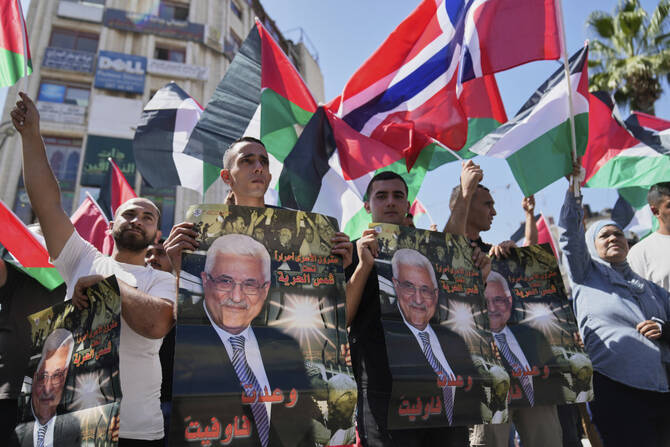
Palestinians carry posters with pictures of President Mahmoud Abbas and read "you kept your promise," during a rally in the West Bank city of Ramallah on Sept. 23, 2025. (AP)
Short Url
Updated 25 September 2025
Follow

Palestinian leader to address UN General Assembly as peace push gathers steam

  • President Mahmud Abbas will address UNGA three days after a slew of Western nations recognized a state of Palestine
  • Trump administration adamantly rejected statehood and barred Abbas from traveling to New York for the annual gathering of world leaders

UNITED NATIONS: Palestinian leader Mahmud Abbas will address the United Nations virtually on Thursday as the United States, despite its opposition to him, weighs whether to try to stop Israeli annexation of the West Bank.
The veteran 89-year-old Palestinian Authority president will address the UN General Assembly three days after a slew of Western nations recognized a state of Palestine.
US President Donald Trump’s administration adamantly rejected statehood and, in a highly unusual step, barred Abbas and his senior aides from traveling to New York for the annual gathering of world leaders.
The General Assembly overwhelmingly voted to let Abbas address the world body with a video message.
Israeli Prime Minister Benjamin Netanyahu has vowed not to allow a Palestinian state and far-right members of his cabinet have threatened to annex the West Bank in a bid to kill any prospect of true independence.
French President Emmanuel Macron, despite his disagreements with Trump on statehood, said Wednesday that the US leader joined him in opposing annexation.
“What President Trump told me yesterday was that the Europeans and Americans have the same position,” Macron said in an interview jointly with France 24 and Radio France Internationale.
Steve Witkoff, Trump’s golfing friend turned roving global negotiator, said that Trump in a separate meeting with a group of leaders of Arab and Islamic nations presented a 21-point plan for ending the war.
“I think it addresses Israeli concerns as well as the concerns of all the neighbors in the region,” he told the Concordia summit on the sidelines of the UN General Assembly.
“We’re hopeful, and I might say even confident, that in the coming days we’ll be able to announce some sort of breakthrough.”
A White House official told AFP that Trump wants to bring the conflict “to an expeditious close” and that foreign partners from the meeting “expressed the hope that they could work together with Special Envoy Witkoff to consider the President’s plan.”

Divide on Palestinian Authority 

Macron said that the US proposal incorporates core elements of a French plan including disarmament of Hamas and the dispatch of an international stabilization force.
A French position paper seen by AFP calls for the gradual transfer of security control in Gaza to a reformed Palestinian Authority once a ceasefire is in place.
Indonesian President Prabowo Subianto, one of the leaders who met jointly with Trump, said that the world’s most populous Muslim-majority country was willing to offer at least 20,000 troops.
Abbas’s Palestinian Authority enjoys limited control over parts of the West Bank under agreements reached through the Oslo peace accords that started in 1993.
Abbas’s Fatah is the rival of Hamas, which controls the Gaza Strip, although Netanyahu’s government has sought to conflate the two.
Abbas in his address on Monday condemned the massive October 7, 2023, attacks by Hamas on Israel, which has responded with a relentless military offensive.
He also called on Hamas to disarm to the Palestinian Authority.
France and other European powers, while not joining Israeli and US efforts to delegitimize the Palestinian Authority, have said that it needs major reforms.
Netanyahu will address the UN General Assembly on Friday.


Lebanon’s south could become US-backed economic zone, according to local paper Nidaa Al-Watan

Updated 16 December 2025
Follow

Lebanon’s south could become US-backed economic zone, according to local paper Nidaa Al-Watan

  • Lebanese daily quotes sources as saying the US plan casts southern Lebanon as a key gateway for broader economic transformation
  • White House fails to respond to Arab News’ request for comment

LONDON: Lebanese daily Nidaa Al-Watan has reported that the office of Jared Kushner, son-in-law and senior adviser to US President Donald Trump, has prepared detailed maps for a so‑called “Trump Economic Zone” in southern Lebanon. 

According to columnist Tarek Abou Zeinab, the Kushner plan has been formally submitted to the White House for consideration. 

Citing unnamed sources, the column said that the idea is no longer just a “whispered” concept among political circles but has entered what it described as “concrete border‑related discussions aimed at fast‑tracking the plan onto the US administration’s Middle East implementation agenda.” 

Arab News asked the US Embassy in Beirut and the US State Department for comment, but was directed to the White House for any official response. The White House was subsequently contacted but has not responded. 

Lebanon has been mired in prolonged political paralysis. Large parts of the south remain under Hezbollah’s influence, while Israel illegally occupies at least five outposts along the border that are within Lebanese sovereign land. 

According to Nidaa Al‑Watan’s sources, the US concept frames southern Lebanon as a key gateway for a wider economic transformation, tying large‑scale investment and infrastructure projects to security arrangements on the ground. 

The reported plan would seek to attract international capital, establish factories and logistics hubs, upgrade infrastructure, and build a port connected to global shipping routes. 

Its aim, according to the column, would be to open new export channels through a free‑zone model and lure major energy companies by linking southern Lebanon to wider schemes such as the India–Middle East–Europe Economic Corridor. 

Supporters of the plan argue it could trigger large Arab and international investments, raise living standards and create long‑term jobs, thereby lowering the risk of renewed conflict. 

However, Lebanese political and media sources quoted by the daily have warned that the proposal follows a new “hegemonic” approach and carries major political implications that cannot be ignored. 

The critics say the reported US vision goes beyond development to include the establishment of Jewish settlements in parts of southern Lebanon, justified on religious and security grounds to protect northern Israel. 

One source expressed concern that such moves would create a geographic and symbolic link between Israel and southern Lebanon, deepening fears over sovereignty and the region’s future political trajectory. 

The paper said Kushner is focussed on areas stretching from Mount Hermon to Shebaa and Naqoura in the far south at a time when Israel has been pressing for a buffer zone along the border, citing security concerns since the end of major clashes with Hezbollah in November 2024. 

The proposed zone would cover more than 27 southern towns, raising questions over Lebanese sovereignty. 

In parallel, the Lebanese army has been tasked with bringing all weapons under state control and asserting government authority in areas long dominated by Hezbollah, as part of a broader disarmament and security plan. 

Despite a ceasefire, Israel has continued to carry out attacks inside Lebanese territory and maintains control over parts of the south, saying the measures are necessary for security. 

Lebanese and Israeli delegations held talks in Naqoura earlier in December to shore up the ceasefire and discuss reconstruction in the south.