

Pakistan, Syria agree to form joint working group to boost agricultural cooperation

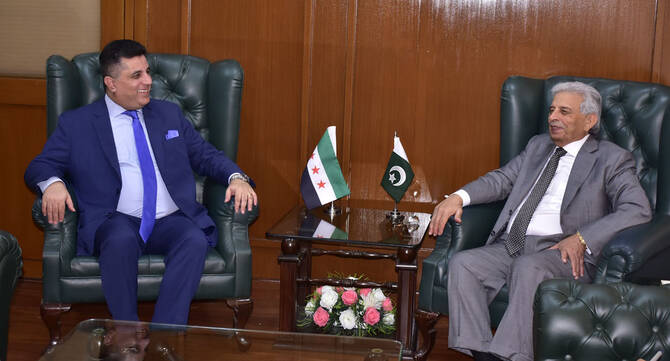
Pakistan Food Security Minister Rana Tanveer Hussain meeting with Syria’s Ambassador to Pakistan Dr. Ramez Alraee in Islamabad, on September 24, 2025. (GoP)
Short Url
Updated 24 September 2025
Follow

Pakistan, Syria agree to form joint working group to boost agricultural cooperation

  • Syria’s Ambassador Dr. Ramez Alraee meets Pakistan’s food security minister in Islamabad
  • Working group to fast-track collaboration in agricultural research, modern farming practices

ISLAMABAD: Pakistan and Syria have agreed to form a Joint Working Group to fast-track collaboration in agricultural research, modern farming practices and water resource management, Pakistan’s food ministry said on Wednesday, as Islamabad seeks closer cooperation with Damascus. 

Food Security Minister Rana Tanveer Hussain met Syria’s Ambassador to Pakistan Dr. Ramez Alraee in Islamabad, where both sides discussed strengthening bilateral cooperation in agriculture, trade and cultural exchanges. 

Pakistan has sought closer trade and economic cooperation with Syria recently. Last week, Pakistan’s Finance Minister Muhammad Aurangzeb met Alraee, during which Aurangzeb hoped the lifting of US sanctions would open up bilateral trade and investment opportunities. 

“To institutionalize and fast-track cooperation, both sides agreed to form a Joint Working Group that will explore practical avenues of collaboration, including modern farming practices, water resource management, capacity building and agricultural trade facilitation,” Pakistan’s food ministry said in a statement. 

Hussain said Pakistan is ready to share its expertise and extend technical support to Syria in modern agriculture and food security strategies. He noted that such initiatives would not only boost bilateral trade but also contribute to sustainable development and prosperity in the region.

“Ambassador Dr. Ramez Alraee appreciated Pakistan’s continued support and welcomed the proposal of establishing a Joint Working Group, assuring Syria’s commitment to work closely with Pakistan in areas of mutual benefit,” the statement said. 

Agriculture is the backbone of Pakistan’s economy and contributes around 23 percent to its GDP. It also employs roughly 37.4 percent of the labor force, according to the Food and Agriculture Organization.


Pakistan, UAE review bilateral ties, economic and trade cooperation

Updated 7 sec ago
Follow

Pakistan, UAE review bilateral ties, economic and trade cooperation

  • UAE Ambassador Salem Mohammed Al Zaabi meets Pakistan’s deputy PM, ministers of defense, finance and IT
  • UAE is Pakistan’s third-largest trading partner after China and the US, and home to around 2 million Pakistani expats

ISLAMABAD: UAE Ambassador Salem Mohammed Al Zaabi met Deputy Prime Minister Ishaq Dar and other members of the Pakistani cabinet on Sunday to review bilateral ties and discuss trade and economic cooperation between the two countries, the UAE embassy said. 

Al Zaabi held separate meetings with Dar, Defense Minister Khawaja Muhammad Asif, Finance Minister Muhammad Aurangzeb, IT Minister Shaza Fatima Khawaja, Railways Minister Hanif Abbasi, Senate Chairman Yousaf Raza Gilani and National Assembly Speaker Ayaz Sadiq. 

“Views on the latest developments at the regional and international levels and matters of common interest between the two friendly countries were discussed and exchanged,” the UAE embassy in Islamabad wrote on social media platform X. 

Meanwhile, the embassy said Zaabi discussed bilateral relations and ways to enhance economic and trade cooperation in his meeting with Aurangzeb. 

Pakistan enjoys cordial ties with UAE rooted in shared values, faith, culture and economic relations. The Gulf nation is Pakistan’s third-largest trading partner after China and the US.

The UAE is also home to two million Pakistani expatriates, who make it the second-largest source of foreign remittances for cash-strapped Pakistan after Saudi Arabia. 

The UAE is also a major source of foreign investment in Pakistan, which have been valued at over $10 billion in the last 20 years, according to the Gulf state’s foreign ministry. 

Policymakers in Pakistan consider the UAE an optimal export destination due to its geographical proximity, which minimizes transportation and freight costs while facilitating commercial transactions.

Both nations have signed agreements worth billions of dollars recently as Pakistan eyes greater trade and economic ties with Gulf states. In January 2024, Pakistan and the UAE signed multiple agreements worth more than $3 billion for cooperation in railways, economic zones and infrastructure.