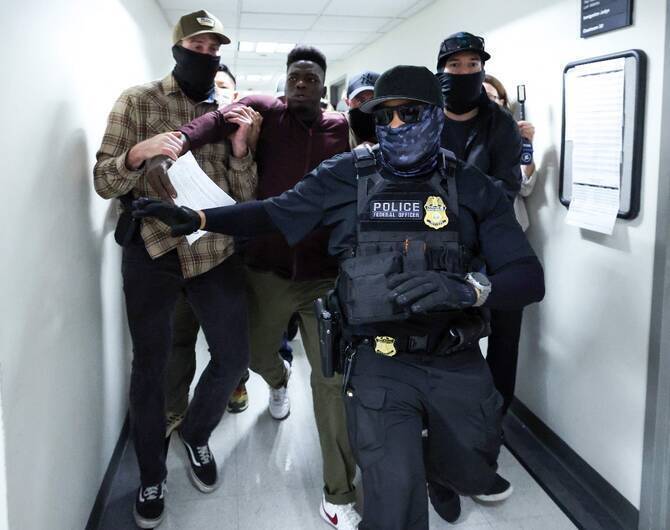
JOHANNESBURG: US expulsions of detainees to African countries under “opaque deals,” some involving millions of dollars in financial assistance, violated global rights law and must be rejected, a rights watchdog said Tuesday.
Eswatini, Ghana, Rwanda and South Sudan have in recent months accepted US deportees as part of a scheme by President Donald Trump’s administration to expel undocumented migrants.
Human Rights Watch said a deal between the United States and the small African kingdom of Eswatini, which has not been made public, involved $5.1 million to build its border and migration management capacity.
In return, Eswatini agreed to accept up to 160 deportees, HRW said in a statement.
The kingdom in July accepted five nationals from Cuba, Jamaica, Laos, Vietnam and Yemen who had been convicted of crimes in the United States.
It jailed them at its maximum security Matsapha Correctional Center, which is notorious for holding political prisoners and for overcrowding.
A 62-year-old Jamaican national, who had reportedly completed a sentence for murder in the United States, was sent to Jamaica at the weekend, a government spokesman said.
Lawyers and civil society groups in Eswatini have gone to court to challenge the legality of the detentions and demand the government make public the terms of its deal with Washington.
HRW said it had also seen the deal with Rwanda, which had reportedly agreed to accept up to 250 deportees in exchange for roughly $7.5 million in US financial support.
“The opaque deals that facilitate these transfers, at least some of which include US financial assistance, are part of a US policy approach that violates international human rights law and is designed to instrumentalize human suffering as a deterrent to migration,” HRW said.
It urged African governments to refuse to accept US deportees and to terminate deals already in effect.
“These agreements make African governments partners in the Trump administration’s horrifying violations of immigrants’ human rights,” said advocacy director Allan Ngari.
The countries involved should “disclose their terms, allow access to independent monitors, refrain from detaining any deportees absent a clear legal basis,” it said.
And they should ensure that none are returned to their home country if there is evidence that they could be harmed, HRW said.

Right group urges Africa nations to reject US deportee deals
Short Url
https://arab.news/jn5jn
Right group urges Africa nations to reject US deportee deals
- Lawyers and civil society groups in Eswatini have gone to court to challenge the legality of the detentions
- HRW urged African governments to refuse to accept US deportees and to terminate deals already in effect
Tens of thousands attend funeral of killed Bangladesh student leader
- Tens of thousands of mourners gathered in the Bangladeshi capital Dhaka on Saturday for the funeral of a student leader, after two days of violent protests over his killing
DHAKA: Tens of thousands of mourners gathered in the Bangladeshi capital Dhaka on Saturday for the funeral of a student leader, after two days of violent protests over his killing.
Huge crowds accompanied the funeral procession of Sharif Osman Hadi, a key figure in last year’s pro-democracy uprising who died in a hospital in Singapore on Thursday after being shot by masked gunmen while leaving a Dhaka mosque.
Police wearing body cameras were deployed in front of the parliament building where the funeral prayers were held.
Hadi’s body, which was brought to the capital on Friday, was buried at the central mosque of Dhaka University.
“We have not come here to say goodbye,” interim leader Muhammad Yunus said in an emotional speech.
“You are in our hearts and you will remain in the heart of all Bangladeshis as long as the country exists.”
Hadi, 32, was an outspoken critic of India and was set to contest the general elections in February.
Iqbal Hossain Saikot, a government employee who traveled from afar to attend the prayers, said Hadi was killed because he staunchly opposed India.
He will continue to live “among the millions of Bangladeshi people who love the land and its sovereign territory,” Saikot, 34, told AFP.
Hadi’s death has triggered widespread unrest, with protesters across the South Asian nation demanding the arrest of those responsible.
Late Thursday, people set fire to several buildings in Dhaka including the offices of leading newspapers Prothom Alo and the Daily Star.
Critics accuse the publications of favoring neighboring India, where Bangladesh’s ousted prime minister Sheikh Hasina has taken refuge since fleeing Dhaka in the wake of the 2024 uprising.
Rights group Amnesty International on Saturday urged Bangladesh’s interim government to carry out “prompt, thorough, independent and impartial” investigations into Hadi’s killing and the violence that followed.
It also expressed alarm over the lynching of Hindu garment worker Dipu Chandra Das following allegations of blasphemy.
Yunus said seven suspects had been arrested in connection with Das’s killing in the central district of Mymensingh on Thursday.
Huge crowds accompanied the funeral procession of Sharif Osman Hadi, a key figure in last year’s pro-democracy uprising who died in a hospital in Singapore on Thursday after being shot by masked gunmen while leaving a Dhaka mosque.
Police wearing body cameras were deployed in front of the parliament building where the funeral prayers were held.
Hadi’s body, which was brought to the capital on Friday, was buried at the central mosque of Dhaka University.
“We have not come here to say goodbye,” interim leader Muhammad Yunus said in an emotional speech.
“You are in our hearts and you will remain in the heart of all Bangladeshis as long as the country exists.”
Hadi, 32, was an outspoken critic of India and was set to contest the general elections in February.
Iqbal Hossain Saikot, a government employee who traveled from afar to attend the prayers, said Hadi was killed because he staunchly opposed India.
He will continue to live “among the millions of Bangladeshi people who love the land and its sovereign territory,” Saikot, 34, told AFP.
Hadi’s death has triggered widespread unrest, with protesters across the South Asian nation demanding the arrest of those responsible.
Late Thursday, people set fire to several buildings in Dhaka including the offices of leading newspapers Prothom Alo and the Daily Star.
Critics accuse the publications of favoring neighboring India, where Bangladesh’s ousted prime minister Sheikh Hasina has taken refuge since fleeing Dhaka in the wake of the 2024 uprising.
Rights group Amnesty International on Saturday urged Bangladesh’s interim government to carry out “prompt, thorough, independent and impartial” investigations into Hadi’s killing and the violence that followed.
It also expressed alarm over the lynching of Hindu garment worker Dipu Chandra Das following allegations of blasphemy.
Yunus said seven suspects had been arrested in connection with Das’s killing in the central district of Mymensingh on Thursday.
© 2025 SAUDI RESEARCH & PUBLISHING COMPANY, All Rights Reserved And subject to Terms of Use Agreement.


