DALLAS, USA: A shooter with a rifle opened fire from a nearby roof onto a US Immigration and Customs Enforcement location in Dallas on Wednesday, killing one detainee and wounding two others before taking his own life, authorities said.
The exact motivation for the attack was not immediately known. The head of the FBI, Kash Patel, released a photo on social media that shows a bullet found at the scene with the words “ANTI-ICE” written in what appears to be marker.
The attack is the latest public, targeted killing in the US and comes two weeks after conservative leader Charlie Kirk was killed by a rifle-wielding shooter on a roof.
“The shooter fired indiscriminately at the ICE building, including at a van in the sallyport where the victims were shot,” the Department of Homeland Security said in a release about the Dallas shooting.
The detainee who survived was in critical condition at a hospital, DHS said.
No ICE agents were injured.
‘Targeted violence’
At a news conference, authorities gave few details about the shooting and did not release the names of the victims or the gunman.
The FBI said it was investigating the shooting as “an act of targeted violence.”
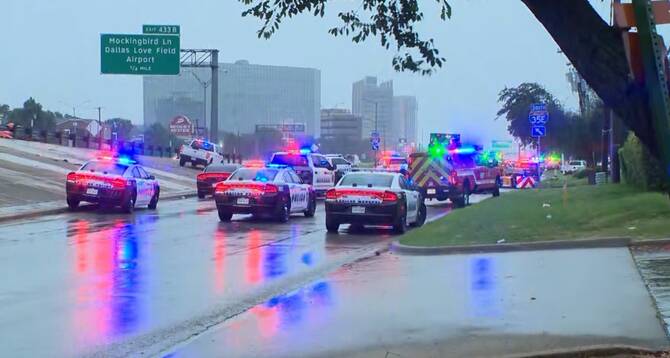
Officers responded to a call to assist an officer on North Stemmons Freeway around 6:40 a.m. Wednesday and determined that someone opened fire at a government building from an adjacent building, Dallas police spokesperson Officer Jonathen E. Maner said in an email.
Edwin Cardona, an immigrant from Venezuela, said he was entering the ICE building with his son for an appointment around 6:20 a.m. when he heard gunshots.
An agent gathered people who were inside, took them to a more secure area and explained that there was an active shooter, Cardona said.
“I was afraid for my family because my family was outside. I felt terrible because I thought something could happen to them. Thank God no,” Cardona said.
Cardona said his family was brought into the building, and they were later reunited.
The ICE facility is along Interstate 35 East, just southwest of Dallas Love Field, a large commercial airport serving the Dallas-Fort Worth metropolitan area, and blocks from hotels catering to travelers.
Officials call for end to political violence
Shortly after the shooting and before officials said at least one victim was a detainee, Vice President JD Vance posted on the social platform X that “the obsessive attack on law enforcement, particularly ICE, must stop.”
Republican US Sen. Ted Cruz from Texas continued in that direction, calling for an end to politically motivated violence.
“To every politician who is using rhetoric demonizing ICE and demonizing CPB: stop,” Cruz told reporters, referencing Customs and Border Protection.
But immediately after the news conference in which officials refused to say whether the victims included detainees, Democratic US Rep. Marc Veasey called in to Dallas’ WFAA-TV newscast and told them he was “absolutely sickened” by some officials’ comments.
“If they are trying to control this narrative and they don’t want migrants to be the victim in this story, then they may want to slow-walk giving us any information about this so they can still keep on talking about attacks on ICE,” Veasey said.
The Rev. Ashley Anne Sipe, who prays outside of the Dallas ICE facility every Monday, called the shooting heartbreaking.
“Violence doesn’t heal anything,” Sipe, a pastor in Lewisville near Dallas, told The Associated Press.
Sipe and other local faith leaders who have decried deportations hold weekly vigils and serve as “moral witnesses.” They pray and observe for about three hours, watching as immigrants enter the building to meet with their advisers and to report for check-ins.
Over the past couple of months, Sipe said she has noticed that people who walk into the building are shuttled away on buses.
“They’re taking them away, and we don’t know where they’re taking them,” Sipe said.
Noem: ICE agents targeted
Homeland Security Secretary Kristi Noem noted a recent uptick in targeting of ICE agents.
A July 4 attack at a Texas immigration detention center injured a police officer, who was shot in the neck. Attackers dressed in black military-style clothing opened fire outside the Prairieland Detention Center in Alvarado, southwest of Dallas, federal prosecutors said. At least 11 people have been charged in connection with the attack.
Days later, a man with an assault rifle fired dozens of rounds at federal agents leaving a US Border Patrol facility in McAllen on July 7. The man, identified as Ryan Louis Mosqueda, injured a police officer who responded to the scene before authorities shot and killed him. Police later found other weaponry, ammunition and backpacks inside Mosqueda’s car.
In suburban Chicago, federal authorities erected a fence around an immigration processing center after tensions recently flared with protesters. President Donald Trump’s administration has stepped up immigration enforcement in the Chicago area for weeks, resulting in hundreds of arrests.
Ahead of the latest immigration operation, federal officials boarded up windows at the center.
Sixteen people have been arrested outside the center, according to federal authorities who characterized the activists as “rioters.”


![]()

Detainee killed, and 2 others critically injured in Dallas ICE facility, Homeland Security says
Short Url
https://arab.news/479kv
Detainee killed, and 2 others critically injured in Dallas ICE facility, Homeland Security says
- The head of the FBI, Kash Patel, released a photo on social media that shows a bullet found at the scene with the words “ANTI-ICE” written in what appears to be marker
- The attack is the latest public, targeted killing in the US and comes two weeks after conservative leader Charlie Kirk was killed


Latest updates


© 2026 SAUDI RESEARCH & PUBLISHING COMPANY, All Rights Reserved And subject to Terms of Use Agreement.