NASA launches mission to study space weather

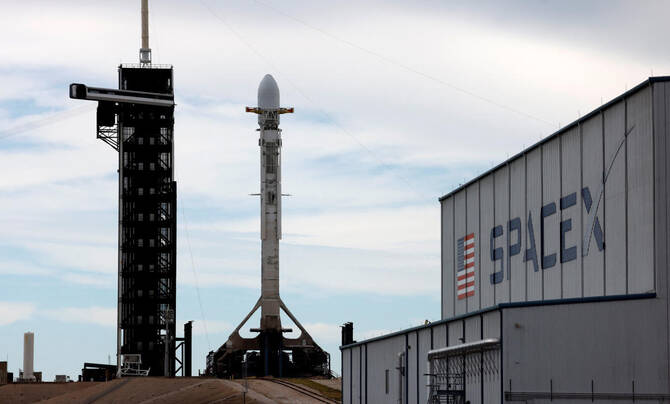
A SpaceX Falcon 9 rocket is prepared for launch carrying NASA’s IMAP mission, which will study the boundary of the Sun’s heliosphere and other scientific payloads, at the Kennedy Space Center in Cape Canaveral, Florida on Sept. 23, 2025. (Reuters)
Short Url
Updated 24 September 2025
Follow

NASA launches mission to study space weather

  • Solar storms are high-radiation events caused by flares on the Sun’s surface, and are very difficult to predict
  • They can impact activities on Earth, including aviation, mobile communications and power grids

WASHINGTON: The United States launched three spacecraft on Wednesday in an effort to better monitor space weather such as solar storms, which can interfere with technology and power systems on Earth.
The three probes blasted off from Florida’s Kennedy Space Center aboard a Falcon 9 rocket, built by the private company SpaceX.
Once in space, the probes will begin a long journey to reach the Lagrange 1 point – a spot approximately 1.5 million kilometers (930,000 miles) from the Sun that offers a stable vantage point for observation.
The “Interstellar Mapping and Acceleration Probe” (IMAP) will use its instruments to study the Sun’s high-energy particles and the protective magnetic bubble surrounding our solar system known as the heliosphere, data that can offer insight into space weather and cosmic radiation.
Solar storms are high-radiation events caused by flares on the Sun’s surface, and are very difficult to predict.
They can impact activities on Earth, including aviation, mobile communications and power grids – and potentially endanger astronauts and satellites in space.
The Space Weather Follow-on (SWFO-L1) spacecraft, operated by the National Oceanic and Atmospheric Administration (NOAA), aims to detect the weather patterns in advance.
“It can’t stop an incoming threat, but it can give us time to prepare,” said Irene Parker of NOAA.
With notice, authorities could shelter astronauts, warn aircraft pilots of forthcoming disruptions of GPS systems and adapt power grids in anticipation.
And the Carruthers Geocorona Observatory, the third passenger on the rocket, will study the Earth’s exosphere in a bid to better understand how space weather affects it.


Canada PM Carney says can’t rule out military participation in Iran war

Updated 55 min 12 sec ago
Follow

Canada PM Carney says can’t rule out military participation in Iran war

  • Carney had said the US-Israeli strikes on Iran were “inconsistent with international law”
  • However, he supports the efforts to stop Iran from obtaining a nuclear weapon

CANBERRA, Australia: Canadian Prime Minister Mark Carney said Thursday that he couldn’t rule out his country’s military participation in the escalating war in the Middle East.
Carney’s visit to Australia this week has been overshadowed by expanding war in the Middle East, sparked by a massive US-Israeli strike on Iran that killed its supreme leader, Ayatollah Ali Khamenei.
Speaking alongside local counterpart Anthony Albanese in Canberra, Carney was asked whether there was a situation in which Canada would get involved.
“One can never categorically rule out participation,” he said, while stressing the question was a “hypothetical” one.
“We will stand by our allies,” said Carney, adding that “we will always defend Canadians.”
Carney had said the US-Israeli strikes on Iran were “inconsistent with international law.”
However, he supports the efforts to stop Iran from obtaining a nuclear weapon — a position that Canada takes “with regret” as it represented “another example of the failure of the international order.”
The Canadian leader reiterated on Thursday his call for a “de-escalation” of the conflict.
Carney’s trip is part of a multi-country tour of the Asia-Pacific aimed at reducing reliance on the United States — a hedge against what he has described as a fading US-led global order.
The Australia leg of the tour is aimed at bringing in investment and deepening ties with a like-minded “middle power” partner.

‘Middle power’ rallying cry

On Thursday morning he issued a rallying cry in Australia’s parliament to “middle powers,” urging them to work together in an increasingly hegemonic world order.
Nations like Australia and Canada faced a stark choice — work together to help write the “new rules” of the global order or have great powers do it for them, he said.
“In this brave new world, middle powers cannot simply build higher walls and retreat behind them. We must work together,” he said.
“Great powers can compel, but compulsion comes with costs, both reputational and financial,” the former central banker added.
“Middle powers like Australia and Canada hold this rare convening power because others know we mean what we say and we will match our values with our actions.”
The Canadian leader also said the two countries would together as “strategic collaborators” to pool their vast combined rare earth mineral resources.
And he detailed renewed cooperation in areas from defense to artificial intelligence.
“We know we must work with others who share our values to build solid capabilities,” he told parliament.
Otherwise, he warned, they risked being “caught between the hyperscalers and the hegemons.”
The Canadian leader has frequently clashed with US President Donald Trump, who has repeatedly threatened to annex Canada and slapped swingeing tariffs on the country.
In a speech to political and financial elites at the World Economic Forum in January, Carney warned the US?led global system of governance was enduring “a rupture.”