UNITED NATIONS: From France to South Korea, South Africa to Suriname, leaders gave strong support Tuesday to the UN chief’s call to work together to address global challenges – war, poverty and climate chaos. But US President Donald Trump had other ideas and touted his “America First” agenda.
UN Secretary-General Antonio Guterres opened the annual meeting of presidents, prime ministers and monarchs at the General Assembly with a plea to choose peace over war, law over lawlessness, and a future where nations come together rather than scramble for self-interests.
France’s President Emmanuel Macron warned that 80 years after the UN was founded on the ashes of World War II, “we’re isolating ourselves.”
“There’s more and more divisions, and that’s plagued the global order,” he said. “The world is breaking down, and that’s halting our collective capacity to resolve the major conflicts of our time and stopping us from addressing global challenges.”
But Macron said a complex world isn’t reason “to throw in the towel” on supporting the UN’s key principles of peace, justice, human rights and nations working together. Only respectful relations and cooperation among peers make it possible to fight against military proliferation, address climate change and have “a successful digital transformation,” he said.
A call for collaboration
Speaker after speaker made similar appeals to support multilateralism.
Suriname’s President Jennifer Geerlings-Simons called multilateralism “one of humanity’s most important achievements, which needs our protection at this time of change.”
South Africa’s President Cyril Ramaphosa said “our collective membership of the United Nations is our shared humanity in action,” and the UN at 80 compels members to build “an organization that is able to address our common challenges.”
As South Korea’s President Lee Jae Myung put it, “The more difficult the times are, the more we must return to the basic spirit of the UN” He added, “We today must cooperate more, trust more, and join hands more firmly, in order to build a better future, a better world for future generations.”
The General Assembly meeting continues Wednesday with the leaders of Ukraine, Iran and Syria among the speakers.
Guterres in his remarks noted the world is becoming increasingly multipolar — certainly a nod to rising economic powers China and India but a slap to the US insistence on superpower status. The UN chief said a world of many powers can be more diverse and dynamic, but warned that without international cooperation and effective global institutions there can be “chaos.”
But Trump, making the first address to the General Assembly since he was elected to a second term last November, ceded no ground and gave an “America First” speech.
The United States has the strongest borders, military, friendships “and the strongest spirit of any nation on the face of the earth,” he boasted. “This is indeed the golden age of America.”
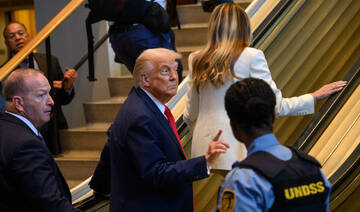
He portrayed the United Nations as ineffectual and “not even coming close to living up” to its potential, blaming the organization for an escalator that stopped en route to the assembly chamber and for a broken teleprompter. The UN cited a safety function for the escalator incident and the White House for the teleprompter.
Trump met with Guterres
While Trump told the assembly the UN delivers “empty words — and empty words don’t solve war,” his tone shifted at a later meeting with Guterres.
“Our country is behind the United Nations 100 percent,” the president told Guterres at the start of their first meeting since his reelection. “I may disagree with it sometimes, but I am so behind it because the potential for peace at this institution is great.”
UN humanitarian chief Tom Fletcher said in an interview with The Associated Press late Tuesday that their subsequent private meeting was “very good.”
The UN and US leaders talked about ending conflicts around the world, about efficiency, about bringing in the private sector in a bigger way, and humanitarian efforts, Fletcher said. “At least we’ve got a conversation going. This is dialogue. This is diplomacy. And it’s technicolor — and it’s glorious.”
The UN is facing financial cuts as the US, its largest source of revenue, and some other nations have pulled back funding. Guterres said aid cuts are “wreaking havoc,” calling them “a death sentence for many.”
Fletcher said this year’s UN appeal for $29 billion to help 114 million people around the world is only 19 percent funded. He said he has been talking with Saudis, Europeans, Americans and others about the funding crisis, calling it “a work in progress.”
UN talks about the wars in Ukraine and Gaza
Elsewhere at the UN, the Security Council held emergency back-to-back meetings Tuesday on the two major wars – the more than three-year conflict in Ukraine sparked by Russia’s invasion on Feb. 24, 2022, and the nearly two-year war in Gaza that followed Hamas’ surprise attack on Israel on Oct. 7, 2023.
In a dramatic shift, Trump posted on social media soon after meeting Ukraine’s President Volodymyr Zelensky that he believes Ukraine can win back all the territory it lost to Russia. The US leader previously called on Ukraine to make territorial concessions to end the war.
The emergency meeting on Gaza highlighted the isolation of the Trump administration, Israel’s closest ally.
A day after France led other nations in adding significantly to the list of countries recognizing Palestinian statehood, the UN Security Council once again witnessed the deep divide between the veto-wielding United States and most of the rest of the world over how to end the war in the Gaza Strip and resolve the nearly eight-decade Middle East conflict.
Most nations called for an immediate ceasefire and an influx of humanitarian aid, but the new US ambassador, Mike Waltz, called the meeting a disappointing “charade” and expressed regret it was held on Rosh Hashana, the Jewish New Year, preventing Israel from attending.
Speaking at the assembly earlier, Jordan’s King Abdullah II said it’s an illusion that Israeli Prime Minister Benjamin Netanyahu’s government “is a willing partner for peace,” pointing to its “hostile rhetoric: and violations of the sovereignty of Lebanon, Iran, Syria, Tunisia and most recently Qatar.”
“How long before we recognize the Palestinians as people who aspire to the same things you and I do — and we act on that recognition?,” Abdullah asked. “How long before we recognize that statehood is not something Palestinians need to earn? It is not a reward — it is an indisputable right.”


![]()

Many leaders back a UN call to address challenges together but Trump says ‘America First’

Short Url
https://arab.news/8yy7x
Many leaders back a UN call to address challenges together but Trump says ‘America First’
- Trump, making the first address to the General Assembly since he was elected to a second term last November, ceded no ground and gave an “America First” speech
- He portrayed the United Nations as ineffectual and “not even coming close to living up” to its potential, blaming the organization for an escalator that stopped en route to the assembly chamber and for a broken teleprompter

Latest updates




© 2026 SAUDI RESEARCH & PUBLISHING COMPANY, All Rights Reserved And subject to Terms of Use Agreement.