If US President Donald Trump really wants to win the Nobel Peace Prize, he needs to stop the war in Gaza, French President Emmanuel Macron said on Tuesday.
Speaking to France’s BFM TV from New York, Macron said that only Trump has the power to put pressure on Israel to end the war.
“There is one person who can do something about it, and that is the US president. And the reason he can do more than us, is because we do not supply weapons that allow the war in Gaza to be waged. We do not supply equipment that allows war to be waged in Gaza. The United States of America does,” Macron said.
Trump on Tuesday gave a combative, wide-ranging speech to the United Nations General Assembly that rejected moves by Western allies to endorse a Palestinian state, saying that would be a reward for Hamas militants.
“We have to stop the war in Gaza immediately. We have to immediately negotiate peace,” Trump said.
Discussing Trump’s speech, Macron said: “I see an American president who is involved, who reiterated this morning from the podium: ‘I want peace. I have resolved seven conflicts’, who wants the Nobel Peace Prize. The Nobel Peace Prize is only possible if you stop this conflict,” Macron said.
Several countries, including Israel, Pakistan and Cambodia, have nominated Trump for the annual prize for brokering peace agreements or ceasefires. Trump himself has said he deserves the Norwegian-bestowed accolade that four White House predecessors received.

If Trump wants Nobel Peace Prize, he should stop Gaza war, Macron says
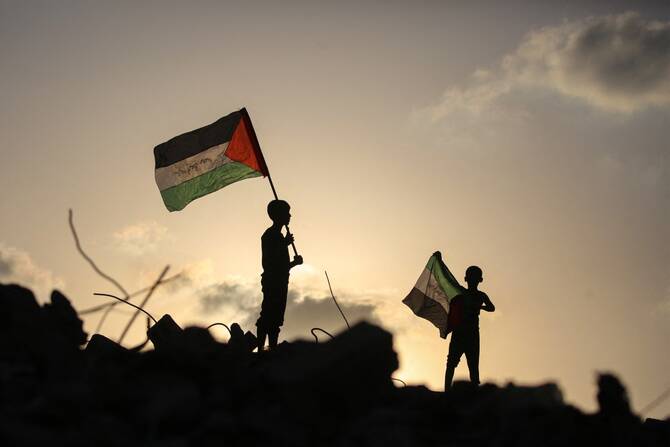
https://arab.news/ynbka
If Trump wants Nobel Peace Prize, he should stop Gaza war, Macron says
- Macron said that only Trump has the power to put pressure on Israel to end the war
- Trump at the UN rejected moves by Western allies to endorse a Palestinian state
US will respond to Rwanda’s violation of peace pact, says Rubio
- Waltz told the Security Council meeting that the US “is deeply concerned and increasingly disappointed” by this resurgence of violence
WASHINGTON: Top US diplomat Marco Rubio said on Saturday that Rwanda had clearly violated the peace agreement it signed with the Democratic Republic of Congo in Washington last week and vowed unspecified “action” in response.
The Rwandan-backed M23 armed group advanced in eastern DRC and seized the key border city of Uvira, just days after the leaders signed the “Washington Accords” on Dec. 4.
“Rwanda’s actions in eastern DRC are a clear violation of the Washington Accords, and the US will take action to ensure promises made to the President are kept,” Secretary of State Rubio wrote on X.
FASTFACT
UN peacekeeping chief Jean-Pierre Lacroix warned the new offensive ‘has revived the specter of a regional conflagration with incalculable consequences.’
The capture of Uvira, along the border with Burundi, has raised fears that the conflict could escalate into a regional war.
As part of an offensive launched at the beginning of December in South Kivu province, the armed group’s takeover follows its earlier this year capture of Goma and Bukavu, other major cities in the DRC’s mineral-rich east.
On Friday, US Ambassador to the UN Mike Waltz accused Rwanda of “leading the region toward more instability and toward war.”
“The Rwandan defense forces have provided materiel, logistics, and training support to M23 as well as fighting alongside M23 in DRC with roughly 5,000 to 7,000 troops,” not including possible reinforcements during the latest offensive, Waltz told the UN Security Council.
The Rwandan firepower has included surface-to-air missiles, drones, and artillery, he added.
Since taking up arms again in 2021, the M23 has seized swaths of territory, displacing tens of thousands and leading to a spiraling humanitarian crisis.
Earlier this month, UN experts said Rwanda’s army and the M23 had carried out summary executions and forced mass displacements of people in the region.
Waltz told the Security Council meeting that the US “is deeply concerned and increasingly disappointed” by this resurgence of violence.
The envoy denounced “the scale and sophistication” of Rwanda’s involvement in eastern DRC.
UN peacekeeping chief Jean-Pierre Lacroix warned the new offensive “has revived the specter of a regional conflagration with incalculable consequences.”
“Recent developments pose a serious risk of the progressive fragmentation of the Democratic Republic of Congo, particularly its eastern part,” he said.
Burundi on Friday accused Rwanda of bombing its territory, and its ambassador, Zephyrin Maniratanga, told the council it “reserves the right to use self-defense.”
He warned that if the attacks continue, it would be extremely difficult to avoid an escalation between the two African countries.
“Rwanda is not waging war against the Republic of Burundi and has no intention of doing that,” Ambassador Martin Ngoga said.
Meanwhile, Congolese Foreign Minister Therese Kayikwamba Wagner criticized the Security Council for its “lack of action” and called for sanctions against Rwanda.
Despite a resolution adopted in February demanding the withdrawal of Rwandan troops and a ceasefire, “the situation is undeniable: another city has fallen, a parallel administration has consolidated itself, thousands more families have fled, and others have been killed, raped, and terrorized,” she said.


