

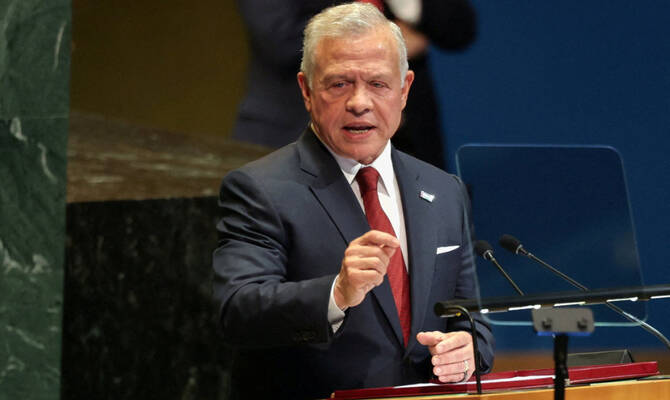

LONDON: The war in Gaza is “one of the darkest moments” in the UN’s history, Jordan’s King Abdullah II told the UN General Assembly in New York on Tuesday.
The UNGA “was born 80 years ago, pledging to learn from, not repeat, history. The world vowed never again,” he said.
“However, for almost as long, Palestinians have been living through a cruel cycle yet again; bombed indiscriminately yet again; killed, injured and maimed yet again; displaced and dispossessed yet again; denied rights, dignity, their basic humanity yet again.
“So I must ask, how long? How long will it be before we find a resolution to this conflict, one that safeguards the rights of all sides and allows a level of normalcy in the lives of the families at its core?”
King Abdullah said the ongoing suffering has made him “question the worth and utility of words in capturing the magnitude of the crisis, yet not speaking about it would signal acceptance of the situation and abandonment of our humanity, and that I won’t do.”
The Israeli-Palestinian conflict “remains unique” among the ones the UN has dealt with over eight decades, he added.
“It’s the longest-standing conflict in the world, an illegal occupation of a helpless population by a self-declared democratic nation, and a flagrant violation of repeated UN resolutions, international law and human rights conventions, a failure that should’ve elicited outrage and action, especially from major democracies. Instead, it has been met with decades of inertia.”
He reminded the assembly that the Palestinian cause “has remained on the UN agenda for its entire eight-decade existence,” adding: “How long will we be satisfied with condemnation after condemnation without concrete action?”
King Abdullah criticized the double standards with which Israel is treated, saying: “The current Israeli government’s provocative calls for a so-called Greater Israel can only be realized through the blatant violation of the sovereignty and territorial integrity of its neighbors, and there’s nothing great about that.”
He added: “I can’t help but wonder if a similar outrageous call were made by an Arab leader, would it be met with the same global apathy?”
Urging the international community to “stop entertaining the illusion” that Israel is a willing partner for peace, he warned that its ongoing violations of international law risk inciting “a religious war that would reach far beyond the region and lead to an all-out clash that no nation would be able to escape.”
King Abdullah, who is set to join a delegation of Arab and Muslim leaders meeting with US President Donald Trump in New York to discuss peace principles and post-war governance in Gaza, praised the Jordanian people for working tirelessly to provide relief to Palestinians, even under fire.
He stressed that the two-state solution remains the only viable path to security and prosperity in the region.
“We all know that force is no foundation for security; it’s a prelude for greater violence. Repeated wars are teaching generations of Israelis and Palestinians that their only recourse is the gun. Security will only come when Palestine and Israel begin to coexist,” he said.
“For the past two years, we’ve finally seen the world’s conscience stirring in the courage of ordinary people, from every walk of life and every corner of the globe, raising their voices as one and declaring, ‘It has been too long.’
“This UN must echo that call. It has been too long, and it must act on that call until peace is a reality.”


